Galileo Galilei was born on February 15, 1564, in Pisa, Italy, at a time when Europe stood at the threshold of intellectual transformation. The Renaissance had revived classical learning, yet natural philosophy remained deeply rooted in the authority of Aristotle. Galileo’s father, Vincenzo Galilei, was a musician and theorist who challenged conventional wisdom in music, and this spirit of skepticism toward authority profoundly shaped Galileo’s intellectual development. Rather than accepting inherited truths, he learned to question, test, and verify.
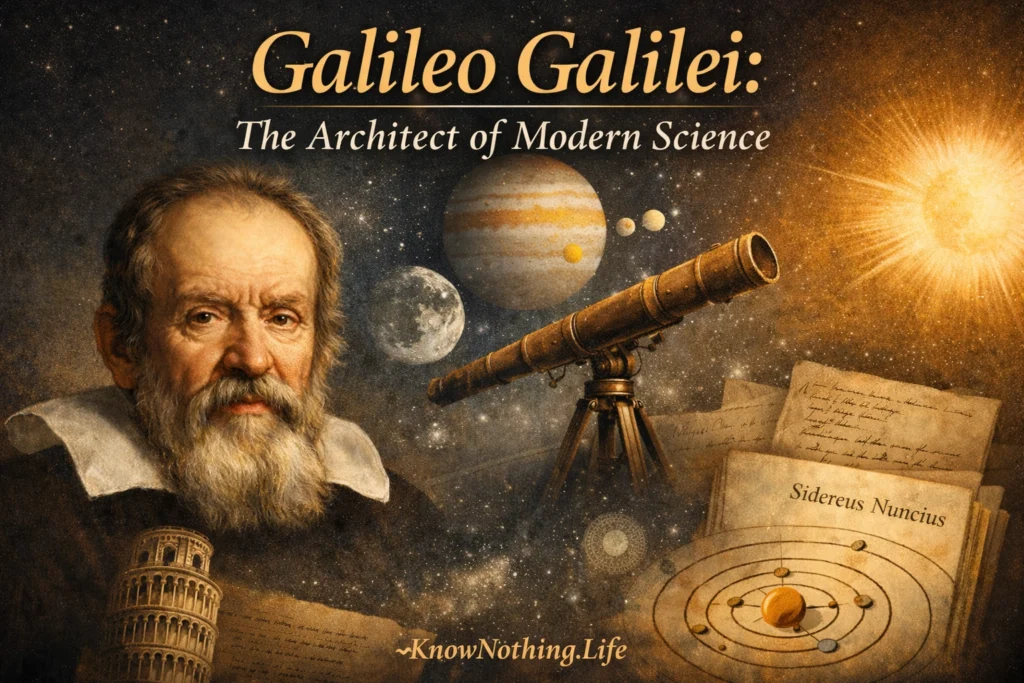
Initially enrolled at the University of Pisa to study medicine, Galileo soon found himself captivated by mathematics and natural philosophy. His early exposure to geometry and mechanics redirected his path entirely. Rejecting a career in medicine, he pursued mathematics with intensity, eventually securing a teaching position. During this period, he began to challenge Aristotelian physics, particularly the notion that heavier objects fall faster than lighter ones—an idea he reportedly tested through experiments associated with the Leaning Tower of Pisa.
Galileo’s formative years reveal a mind deeply committed to observation and reasoning. Unlike many of his contemporaries, he did not treat knowledge as something handed down through tradition, but as something to be actively discovered. This shift—from authority to experimentation—would define not only his career but the future of science itself.
Scientific Breakthroughs and Astronomical Discoveries
Galileo’s most transformative contributions emerged from his improvements to the telescope, an instrument originally developed in the Netherlands. By refining its design, he created a device capable of magnifying distant objects up to 20 times. Turning it toward the heavens in 1609, he began a series of observations that would fundamentally alter humanity’s understanding of the universe. His discoveries were published in Sidereus Nuncius (1610), one of the most important scientific works in history.
Through his telescope, Galileo observed mountains and craters on the Moon, challenging the long-held belief that celestial bodies were perfect and unchanging. He discovered four moons orbiting Jupiter—now known as the Galilean moons—demonstrating that not everything revolved around Earth. He also documented the phases of Venus, providing strong evidence for the heliocentric model proposed by Nicolaus Copernicus. These observations directly contradicted the geocentric worldview endorsed by both classical philosophy and the Church.
Galileo’s work extended beyond astronomy into physics. He conducted pioneering studies on motion, laying the groundwork for the laws later formalized by Isaac Newton. His investigations into inertia, acceleration, and projectile motion introduced a new mathematical approach to understanding nature. As he famously stated, “Nature is written in the language of mathematics,” a declaration that encapsulates his revolutionary methodology.
Conflict with the Church and the Trial of 1633
Galileo’s advocacy for heliocentrism inevitably brought him into conflict with the Roman Catholic Church. At the time, the Church endorsed the geocentric model, which aligned with certain scriptural interpretations. Although heliocentrism had been proposed earlier, Galileo’s empirical evidence made the challenge far more difficult to ignore. His insistence on presenting these findings as physical reality—not merely mathematical convenience—intensified the controversy.
In 1632, Galileo published Dialogue Concerning the Two Chief World Systems, a masterful work that compared the geocentric and heliocentric models through a structured conversation. While ostensibly balanced, the dialogue clearly favored the Copernican view. This publication provoked the Church, leading to Galileo’s trial before the Inquisition in 1633. He was found “vehemently suspect of heresy” and forced to recant his support for heliocentrism.
Despite his public recantation, Galileo’s intellectual defiance endured. He was sentenced to house arrest for the remainder of his life, yet continued to work and write. The trial has since become emblematic of the tension between science and institutional authority. Galileo’s experience illustrates the cost of challenging entrenched systems of belief, as well as the resilience required to pursue truth in the face of opposition.
Major Works and Intellectual Legacy
Galileo’s written works represent a cornerstone of scientific literature. Sidereus Nuncius introduced the world to his telescopic discoveries, while Dialogue Concerning the Two Chief World Systems presented a compelling argument for heliocentrism. Later, under house arrest, he completed Discourses and Mathematical Demonstrations Relating to Two New Sciences (1638), a work that synthesized his research on motion and materials. This final publication is often regarded as the foundation of modern physics.
His writing style combined clarity, wit, and persuasive reasoning. Unlike many scholars of his time, Galileo wrote in Italian rather than Latin, making his ideas accessible to a broader audience. This decision reflects his commitment to public understanding and intellectual democratization. His ability to communicate complex ideas in an engaging manner contributed significantly to the spread of scientific thought.
Among his most enduring quotes is: “And yet it moves” (“E pur si muove”), a phrase traditionally attributed to him after his recantation, symbolizing his unwavering belief in the Earth’s motion. Another notable statement—“All truths are easy to understand once they are discovered; the point is to discover them”—captures the essence of his scientific philosophy. Galileo did not merely accumulate knowledge; he transformed the way knowledge itself was pursued.
Philosophical Impact and the Birth of Modern Science
Galileo’s influence extends far beyond his specific discoveries. He played a central role in the Scientific Revolution, a period that redefined humanity’s relationship with knowledge and nature. By emphasizing observation, experimentation, and mathematical analysis, he helped establish the scientific method as the dominant framework for inquiry. This methodological shift marked a decisive break from scholastic traditions rooted in authority and speculation.
His work also contributed to a broader philosophical transformation. The universe, once understood through qualitative descriptions and metaphysical assumptions, became a system governed by measurable laws. This perspective laid the groundwork for modern physics and inspired generations of scientists, including René Descartes and Newton. Galileo’s insistence on empirical evidence reshaped epistemology—the study of knowledge—by prioritizing experience over doctrine.
In many ways, Galileo embodies the transition from medieval to modern thought. He challenged not only specific ideas but the very structures that upheld them. His legacy is not confined to astronomy or physics; it resides in the enduring principle that truth must be tested, not assumed. This principle continues to guide scientific inquiry today.
Final Years and Enduring Legacy
In his final years, Galileo lived under house arrest near Florence, where he continued to write despite failing health and eventual blindness. Even in isolation, his intellectual activity did not cease. The publication of Two New Sciences ensured that his ideas would reach beyond the constraints imposed upon him. Visitors, including young scholars, sought him out, recognizing his profound contributions to knowledge.
Galileo died on January 8, 1642, the same year Newton was born—a symbolic passing of the torch from one scientific giant to another. Over time, his reputation was rehabilitated, and his work came to be celebrated rather than condemned. In 1992, the Catholic Church formally acknowledged errors in its treatment of Galileo, underscoring the lasting significance of his case.
Today, Galileo is widely regarded as the “father of modern science.” His life represents a turning point in human history, where observation replaced assumption and inquiry overcame authority. His legacy endures not only in scientific institutions and discoveries but in the very mindset that drives exploration and understanding. Through his work, humanity learned to look at the universe—and itself—with new eyes.