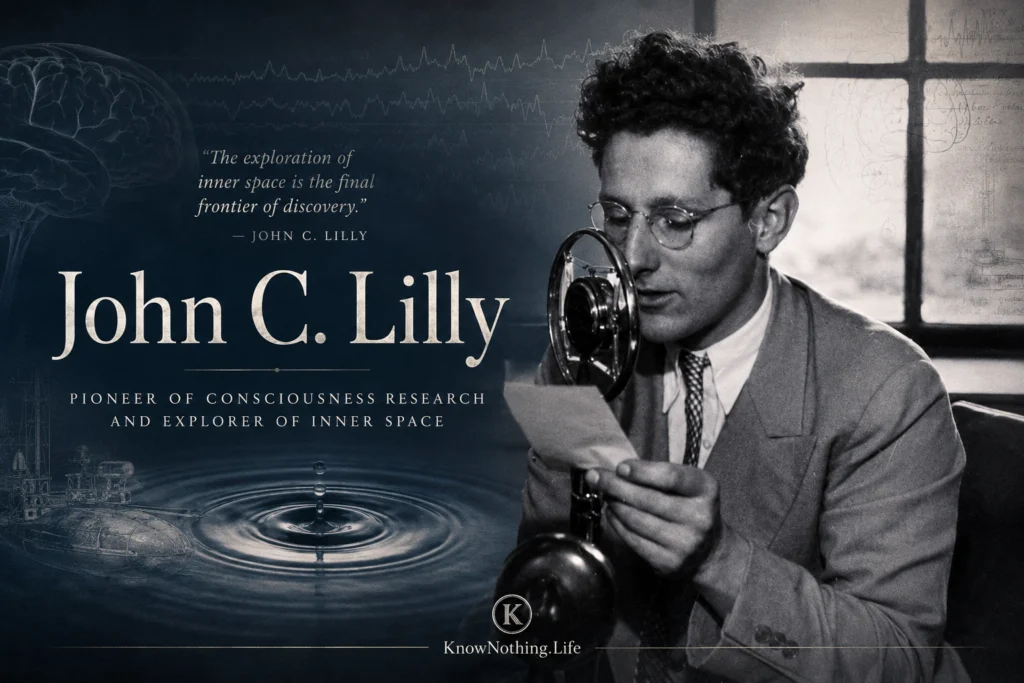
John C. Lilly was one of the twentieth century’s most unusual scientific figures—a physician and neuroscientist whose career moved from laboratory research into investigations of consciousness, animal intelligence, psychedelics, and belief. Born in Saint Paul, Minnesota, on January 6, 1915, Lilly trained in physics, medicine, neurophysiology, and psychoanalysis before becoming known for developing the first sensory-isolation tank and attempting communication between humans and dolphins. His work combined electronics, brain science, psychology, computer theory, and philosophy. To admirers, he was a fearless investigator of neglected questions. To critics, his later work blurred controlled research, personal revelation, and speculation.
Lilly began as an accomplished medical researcher, helped develop safer methods of electrical brain stimulation, and later advocated recognizing dolphins as intelligent beings. By the 1970s, his books increasingly described psychedelic states, mystical experiences, nonhuman intelligences, and belief systems that could reshape perceived reality. His career became a sustained investigation of one problem: how much of reality is given by the external world, and how much is constructed by the nervous system, language, memory, culture, and belief?
Early Life, Medicine, and Brain Research
Lilly studied biology and physics at the California Institute of Technology, graduating in 1938. He continued his medical education at Dartmouth before transferring to the University of Pennsylvania, where he earned his medical degree. During World War II, he researched high-altitude aviation and developed instruments for measuring pressure and respiratory gases. Afterward, he trained in psychoanalysis and pursued neurophysiology, joining an engineer’s interest in instruments with a physician’s interest in the brain. His early publications examined cerebral activity, cortical stimulation, and the challenge of studying living neural tissue without causing lasting damage.
One of Lilly’s most durable contributions came from electrical brain stimulation. In a 1955 paper with colleagues, he described a brief, charge-balanced waveform intended to stimulate neural tissue while reducing injury. Later research identified this biphasic, charge-balanced approach as an important early development in safer electrical stimulation. The achievement is often overshadowed by the sensational chapters of his biography, yet it shows that Lilly possessed genuine technical skill and contributed to methods that remained relevant after many of his broader claims moved outside mainstream science.
The Isolation Tank and Inner Space
In 1954, while working at the National Institute of Mental Health, Lilly developed an early isolation tank to investigate what happened when the brain received minimal external stimulation. The original apparatus differed from modern float tanks: the participant was immersed upright in temperature-controlled water, wore a breathing mask, and experienced reduced light, sound, and tactile input. Lilly wanted to know whether consciousness would shut down without ordinary sensory signals or continue producing experience from its own activity. His experiments suggested that the mind did not become blank. Attention turned inward, while thoughts, memories, imagery, and altered perceptions became unusually vivid.
The tank became both a scientific instrument and a symbol of Lilly’s method. He believed self-observation could complement external measurements of the brain, and he later combined isolation with psychoanalytic ideas, meditation, LSD, and ketamine. These experiments made him influential within the counterculture and inspired interest in flotation-REST, although modern research generally separates flotation from his metaphysical interpretations. In The Deep Self, Lilly presented isolation as a tool for relaxation and self-examination. In The Center of the Cyclone, he wrote, “In the province of the mind, what one believes to be true either is true or becomes true,” adding, “These limits are further beliefs to be transcended.”
Dolphins and Interspecies Communication
During the late 1950s and 1960s, Lilly turned toward dolphins, whose large brains, complex vocalizations, and social behavior convinced him that humans might communicate with another intelligent species. He established research facilities, including the Communication Research Institute in the U.S. Virgin Islands, and published papers on dolphin sounds and vocal exchanges. In Man and Dolphin and The Mind of the Dolphin, he argued that dolphins should be approached as minds worthy of intellectual engagement rather than merely as trainable animals. His group recorded whistles, clicks, and apparent imitations of human sounds. Lilly proposed that some vocalizations were “attempts to communicate with us,” revealing both curiosity and a tendency to interpret ambiguous behavior optimistically.
The most famous phase involved a partially flooded building where researcher Margaret Howe Lovatt lived with a dolphin named Peter while attempting to teach him human speech patterns. The project received government support connected partly to interest in nonhuman intelligence, but its methods, captive conditions, and administration of LSD to dolphins became controversial. The experiments did not establish a shared human-dolphin language, and Lilly’s interpretations often exceeded the evidence. Even so, his insistence that cetaceans possessed complex intelligence broadened discussion of animal consciousness and moral status. His dolphin work remains a mixture of ambition, weak controls, ethical problems, and a challenge to human-centered definitions of intelligence.
The Human Biocomputer and Psychedelic Research
Lilly’s best-known theoretical concept appeared in Programming and Metaprogramming in the Human Biocomputer. Drawing on cybernetics and early computer science, he described the brain and body as biological hardware, while habits, beliefs, memories, and behavioral patterns functioned as programs. Metaprogramming meant the capacity to examine and revise those programs. “All human beings,” he wrote, “are programmed biocomputers.” The metaphor presented identity as partially constructed and potentially changeable. It influenced countercultural psychology and popular discussions of mental reprogramming, although the analogy simplified the biological complexity of the brain.
As Lilly’s self-experimentation intensified, he increasingly treated unusual mental events as possible encounters with realities or intelligences beyond ordinary awareness. In The Center of the Cyclone, The Scientist, and Simulations of God, he explored belief systems, mystical states, coincidence, and entities he believed might influence human life. He sometimes presented these accounts as provisional models, yet the distinction between experiment and conviction became difficult to preserve. His ketamine use was destabilizing, and his later writings developed elaborate cosmological ideas. These books are significant as records of a trained scientist mapping altered consciousness from within, but they do not provide reproducible evidence for the beings or agencies he described.
Major Works and Lasting Legacy
Lilly’s books document the transformation of his interests. Man and Dolphin introduced his vision of interspecies communication, while The Mind of the Dolphin developed his argument for nonhuman intelligence. Programming and Metaprogramming in the Human Biocomputer presented his cybernetic model of mind; The Center of the Cyclone chronicled inner experience; The Deep Self focused on isolation-tank practice; and Simulations of God examined the construction of ultimate beliefs. Other works include Communication Between Man and Dolphin, Lilly on Dolphins, The Scientist, and, with Antonietta Lilly, The Dyadic Cyclone. Together, they span neuroscience, autobiography, philosophy, and spiritual speculation.
John C. Lilly died in Los Angeles on September 30, 2001, at the age of eighty-six. His legacy remains divided. Flotation therapy traces part of its history to his isolation research, and neurostimulation literature recognizes his early technical work. At the same time, his dolphin experiments raise ethical questions, while his psychedelic claims show the danger of allowing private experience to replace independently testable evidence. Lilly demonstrated how scientific imagination can open neglected questions, but also how easily exploration can outrun verification. His life remains a study of intellectual courage, personal obsession, and the uncertain border between discovery and belief.