Habits are the invisible architecture of daily life. From brushing one’s teeth in the morning to checking a phone without conscious intent, much of human behavior operates on automatic patterns formed through repetition. Habit psychology seeks to understand how these patterns are created, maintained, and changed. It reveals that behavior is not always the result of deliberate choice but is often shaped by learned routines that unfold with minimal conscious effort.
The study of habits bridges multiple domains within psychology, including learning, cognition, and neuroscience. Early insights can be traced to William James, who described habits as the “enormous flywheel of society,” emphasizing their role in stabilizing behavior. In modern research, habits are understood as learned associations between cues and responses, reinforced over time through repetition and reward.
Understanding habits is essential for both explaining behavior and enabling change. Because habits operate automatically, they can either support or undermine long-term goals. By examining how habits form and function, psychologists aim to uncover strategies for building beneficial routines and breaking maladaptive ones, offering practical insights into self-control and personal development.
The Nature of Habits
Habits are behaviors that become automatic through repetition in consistent contexts. Unlike deliberate actions, which require conscious thought and effort, habitual behaviors are triggered by environmental cues and executed with little awareness. This automaticity allows individuals to perform routine tasks efficiently, freeing cognitive resources for more complex activities.
From a cognitive perspective, habits represent a shift from controlled to automatic processing. Initially, a behavior requires attention and effort, but as it is repeated, it becomes encoded in memory as a routine. Over time, the presence of a specific cue—such as a time of day or a physical location—can trigger the behavior without conscious deliberation. This process highlights the importance of context in shaping behavior.
Neuroscientific research has identified brain structures involved in habit formation, particularly the basal ganglia, which play a key role in procedural learning. As behaviors become habitual, they rely less on regions associated with conscious decision-making, such as the prefrontal cortex. This transition underscores the efficiency of habits while also explaining why they can be difficult to change once established.
The Habit Loop and Learning Mechanisms
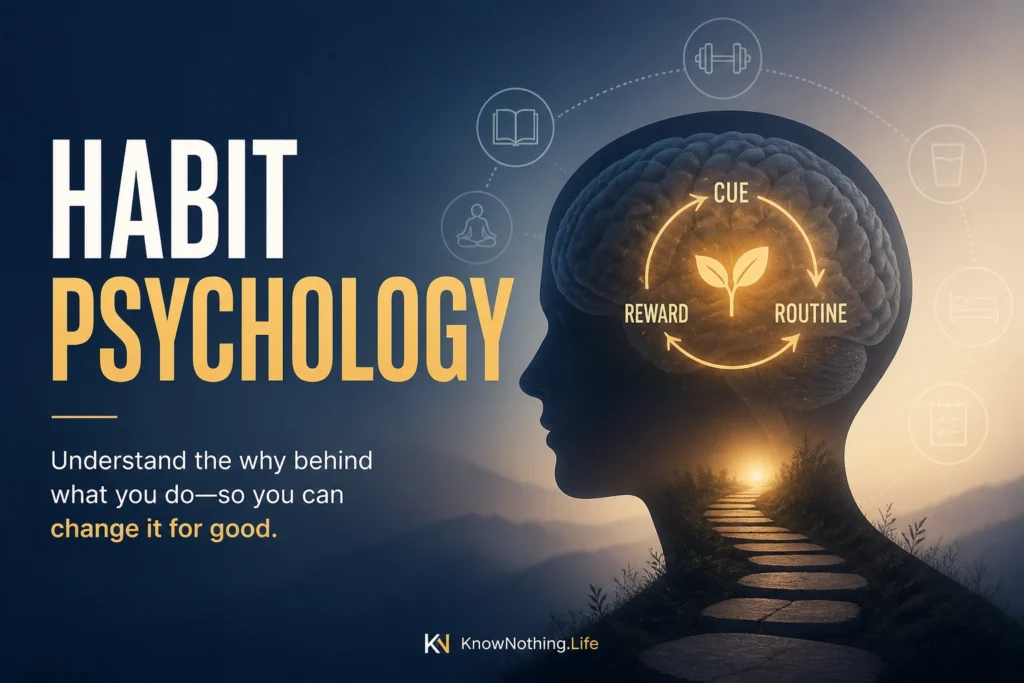
One of the most influential models in habit psychology is the habit loop, consisting of three components: cue, routine, and reward. A cue triggers the behavior, the routine is the behavior itself, and the reward reinforces it, increasing the likelihood of repetition. This cycle, repeated over time, strengthens the association between cue and response, solidifying the habit.
The concept of reinforcement is central to this process. Behaviors that lead to positive outcomes are more likely to be repeated, a principle rooted in the work of B. F. Skinner. However, habits differ from simple reinforcement in that they become less dependent on the outcome over time. Once established, a habit may persist even when the original reward is no longer present, driven instead by the cue-response association.
Learning mechanisms such as classical and operant conditioning contribute to habit formation. Through repeated pairing of stimuli and responses, individuals develop automatic reactions to specific cues. This process illustrates how habits are not merely behaviors but learned patterns embedded within the brain’s structure, shaped by both experience and environment.
The Role of Context and Environment
Context plays a critical role in the formation and maintenance of habits. Because habits are triggered by cues, the environment in which a behavior occurs can strongly influence its repetition. For example, a person who consistently studies in a particular location may find it easier to focus in that environment, as the context itself becomes a cue for the behavior.
Research by Wendy Wood has demonstrated that a significant portion of daily behavior is habitual and context-dependent. Changes in environment, such as moving to a new home or starting a new job, can disrupt existing habits by removing familiar cues. This insight has important implications for behavior change, suggesting that altering one’s environment can be an effective strategy for breaking unwanted habits.
At the same time, environments can be designed to support positive habits. By structuring surroundings to include cues that trigger desired behaviors, individuals can make beneficial actions more automatic. This approach shifts the focus from relying solely on willpower to leveraging environmental design as a tool for behavior change.
Habits and Self-Control
Habits are often contrasted with self-control, which involves the deliberate regulation of behavior in accordance with goals. However, these concepts are more closely related than they might appear. While self-control is necessary for initiating behavior change, habits can sustain behavior over time by reducing the need for conscious effort.
Psychologist Roy Baumeister has explored the limits of self-control, suggesting that it is a finite resource that can be depleted. From this perspective, habits can be seen as a way of conserving self-control by automating behavior. Once a positive habit is established, it requires less effort to maintain, freeing cognitive resources for other tasks.
This relationship highlights the importance of habit formation in achieving long-term goals. Rather than relying on continuous self-control, individuals can create systems of behavior that operate automatically. In this sense, habits are not opposed to self-control but are its extension, transforming effortful actions into routine patterns.
Breaking and Changing Habits
Changing habits is often challenging because of their automatic nature and strong neural associations. Simply attempting to suppress a habit is rarely effective, as the underlying cue-response pattern remains intact. Instead, successful behavior change typically involves modifying one or more components of the habit loop.
One effective strategy is to replace the routine while keeping the cue and reward constant. By identifying the trigger and the desired outcome, individuals can substitute a new behavior that fulfills the same function. This approach leverages the existing structure of the habit while redirecting it toward a more desirable action.
Another important factor is consistency. Repetition in a stable context is essential for forming new habits, as it strengthens the association between cue and response. Research suggests that habit formation is a gradual process, often requiring weeks or months of consistent practice. Recognizing this timeline can help individuals maintain realistic expectations and persist in their efforts.
Habits and Identity
Beyond behavior, habits are closely linked to identity. The actions individuals repeat over time contribute to their sense of self, reinforcing beliefs about who they are. For example, consistently engaging in exercise may lead an individual to see themselves as a healthy or disciplined person. This relationship between habit and identity can be a powerful motivator for behavior change.
Philosophically, this connection echoes ideas about the formation of character through repeated action. Aristotle argued that “we are what we repeatedly do,” suggesting that habits shape not only behavior but moral character. This perspective emphasizes the cumulative impact of small actions over time, highlighting the importance of consistency in personal development.
By aligning habits with desired identities, individuals can create a sense of coherence between their actions and their self-concept. This alignment reinforces behavior, making it more likely to persist. In this way, habit psychology extends beyond mechanics to encompass the broader question of how individuals shape their lives through repeated choices.
Conclusion
Habit psychology reveals that much of human behavior is governed by automatic patterns formed through repetition and reinforcement. From the early insights of William James to contemporary research by Wendy Wood, the study of habits has provided a deeper understanding of how actions become routine and how they can be changed.
By examining the mechanisms of habit formation, the role of context, and the relationship between habits and identity, psychologists have uncovered strategies for building positive behaviors and overcoming negative ones. These insights highlight the importance of consistency, environment, and self-awareness in shaping behavior.
Ultimately, habits are not merely repetitive actions but fundamental components of human life. They structure daily routines, influence long-term outcomes, and contribute to the formation of identity. Understanding and harnessing the power of habits offers a pathway to greater control over behavior and a more intentional approach to living.