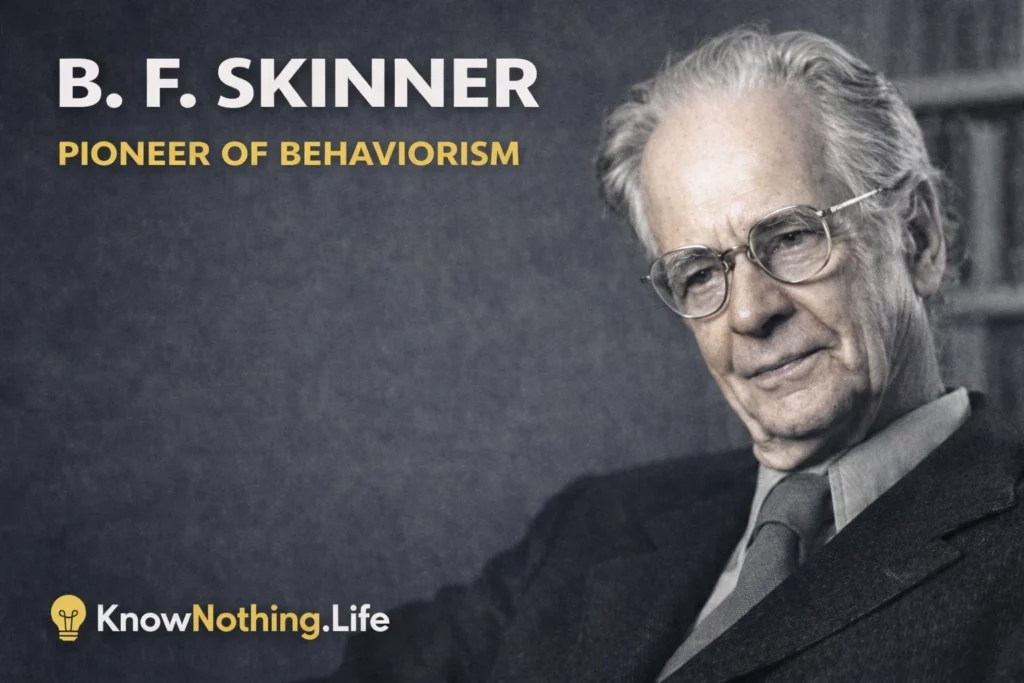
Few figures in modern psychology have shaped the understanding of human and animal behavior as profoundly as B. F. Skinner. As the leading architect of radical behaviorism, Skinner advanced a scientific framework that sought to explain behavior not through introspection or unconscious drives, but through observable actions and their consequences. His work reframed psychology as an empirical discipline grounded in experimentation, measurement, and prediction. In doing so, he extended the earlier behaviorist traditions of John B. Watson while moving beyond them into a more sophisticated analysis of how environmental contingencies shape behavior over time.
Skinner’s contributions were not confined to laboratories or theoretical debates. He envisioned a world in which behavioral science could be applied to education, social organization, and human well-being. Through innovations such as operant conditioning and reinforcement schedules, he provided tools that remain foundational in psychology, education, and behavioral therapy today. His ideas sparked both admiration and controversy, especially as they challenged long-held assumptions about free will, individuality, and human agency.
Early Life and Intellectual Formation
Burrhus Frederic Skinner was born on March 20, 1904, in Susquehanna, Pennsylvania, a small town that would shape his early outlook on structure, discipline, and community life. His father was a lawyer and his mother a homemaker, both of whom emphasized order and responsibility. As a child, Skinner demonstrated an inventive curiosity, building mechanical devices and experimenting with gadgets—a tendency that foreshadowed his later fascination with controlled environments and behavioral systems.
Skinner initially pursued a career in writing, studying English literature at Hamilton College. However, after a period of personal uncertainty and dissatisfaction with his literary ambitions, he turned toward psychology, inspired in part by the work of Ivan Pavlov and the emerging behaviorist movement. He enrolled at Harvard University, where he would complete his Ph.D. and begin developing the experimental methods that would define his career.
At Harvard, Skinner rejected introspective psychology, which relied on subjective reports of inner experience. Instead, he sought a purely objective science of behavior. This shift marked a decisive turning point, as he began to construct experimental apparatuses and theoretical frameworks designed to isolate and analyze the relationship between behavior and environmental stimuli.
Operant Conditioning and the Skinner Box
Skinner’s most significant contribution to psychology is the concept of operant conditioning, a theory that explains how behavior is shaped and maintained by its consequences. Unlike classical conditioning, which focuses on associations between stimuli, operant conditioning examines how voluntary actions are influenced by reinforcement and punishment. Skinner argued that behavior is not merely a response to stimuli but an active process shaped by environmental contingencies.
To study these processes, Skinner developed the operant conditioning chamber, commonly known as the “Skinner box.” This device allowed researchers to observe how animals, such as rats or pigeons, learned to perform specific behaviors—like pressing a lever or pecking a key—in order to receive rewards. By manipulating reinforcement schedules, Skinner demonstrated how different patterns of reward could produce distinct behavioral outcomes, including persistence, extinction, and variability.
His findings revealed that behavior could be systematically controlled and predicted through reinforcement. Positive reinforcement strengthened behavior by introducing a rewarding stimulus, while negative reinforcement increased behavior by removing an aversive condition. Punishment, in contrast, was shown to be less effective for long-term behavioral change. These insights laid the groundwork for modern behavioral psychology and influenced fields ranging from education to animal training.
Major Works and Theoretical Contributions
Skinner’s intellectual legacy is captured in a series of influential works that articulated and expanded his theory of behavior. His early book, The Behavior of Organisms (1938), introduced the principles of operant conditioning and established the experimental foundation for his approach. In this work, Skinner emphasized the importance of studying behavior in controlled environments, where variables could be precisely manipulated.
In Walden Two (1948), Skinner turned to fiction to explore the application of behavioral principles to society. The novel depicts a utopian community organized around reinforcement-based systems, where social harmony is achieved through carefully designed environmental conditions. While some readers interpreted the book as a blueprint for social engineering, others saw it as a provocative thought experiment about the possibilities and limits of behavioral science.
Perhaps his most controversial work, Beyond Freedom and Dignity (1971), challenged deeply ingrained beliefs about human autonomy. Skinner argued that concepts like free will and moral responsibility were illusions that obscured the true determinants of behavior. He wrote, “A person does not act upon the world, the world acts upon him.” This perspective sparked intense debate, as critics accused him of reducing human beings to passive products of their environment.
Despite the controversy, Skinner’s writings demonstrated a consistent commitment to scientific rigor and practical application. He believed that understanding behavior could lead to more effective education systems, improved mental health treatments, and more humane social structures.
Applications in Education and Society
Skinner’s influence extended far beyond theoretical psychology into practical domains such as education and social policy. He developed the concept of programmed instruction, an educational method that uses reinforcement to guide learning. By breaking down complex subjects into manageable steps and providing immediate feedback, programmed instruction aimed to optimize the learning process.
He also invented teaching machines, devices designed to present questions and reinforce correct answers in real time. These innovations anticipated modern digital learning platforms, which similarly rely on feedback loops and adaptive systems. Skinner believed that education should be individualized and based on empirical evidence rather than tradition or intuition.
In the realm of social organization, Skinner advocated for the application of behavioral principles to address societal problems. He envisioned communities structured around positive reinforcement, where desirable behaviors would be encouraged through carefully designed incentives. While some of these ideas were criticized as overly deterministic or authoritarian, they nonetheless sparked important discussions about the role of science in shaping human environments.
Criticism and Controversy
Skinner’s work was not without its detractors. Many critics argued that his emphasis on environmental determinants neglected the complexity of human cognition, emotion, and subjective experience. The rise of cognitive psychology in the mid-20th century, led by figures such as Noam Chomsky, challenged behaviorism’s dominance by emphasizing mental processes that could not be directly observed.
Chomsky’s critique of Skinner’s book Verbal Behavior was particularly influential. He argued that language acquisition could not be explained solely through reinforcement and conditioning, pointing instead to innate cognitive structures. This critique marked a turning point in psychology, contributing to the decline of behaviorism as the dominant paradigm.
Nevertheless, many of Skinner’s methods and findings remained relevant. Behavioral techniques continued to be used in therapy, education, and research, even as the field expanded to incorporate cognitive perspectives. Skinner’s work, though controversial, forced psychologists to grapple with fundamental questions about the nature of behavior and the limits of scientific explanation.
Legacy and Lasting Influence
B. F. Skinner’s legacy is both enduring and complex. His rigorous approach to the study of behavior established psychology as a more objective and experimental science. Concepts such as reinforcement, conditioning, and behavioral shaping remain central to disciplines ranging from clinical psychology to behavioral economics.
His influence can be seen in modern practices such as applied behavior analysis (ABA), which is widely used in the treatment of developmental disorders. Educational technologies, workplace incentive systems, and even digital platforms that rely on reward-based engagement all reflect principles that Skinner helped to formalize.
Skinner once wrote, “The consequences of behavior determine the probability that the behavior will occur again.” This simple yet powerful insight continues to shape how scientists, educators, and policymakers understand human action. While debates about free will and determinism persist, Skinner’s work remains a cornerstone of behavioral science, challenging us to consider how much of what we do is shaped by the world around us.
Final Thoughts
To engage with the ideas of B. F. Skinner is to confront a radically empirical vision of human nature—one that prioritizes observable behavior over internal narratives. His work invites both admiration for its scientific clarity and reflection on its philosophical implications. By stripping away assumptions about autonomy and focusing on environmental influence, Skinner reshaped the conversation about what it means to be human.
Whether embraced or contested, his theories continue to provoke inquiry and innovation. In classrooms, clinics, and research labs around the world, the echoes of his work remain unmistakable. Skinner did not merely study behavior; he redefined how it could be understood, predicted, and ultimately shaped.