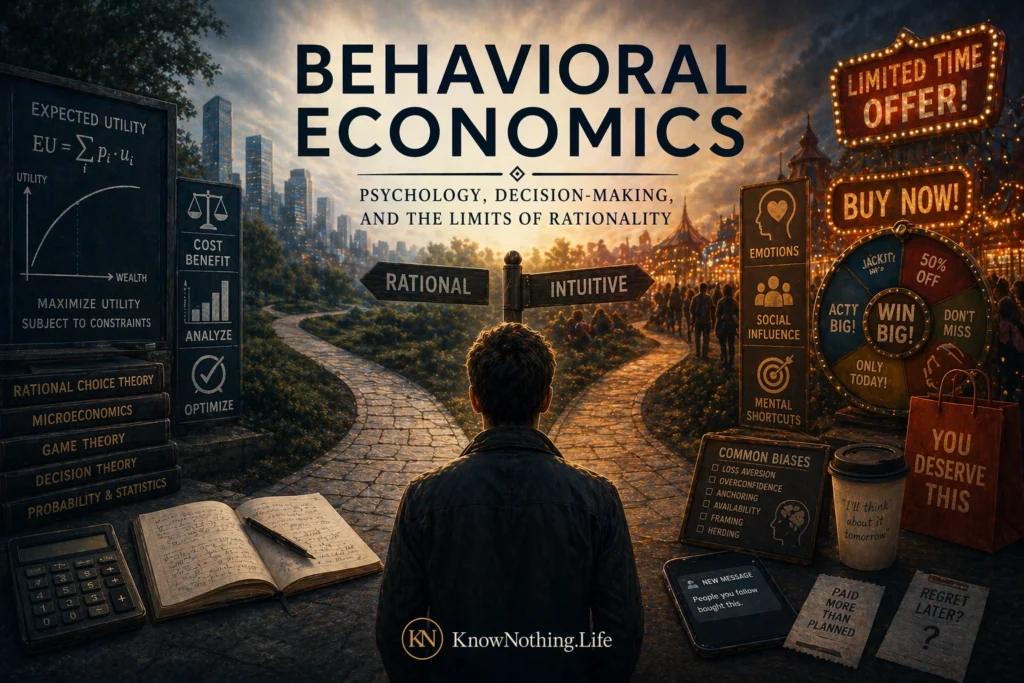
Behavioral economics is a field that challenges one of the most fundamental assumptions of traditional economics: that human beings are fully rational decision-makers. Classical economic theory often models individuals as agents who consistently make choices that maximize their utility, guided by stable preferences and perfect information. Behavioral economics, however, introduces a more nuanced view, incorporating insights from psychology to explain why real human behavior frequently deviates from this idealized model.
Rather than rejecting economic theory altogether, behavioral economics refines it by acknowledging the cognitive, emotional, and social factors that shape decisions. From everyday choices—such as saving money or making purchases—to high-stakes financial decisions, human behavior often reflects biases, heuristics, and contextual influences. By studying these patterns, behavioral economics provides a more realistic framework for understanding how people actually think and act, offering valuable insights for policymakers, businesses, and individuals alike.
The Limits of Rational Choice
Traditional economic models rely heavily on the concept of rational choice, which assumes that individuals evaluate all available options, weigh costs and benefits accurately, and choose the option that maximizes their well-being. While this framework is elegant and mathematically tractable, it often fails to capture the complexity of real-world decision-making. Behavioral economics highlights the ways in which human cognition is limited, leading to systematic deviations from rationality.
One of the key insights is that individuals operate under conditions of bounded rationality, a concept introduced by Herbert Simon. Rather than optimizing, people tend to “satisfice,” choosing options that are good enough given their limited time, information, and cognitive resources. This shift from idealized rationality to practical decision-making reflects the reality that human beings must navigate uncertainty and complexity with imperfect tools.
Heuristics and Cognitive Biases
A central focus of behavioral economics is the study of heuristics—mental shortcuts that simplify decision-making. While heuristics can be efficient, they often lead to predictable errors known as cognitive biases. For example, the availability heuristic causes individuals to overestimate the likelihood of events that are easily recalled, while the anchoring effect leads people to rely heavily on initial information when making judgments.
The pioneering work of Daniel Kahneman and Amos Tversky demonstrated that these biases are not random but systematic. Their research revealed that human judgment is shaped by underlying cognitive processes that can lead to consistent deviations from rationality. Understanding these patterns allows economists to predict behavior more accurately and design interventions that account for human limitations.
Prospect Theory and Risk
One of the most influential contributions to behavioral economics is prospect theory, developed by Kahneman and Tversky. This theory challenges the traditional assumption that individuals evaluate outcomes based solely on final states of wealth. Instead, it suggests that people assess gains and losses relative to a reference point, often placing greater weight on losses than on equivalent gains.
This phenomenon, known as loss aversion, has profound implications for decision-making under risk. Individuals tend to avoid risks when facing potential gains but become more risk-seeking when trying to avoid losses. This asymmetry helps explain a wide range of behaviors, from investment decisions to consumer choices. Prospect theory provides a more accurate description of how people perceive value and risk, highlighting the psychological dimensions of economic behavior.
Time, Preferences, and Self-Control
Behavioral economics also examines how individuals make decisions over time, particularly in relation to self-control and delayed gratification. Traditional models assume that preferences are stable and consistent, but behavioral research shows that people often exhibit time-inconsistent behavior, valuing immediate rewards more highly than future benefits.
This tendency, known as present bias, can lead to decisions that undermine long-term goals, such as failing to save for retirement or engaging in unhealthy habits. Behavioral economists explore mechanisms to address these challenges, including commitment devices and default options that help align short-term actions with long-term interests. These insights have been applied in various domains, from personal finance to public health, demonstrating the practical relevance of behavioral economics.
Social Preferences and Fairness
Contrary to the assumption that individuals act purely out of self-interest, behavioral economics recognizes the importance of social preferences, including fairness, reciprocity, and altruism. Experimental studies have shown that people are often willing to sacrifice personal gain to achieve fair outcomes or to punish perceived injustice.
These findings challenge the notion of the purely self-interested “economic agent” and suggest that human behavior is deeply influenced by social norms and moral considerations. The work of researchers like Ernst Fehr has demonstrated that cooperation and fairness play a significant role in economic interactions, shaping outcomes in markets, workplaces, and communities. Incorporating these factors into economic models provides a more comprehensive understanding of human behavior.
Nudges and Policy Applications
One of the most visible applications of behavioral economics is the concept of “nudging,” popularized by Richard Thaler and Cass Sunstein. A nudge is a subtle change in the way choices are presented that influences behavior without restricting options. For example, setting default enrollment in retirement savings plans can significantly increase participation rates.
Nudges leverage insights about human behavior to design policies that improve outcomes while preserving individual freedom. Governments and organizations around the world have adopted behavioral approaches to address issues such as health, education, and environmental sustainability. However, the use of nudges also raises ethical questions about autonomy and manipulation, highlighting the need for transparency and accountability in their application.
Behavioral Economics in Markets
Behavioral insights have important implications for how markets function. Traditional theories assume that markets are efficient because rational actors quickly incorporate information into prices. However, behavioral economics suggests that biases and emotions can lead to market anomalies, such as bubbles and crashes.
Investor behavior, for instance, is often influenced by overconfidence, herd behavior, and emotional reactions to gains and losses. These factors can cause prices to deviate from fundamental values, creating opportunities and risks. By incorporating psychological insights, behavioral economics provides a more realistic account of market dynamics, helping to explain phenomena that classical models struggle to address.
Critiques and Ongoing Debates
Despite its contributions, behavioral economics is not without critics. Some argue that it lacks a unified theoretical framework, relying instead on a collection of observed biases and anomalies. Others question whether behavioral findings can be generalized across different contexts and cultures, given the variability of human behavior.
There is also debate about the extent to which behavioral insights should influence policy. While nudges can be effective, critics worry about the potential for paternalism and the erosion of individual autonomy. These discussions reflect broader philosophical questions about the role of government and the balance between guidance and freedom.
Conclusion
Behavioral economics represents a significant evolution in the study of economic behavior, bridging the gap between abstract models and real human experience. By incorporating insights from psychology, it challenges the assumption of perfect rationality and provides a more accurate understanding of how people make decisions.
The field’s emphasis on heuristics, biases, social preferences, and context has transformed both theory and practice, influencing everything from market analysis to public policy. As research continues to evolve, behavioral economics offers valuable tools for addressing complex challenges, while also prompting deeper reflection on the nature of choice, responsibility, and human rationality.