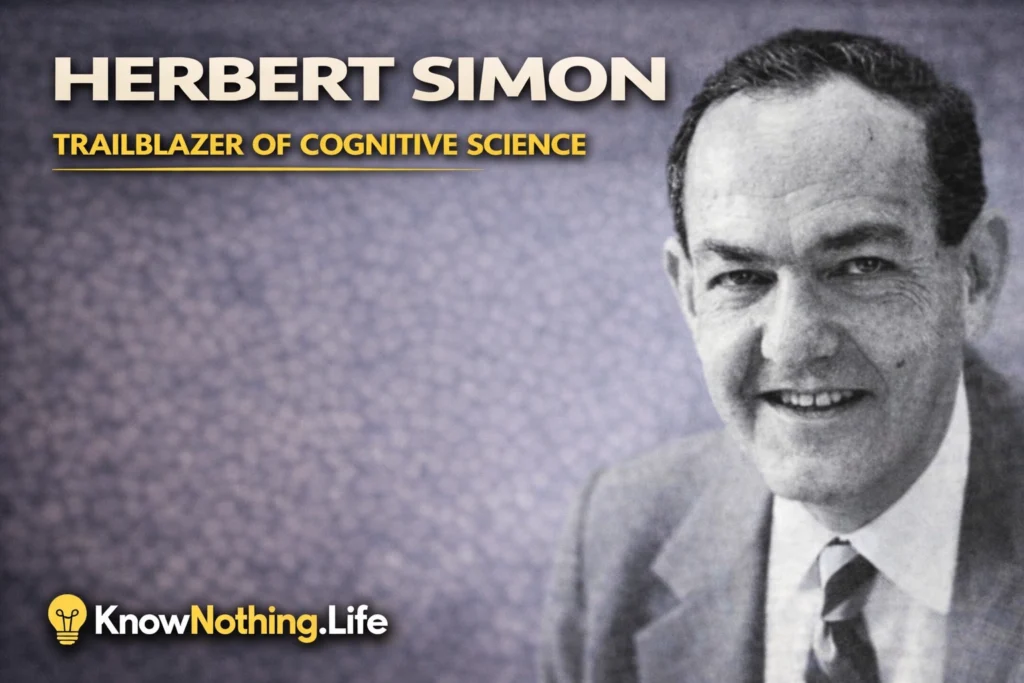
Herbert Alexander Simon was born on June 15, 1916, in Milwaukee, Wisconsin, and became one of the rare modern thinkers whose work changed several fields at once. He was trained in political science, honored with the Nobel Memorial Prize in Economic Sciences, helped found artificial intelligence, shaped cognitive psychology, and influenced organization theory, computer science, management, and design. Simon’s genius was not confined to one discipline because his central question was larger than any single academic field: how do human beings actually make decisions when time, knowledge, attention, and mental capacity are limited?
Simon studied at the University of Chicago, earning his bachelor’s degree in political science in 1937 and his Ph.D. in 1943. Chicago exposed him to economics, mathematics, political theory, statistics, and philosophy of science, giving him the intellectual tools to challenge the clean but unrealistic assumptions of classical rationality. He was not satisfied with theories that imagined decision-makers as all-knowing calculators. Real people, he believed, reason inside limits. They search, compare, simplify, guess, learn, and stop when they find something good enough. That idea became the foundation of his life’s work.
Administrative Behavior and the Study of Decision-Making
Simon’s first major book, Administrative Behavior, published in 1947, changed the study of organizations by placing decision-making at the center of administration. Earlier theories often described formal structures, chains of command, and rules. Simon asked what people inside organizations actually do when they choose policies, allocate resources, follow instructions, interpret goals, and solve problems. Organizations, in his view, were not merely charts of authority. They were systems for coordinating bounded human judgment.
This approach made Simon a founder of modern organization theory. He argued that administrative behavior must be understood through the psychology of choice. People in organizations do not usually examine every possible alternative and calculate a perfect outcome. They rely on routines, roles, habits, authority, and simplified models of reality. In doing so, they make action possible. For Simon, this was not a moral failure; it was a practical necessity. Institutions exist partly because individual minds cannot handle the full complexity of the world alone.
Bounded Rationality and Satisficing
Simon’s most famous concept is bounded rationality. Classical economic theory often assumed that rational actors maximize utility or profit by selecting the best possible option. Simon argued that this model described an impossible creature, not an actual human being. Real decision-makers face incomplete information, uncertain consequences, limited time, and finite computational power. They may intend to be rational, but their rationality is bounded by the conditions under which they think.
His related concept of “satisficing” became one of the most important ideas in the behavioral sciences. Instead of maximizing, people often search until they find an alternative that meets an acceptable threshold. Simon explained that a decision-maker may form an aspiration level and choose the first option that satisfies it. This was not laziness; it was adaptive intelligence in a complex world. His view required, as he memorably put it, “a less God-like, and more rat-like, picture of the chooser.” The phrase captured his revolt against elegant abstractions that ignored the limits of actual minds.
Artificial Intelligence and Human Problem Solving
Simon’s interest in decision-making led naturally to artificial intelligence. With Allen Newell and J. C. Shaw, he helped create the Logic Theorist in the 1950s, one of the first major artificial intelligence programs. The program proved theorems from Principia Mathematica and became a landmark in the history of computing. Simon was so excited by this work that he reportedly told a class, “Over the Christmas holiday, Allen Newell and I invented a machine that thinks.” The claim was bold, but it reflected his deep conviction that computer programs could model aspects of human thought.
With Newell, Simon later developed the General Problem Solver and coauthored Human Problem Solving, published in 1972. These projects were not merely attempts to make machines perform tasks. Simon wanted to understand the mind by building models of its procedures. A computer program, for him, could be a theory of cognition written in executable form. If the program solved problems in ways similar to people, including through shortcuts and errors, then it could teach psychologists something about human reasoning. This made Simon one of the founders of cognitive science as well as artificial intelligence.
The Sciences of the Artificial and the Meaning of Design
Simon’s 1969 book The Sciences of the Artificial expanded his thinking beyond organizations and computers into design, complexity, and human-made systems. He argued that the artificial world deserves its own science because much of human life is spent creating systems that do not simply occur in nature: buildings, institutions, machines, schedules, markets, procedures, and technologies. In one of his most quoted lines, Simon wrote, “Everyone designs who devises courses of action aimed at changing existing situations into preferred ones.”
This definition made design a universal human activity rather than a narrow artistic profession. A manager designs a workflow, a teacher designs a lesson, a programmer designs an interface, a city planner designs a transportation system, and a person designs a daily routine. Simon’s design theory connected thinking with action. Intelligence is not only about describing the world accurately; it is also about changing the world deliberately. That idea made him a lasting influence on design thinking, systems theory, public policy, engineering, and human-computer interaction.
Attention, Information, and the Modern Mind
Simon also understood something that has become even more important in the digital age: information is not the same as understanding. Long before smartphones, search engines, and social media, he saw that abundant information creates a new scarcity. His famous observation was, “A wealth of information creates a poverty of attention.” The point was simple but profound. When information multiplies, the limiting factor becomes the human capacity to notice, filter, prioritize, and act.
This insight connects many parts of Simon’s work. Bounded rationality is partly a theory of attention. Organizations are partly systems for distributing attention. Artificial intelligence is partly an effort to model and extend attention. Design is partly the art of arranging attention toward better outcomes. Simon recognized that human beings do not fail only because they lack facts. They fail because they cannot process every fact, compare every possibility, or foresee every consequence. The management of attention is therefore one of the central problems of modern life.
Major Works, Honors, and Legacy
Simon’s major works include Administrative Behavior, Models of Man, Organizations with James G. March, The New Science of Management Decision, The Sciences of the Artificial, Human Problem Solving with Allen Newell, Models of Bounded Rationality, and his autobiography Models of My Life. These works show the range of a mind that refused to respect artificial boundaries between economics, psychology, politics, computing, and philosophy. Wherever people made choices under limits, Simon saw a common problem.
He received the ACM Turing Award in 1975 with Allen Newell, the Nobel Memorial Prize in Economic Sciences in 1978, and the National Medal of Science in 1986. He died on February 9, 2001, in Pittsburgh, Pennsylvania. Herbert Simon’s lasting importance lies in his replacement of perfect rationality with realistic intelligence. He showed that human beings are neither irrational fools nor omniscient calculators. They are limited problem-solvers trying to act sensibly in complicated environments. That view changed economics, psychology, management, computer science, and the study of institutions. Simon’s legacy is the science of decision-making under limits—and in the modern world, that may be the most human science of all.