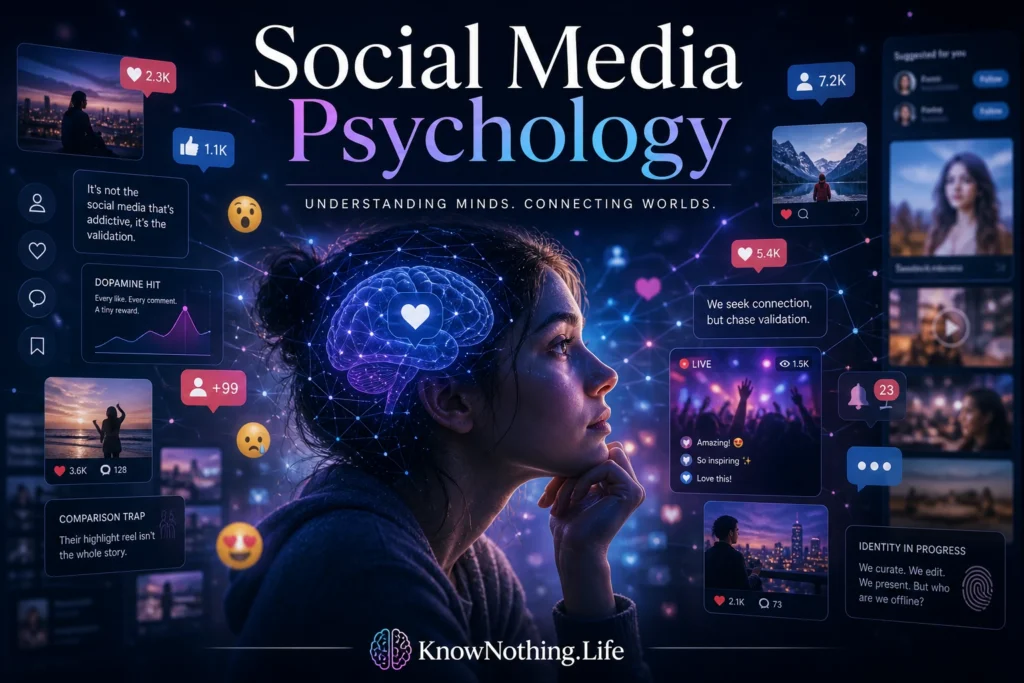
Social media psychology is the study of how platforms such as Facebook, Instagram, TikTok, X, YouTube, Reddit, Snapchat, Discord, and emerging digital communities shape human thought, emotion, identity, behavior, relationships, attention, self-esteem, and social life. Social media is not simply a communication tool. It is a psychological environment where people perform identity, seek belonging, compare lives, signal values, manage impressions, consume information, form groups, experience conflict, and measure social worth through visible metrics. A post, profile, comment, like, share, follower count, or algorithmic recommendation can become part of the way a person understands themselves and the world.
The field draws from classic psychology, sociology, communication theory, and behavioral science. Erving Goffman’s The Presentation of Self in Everyday Life remains one of the most useful foundations because social media intensifies the performance of self. Goffman wrote that when an individual appears before others, they try to control the impression others form of them. Online platforms make that process more deliberate, permanent, and measurable. Marshall McLuhan’s famous claim from Understanding Media that “the medium is the message” also matters because social media changes not only what people communicate but how they think, relate, remember, and react. The platform itself becomes part of the psychology.
The Curated Self and Online Identity
Social media encourages people to create a curated self. Users select profile images, write bios, choose what to post, hide what feels unattractive, and present life through fragments that are often edited for effect. This does not mean online identity is necessarily false. All social life involves selection. People behave differently at work, with family, with friends, and in public. What makes social media distinctive is that self-presentation becomes archived, public, quantified, and constantly available for judgment. The self becomes both personal expression and social product.
William James, in The Principles of Psychology, distinguished between the “I” who experiences and the “Me” that can be observed and evaluated. Social media expands the “Me” into a visible digital object. A person can look at their own profile almost as if it belonged to someone else, asking whether it appears attractive, intelligent, successful, moral, funny, desirable, or authentic. Charles Horton Cooley’s “looking-glass self,” from Human Nature and the Social Order, is equally relevant. Cooley argued that people imagine how they appear to others, imagine the judgment of that appearance, and develop pride or shame from it. Social media turns that imagined mirror into a public interface.
Impression Management and Performance
Goffman described social interaction as a kind of performance, with front stages, back stages, scripts, roles, and audiences. Social media complicates this because audiences collapse into one another. A single post may be seen by family, coworkers, old classmates, strangers, romantic interests, political opponents, and future employers. This “context collapse” creates psychological pressure. People must decide which version of themselves to present when multiple audiences are watching at once. The result can be careful self-censorship, strategic ambiguity, exaggerated branding, or anxiety about being misunderstood.
Performance can also become exhausting because social media rewards constant visibility. To remain socially present, people may feel pressure to post, respond, document, react, and update. A life event can begin to feel incomplete until it has been photographed, captioned, and shared. The self is no longer only lived from within; it is managed for an audience. Sherry Turkle, in Alone Together, warned that digital life can offer “the illusion of companionship without the demands of friendship.” Her concern applies strongly to social media: people may become highly visible while feeling less deeply known.
Social Comparison and Self-Esteem
Social comparison is one of the strongest psychological forces on social media. Leon Festinger’s social comparison theory argued that people evaluate themselves by comparing their abilities, opinions, and status with others. In ordinary life, comparison is limited by environment. A person compares themselves with friends, neighbors, classmates, coworkers, or family. Social media expands the comparison field to celebrities, influencers, filtered strangers, successful peers, idealized bodies, luxurious lifestyles, perfect families, and carefully staged moments of happiness. This creates a constant stream of upward comparisons.
The problem is that people often compare their private reality to other people’s public highlights. They compare their ordinary face to edited images, their messy home to staged interiors, their uncertain career to someone else’s announcement, their relationship struggles to anniversary posts, and their loneliness to images of group belonging. This can distort self-esteem because the comparison is psychologically unfair. Yet users may still feel that the evidence is real: everyone else seems happier, more successful, more attractive, more loved, or more productive. Social media therefore does not merely reflect insecurity; it can organize insecurity into a daily habit.
Likes, Rewards, and the Psychology of Reinforcement
Social media platforms are built around reward systems. Likes, comments, shares, views, saves, followers, streaks, badges, and notifications act as feedback signals. They tell users that something they did was noticed, approved, criticized, ignored, or amplified. B. F. Skinner’s work on operant conditioning is important here because it showed how behavior can be shaped by reinforcement. The most powerful reinforcement schedules are often variable: rewards arrive unpredictably. A person checks a post and may find nothing, or they may find praise, attention, controversy, flirtation, validation, or social opportunity.
This unpredictability helps explain compulsive checking. Social media use is not driven only by entertainment; it is driven by anticipation. The next refresh might deliver social proof. The next notification might answer the question, “Do I matter?” B. J. Fogg’s Persuasive Technology also helps explain platform design because it shows how computers can be built to influence attitudes and behavior. Modern social platforms are not passive bulletin boards. They are behavior-shaping systems designed around friction, reward, prompts, habit formation, and emotional engagement.
Fear of Missing Out and Social Anxiety
Fear of missing out, often called FOMO, is a central feature of social media psychology. It refers to the anxious feeling that others are having rewarding experiences without you, or that something socially important is happening elsewhere. Social media makes absence visible. Before digital platforms, a person might not know about every party, trip, inside joke, group chat, achievement, or gathering they missed. Now exclusion can appear in real time, through photos, tags, stories, and comments. The emotional pain comes not only from missing the event, but from witnessing one’s own non-participation.
FOMO is connected to belonging, status, and identity. Roy Baumeister and Mark Leary’s “belongingness hypothesis” argues that human beings have a fundamental need to form and maintain strong interpersonal bonds. Social media constantly stimulates that need while often failing to satisfy it deeply. Seeing others connect can create hunger for belonging, but scrolling alone may not provide real closeness. This produces a strange emotional contradiction: the platform makes people feel socially surrounded and socially excluded at the same time.
Online Disinhibition, Conflict, and Cruelty
People often behave differently online than they do face-to-face. John Suler’s influential article “The Online Disinhibition Effect” explains how anonymity, invisibility, delayed response, and reduced authority can lead people to disclose more freely or act more aggressively. In its positive form, online disinhibition can help people discuss trauma, illness, grief, sexuality, fear, or shame with honesty. In its destructive form, it can produce insults, harassment, trolling, threats, dehumanization, and cruelty. The screen creates distance from the immediate emotional consequences of speech.
Social media conflict is also intensified by public performance. Arguments are rarely only between two people; they are often staged before an audience. People may become more extreme because they are not only trying to persuade an opponent but also signaling loyalty to their group. Moral outrage becomes a social currency. A harsh reply can gain approval from one’s side even if it makes understanding impossible. Albert Bandura’s concept of moral disengagement helps explain this process. People can justify cruelty by portraying targets as evil, stupid, dangerous, or deserving of punishment. Once the other person becomes a symbol rather than a human being, empathy weakens.
Algorithms, Attention, and Emotional Contagion
Algorithms shape social media psychology by deciding what users see repeatedly. They do not merely deliver content; they structure attention. Content that provokes anger, desire, fear, envy, humor, outrage, or identification often travels quickly because it generates engagement. This matters because attention becomes habit. If a person repeatedly sees threatening political content, idealized bodies, luxury lifestyles, conflict videos, or disaster stories, their emotional world may begin to shift around those patterns. The feed becomes a psychological climate.
Emotional contagion is also important. People absorb moods from the social environments they inhabit. Elaine Hatfield and colleagues studied emotional contagion as the tendency to catch others’ emotions through expression, mimicry, and interaction. On social media, emotional contagion can occur through language, images, memes, outrage cycles, grief posts, panic, humor, and collective excitement. A feed can make a person feel anxious, inspired, angry, amused, lonely, or morally energized before they fully understand why. Social media psychology therefore studies not only individual posts but the cumulative emotional atmosphere created by algorithmic exposure.
Group Identity, Belonging, and Tribalism
Social media gives people access to communities they may never find offline. This can be profoundly beneficial. People with rare illnesses, niche interests, minority identities, artistic passions, political commitments, grief experiences, or unusual questions can find others who understand them. Henri Tajfel and John Turner’s social identity theory explains why this matters: part of the self is formed through group membership. Belonging to a group gives people language, pride, meaning, and a sense of “we.” Online communities can reduce loneliness by making identity socially visible and shared.
Yet group identity can also become tribal. Tajfel’s minimal group experiments showed that even arbitrary group divisions can create in-group favoritism. Social media intensifies this tendency by rewarding group signaling and exposing people to conflict between “us” and “them.” Cass Sunstein’s work on group polarization shows that when like-minded people discuss issues together, they often move toward more extreme positions. Online groups may begin as sources of support but become echo chambers when dissent is punished, outsiders are caricatured, and identity depends on opposition. The same need for belonging that builds community can also fuel hostility.
Body Image, Beauty, and the Visual Self
Visual platforms have made body image a major issue in social media psychology. Photos and videos invite constant evaluation of appearance, and filters, editing tools, lighting, poses, cosmetic trends, and algorithmic beauty standards can distort what people think bodies and faces should look like. The body becomes not only lived but displayed, compared, rated, and optimized. This can increase dissatisfaction, especially among adolescents and young adults whose identities and self-esteem are still developing.
Objectification theory, developed by Barbara Fredrickson and Tomi-Ann Roberts, argues that people, especially women, may internalize an observer’s perspective on their own bodies. Social media can intensify this self-surveillance. A person may begin to experience their body less as a living subject and more as an image to be judged. This does not affect only women, and it is not limited to beauty culture. Fitness ideals, masculinity standards, age anxiety, cosmetic enhancement, and lifestyle branding can all turn the body into a public project. Social media can inspire health and self-expression, but it can also make appearance feel like a permanent audition.
Adolescents and Developmental Vulnerability
Adolescents are especially important in social media psychology because adolescence is a period of identity formation, peer sensitivity, emotional intensity, and social learning. Erik Erikson described adolescence as the stage of “identity versus role confusion,” when young people explore who they are and where they belong. Social media now plays a major role in that exploration. It provides peer feedback, role models, communities, trends, language, and status markers. It also exposes adolescents to comparison, exclusion, cyberbullying, sexualized content, misinformation, and public humiliation.
This does not mean social media is uniformly harmful. For many young people, it provides friendship, creativity, learning, humor, activism, and support. The psychological risk depends on age, personality, platform design, time spent, content type, family environment, sleep, offline support, and existing vulnerabilities. Still, adolescence makes social media especially powerful because peer approval feels central to survival. When popularity becomes quantified and rejection becomes visible, normal developmental worries can become intensified. Social media psychology therefore requires a developmental view rather than a simple moral panic.
Final Thoughts on Social Media Psychology
Social media psychology matters because platforms have become part of the environment in which the modern self develops. People do not merely use social media; they are shaped by its rewards, audiences, comparisons, algorithms, communities, conflicts, and performances. The same platforms can connect and isolate, inform and mislead, empower and exploit, validate and wound. Their psychological power comes from the fact that they touch basic human needs: attention, belonging, identity, status, recognition, curiosity, intimacy, and meaning.
The major thinkers in this field reveal why social media is so influential. Goffman explains performance and impression management; James and Cooley explain the observed self and reflected self; Festinger explains comparison; Skinner and Fogg explain reinforcement and persuasive design; Suler explains online disinhibition; Baumeister and Leary explain belonging; Bandura explains moral disengagement; Tajfel and Turner explain group identity; Sunstein explains polarization; Erikson explains adolescent identity formation. Together, these ideas show that social media is not psychologically trivial. It is one of the central stages on which contemporary human beings seek to be seen, known, approved, defended, and remembered.