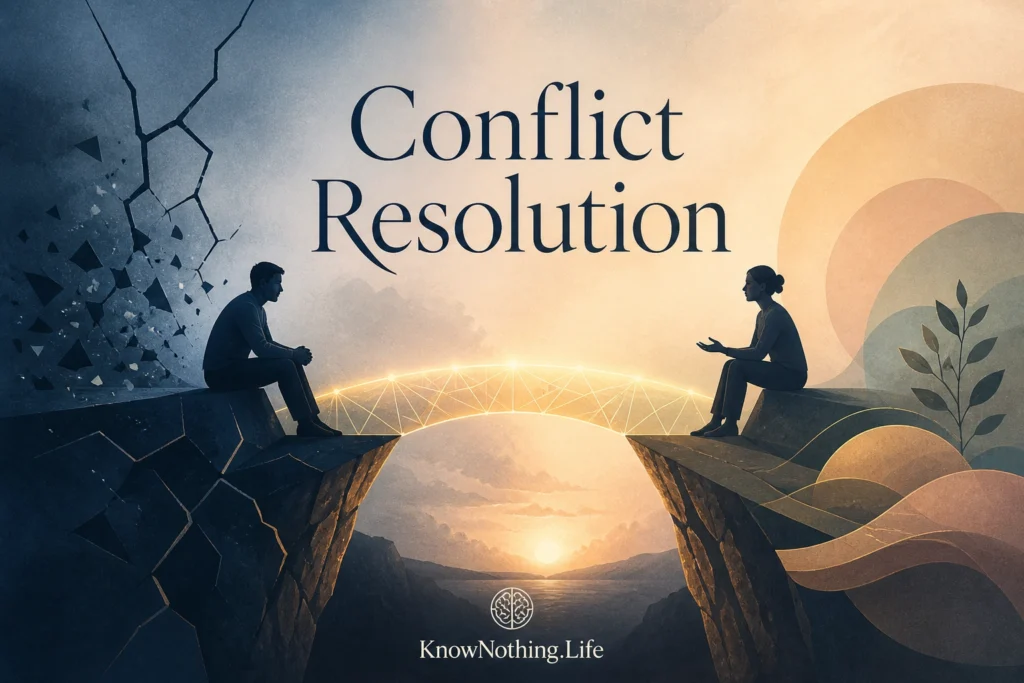
Conflict resolution is the process of addressing disagreement, tension, harm, or incompatible needs in a way that reduces destructive escalation and creates the possibility of understanding, repair, or practical agreement. Conflict is not limited to shouting or open hostility. It can appear as silence, withdrawal, resentment, passive aggression, avoidance, criticism, power struggle, or repeated misunderstanding. Wherever human beings have different needs, values, fears, memories, goals, and interpretations, conflict is possible. It occurs in families, friendships, romantic relationships, workplaces, communities, politics, and inner life. Conflict resolution therefore belongs at the center of interpersonal psychology because it studies how people move from threat and defensiveness toward communication and change.
The study of conflict resolution draws from social psychology, communication theory, negotiation research, family therapy, mediation, organizational psychology, and moral philosophy. Morton Deutsch’s work on cooperation and competition helped define conflict as a social process shaped by interdependence, goals, and trust. Roger Fisher and William Ury’s Getting to Yes popularized principled negotiation, urging people to “separate the people from the problem” and focus on interests rather than fixed positions. John Gottman’s research on couples showed that the emotional style of conflict often predicts relationship outcomes more than the topic itself. Marshall Rosenberg’s Nonviolent Communication emphasized observation, feeling, need, and request as tools for transforming blame into understanding. Conflict resolution is not simply about ending disagreement. It is about learning how to disagree without destroying the relationship or abandoning the truth.
Understanding Conflict
Conflict begins when people perceive that something important is at stake. This may involve resources, respect, freedom, recognition, safety, fairness, affection, control, identity, or belonging. On the surface, a couple may argue about money, chores, sex, parenting, or time. A workplace team may argue about deadlines, roles, credit, or authority. A family may argue about tradition, boundaries, caregiving, or loyalty. Beneath the visible issue, however, conflict often carries deeper emotional meanings: “Do I matter?” “Am I safe?” “Are you listening?” “Will I be controlled?” “Will I be abandoned?” “Will I be treated fairly?”
Morton Deutsch’s The Resolution of Conflict distinguished between constructive and destructive conflict. In constructive conflict, people remain oriented toward problem-solving, mutual understanding, and shared outcomes. In destructive conflict, the interaction becomes competitive, rigid, suspicious, and self-protective. The goal shifts from solving the problem to winning, blaming, avoiding humiliation, or punishing the other person. This distinction matters because conflict itself is not necessarily harmful. In fact, conflict can clarify needs, expose injustice, and strengthen relationships when handled well. The danger lies in how conflict is interpreted and enacted.
The Emotional Brain in Conflict
Conflict activates emotion because disagreement is often experienced as threat. The body may respond with fight, flight, freeze, or appease responses. Fight appears as anger, attack, criticism, interruption, or dominance. Flight appears as avoidance, leaving, changing the subject, or emotional distance. Freeze appears as shutting down, confusion, silence, or inability to speak. Appease appears as people-pleasing, false agreement, or self-erasure. These responses are not always deliberate choices. They are survival patterns that can activate quickly when the nervous system senses danger.
Daniel Goleman’s work on emotional intelligence is useful because conflict resolution requires recognizing and regulating emotion before it hijacks behavior. When people become flooded, they often lose the ability to listen, reason, and respond flexibly. John Gottman uses the term “flooding” to describe a state of physiological overwhelm in conflict, when heart rate and stress responses rise and productive communication becomes difficult. In such moments, pushing forward can make things worse. Effective conflict resolution often begins with slowing down: pausing, breathing, grounding, lowering the voice, taking a break, and returning when the body can participate in dialogue rather than defense.
Positions, Interests, and Needs
One of the most important ideas in conflict resolution is the difference between positions and interests. A position is what a person says they want: “I want this schedule,” “I refuse to move,” “You need to apologize,” “We should spend the money this way.” An interest is the underlying reason: rest, fairness, security, respect, autonomy, belonging, recognition, or trust. Conflicts become stuck when people argue over positions without understanding the interests beneath them.
Fisher and Ury’s Getting to Yes made this distinction central to principled negotiation. Their advice to focus on interests rather than positions helps people move from opposition to possibility. Two people may hold incompatible positions but compatible interests. One partner wants to stay home, another wants to go out; beneath that, one may need rest while the other needs connection. A manager wants strict deadlines, an employee wants flexibility; beneath that, one needs reliability while the other needs realistic workload. Once interests are named, creative solutions become possible. Conflict resolution improves when people stop asking only, “What do you want?” and begin asking, “What matters to you here?”
Communication and Active Listening
Communication is the primary tool of conflict resolution, but not all communication resolves conflict. Some speech escalates: accusation, sarcasm, contempt, exaggeration, mind-reading, interruption, and global judgments such as “you always” or “you never.” Effective communication requires specificity, emotional honesty, and a willingness to understand before responding. The goal is not to perform politeness while resentment grows underneath; it is to make meaning clearer and safer.
Carl Rogers’s person-centered psychology emphasized empathic listening as a powerful condition for change. In On Becoming a Person, Rogers argued that when people are deeply heard without judgment, they become less defensive and more capable of self-understanding. Active listening in conflict involves reflecting back what the other person means, asking clarifying questions, and checking whether one has understood accurately. This does not require agreement. A person can say, “I do not see it the same way, but I understand that you felt dismissed when I left the room.” Such statements lower threat because they separate understanding from surrender.
Blame, Responsibility, and Repair
Blame often dominates conflict because it provides a simple story: one person is wrong, the other is right. But blame rarely resolves complex interpersonal problems. It tends to produce defensiveness, counterattack, shame, or withdrawal. Responsibility is different from blame. Responsibility asks what each person did, what effect it had, and what needs to change. It can include accountability without humiliation. A person may not have intended harm, but they can still take responsibility for impact.
Repair is one of the most important skills in conflict resolution. John Gottman’s research on couples emphasizes that successful relationships are not free from conflict; they are marked by effective repair attempts. A repair attempt may be an apology, a pause, humor used kindly, a clarification, a softening of tone, or a statement such as “Let me try that again.” A strong apology names the behavior, acknowledges the impact, expresses regret, avoids excuses, and points toward change. “I am sorry you felt that way” often fails because it avoids responsibility. “I dismissed your concern and that hurt you. I am sorry. I will slow down and listen next time” is more likely to repair because it joins accountability with care.
Conflict Styles
People develop different conflict styles based on temperament, family history, culture, attachment, trauma, and social learning. Some people confront quickly; others avoid until resentment builds. Some become analytical; others become emotional. Some seek compromise; others seek control. The Thomas-Kilmann conflict mode model identifies styles such as competing, avoiding, accommodating, compromising, and collaborating. Each style can be useful in some situations and harmful in others. Avoidance may be wise when the issue is minor or timing is wrong, but destructive when it protects serious harm. Competition may be necessary in emergencies or injustice, but damaging when used to dominate ordinary disagreement.
A mature approach to conflict resolution requires flexibility. No single style works everywhere. Collaboration is often ideal when relationships and outcomes both matter, but it requires time, safety, and goodwill. Compromise may be practical when resources are limited. Accommodation may preserve harmony in low-stakes situations, but chronic accommodation can erase one person’s needs. Self-awareness helps people ask: What is my usual pattern under stress? Do I attack, withdraw, surrender, intellectualize, or manipulate? What did I learn about conflict growing up? These questions help turn automatic reactions into choices.
Power and Safety
Conflict resolution cannot be understood apart from power. Not every conflict is a misunderstanding between equal parties. Some conflicts involve coercion, abuse, intimidation, exploitation, discrimination, or institutional injustice. In these cases, asking both sides to simply communicate better can be dangerous or morally inadequate. A person being abused does not need better debate skills with an abuser; they need safety, support, and protection. A worker facing retaliation may not be free to speak honestly. A marginalized group may not be heard unless power structures change.
This is why safety is a precondition for genuine conflict resolution. Mediation, dialogue, or negotiation can only be ethical when participants can speak without serious fear of punishment, violence, or coercion. Conflict resolution should never become pressure on the harmed person to reconcile prematurely. Judith Herman’s trauma work is relevant here because recovery from harm requires safety, acknowledgment, and reconnection in that order. Resolution without accountability is often only silence. Real peace is not the absence of open conflict; it is the presence of justice, dignity, and safety.
Negotiation and Problem-Solving
Negotiation is a structured form of conflict resolution in which parties seek an agreement. Fisher and Ury’s principled negotiation model recommends separating people from the problem, focusing on interests, generating options for mutual gain, and using objective criteria. This approach is useful because it reduces personalization. Instead of treating the other person as the enemy, the conflict becomes a shared problem to solve. This does not remove emotion, but it gives emotion a more constructive container.
Good problem-solving begins by defining the issue clearly. Vague conflicts are difficult to resolve because people are not arguing about the same thing. “You do not respect me” may be emotionally true, but resolution requires concrete examples: being interrupted, ignored, excluded from decisions, or spoken to harshly. Once the issue is defined, people can generate options, evaluate consequences, agree on specific actions, and revisit the agreement later. Conflict resolution improves when agreements become behavioral rather than abstract. “We will communicate better” is weak. “We will discuss schedules every Sunday evening before making plans” is stronger.
Nonviolent Communication
Marshall Rosenberg’s Nonviolent Communication offers a practical model for reducing blame and increasing understanding. The method focuses on four elements: observations, feelings, needs, and requests. Instead of saying, “You are selfish,” a person might say, “When you made plans without checking with me, I felt hurt and unimportant because I need consideration. Would you be willing to talk with me before confirming plans next time?” This structure helps translate accusation into information.
The power of nonviolent communication lies in its focus on needs. Rosenberg argued that beneath many judgments are unmet needs. Anger may point to a need for respect. Withdrawal may point to a need for safety. Criticism may point to a need for support. This does not mean all behavior is acceptable because it expresses a need. Rather, it means that naming needs makes conflict more workable. People can disagree about strategies while still recognizing one another’s humanity. The shift from “you are the problem” to “this need is not being met” can transform the emotional field of conflict.
Mediation and Third-Party Help
Some conflicts require third-party help. Mediators, therapists, supervisors, community leaders, or trusted elders can provide structure when direct communication repeatedly fails. A good mediator does not simply split the difference. They help clarify issues, regulate escalation, ensure each party is heard, identify interests, and guide the process toward workable agreements. Mediation is especially useful when emotions are high, trust is low, or the parties keep repeating the same cycle.
Therapeutic conflict resolution is often needed when the conflict is tied to attachment wounds, trauma, chronic resentment, betrayal, or family patterns. Couples therapy, family therapy, and restorative practices can help people address not only the surface disagreement but the emotional system that sustains it. Murray Bowen’s family systems theory is relevant because it shows how conflict can be maintained by patterns across a family or group, not merely by individual personalities. Sometimes the problem is not one argument but a repeated relational dance. Third-party support can help people finally see the dance.
Forgiveness, Reconciliation, and Limits
Forgiveness is often discussed in conflict resolution, but it must be handled carefully. Forgiveness can be healing when it frees a person from ongoing bitterness or revenge. However, forgiveness should not be demanded, rushed, or used to avoid accountability. Reconciliation is different from forgiveness. A person may forgive internally without restoring the relationship. Reconciliation requires trust, changed behavior, safety, and mutual commitment. Some conflicts can be repaired; others require distance.
Desmond Tutu’s work on reconciliation after apartheid emphasized truth as a condition of healing. In interpersonal conflict, the same principle applies. There can be no meaningful reconciliation if the harm is denied, minimized, or repeated. Forgiveness without truth becomes erasure. Reconciliation without change becomes exposure to further harm. Conflict resolution must therefore respect limits. Sometimes the healthiest resolution is not agreement or closeness, but clarity, boundaries, and separation.
Culture and Conflict Resolution
Culture shapes how people understand and handle conflict. Some cultures value direct expression, debate, and explicit problem-solving. Others value harmony, indirect communication, restraint, and face-saving. In some settings, open disagreement is seen as honest; in others, it is seen as disrespectful. Family hierarchy, gender roles, community expectations, and religious values may all influence how conflict is expressed and resolved. Misunderstanding often occurs when one style is treated as universally correct.
Edward T. Hall’s distinction between high-context and low-context communication helps explain these differences. Low-context communication relies more heavily on explicit words, while high-context communication depends more on shared understanding, relationship, and implication. Cross-cultural conflict resolution requires humility. A direct person may need to learn tact; an indirect person may need to clarify needs more explicitly. The goal is not to erase cultural difference, but to create enough shared understanding that conflict does not become a battle over communication style itself.
Inner Conflict and Self-Resolution
Conflict resolution also applies within the individual. People often carry inner conflicts between desire and duty, fear and courage, anger and love, autonomy and belonging, self-protection and vulnerability. Internal conflict can produce anxiety, indecision, guilt, or self-sabotage. A person may want closeness but fear dependence, want change but fear failure, want honesty but fear rejection. These inner conflicts often show up in outer relationships.
Psychodynamic and humanistic approaches both recognize the importance of inner dialogue. Carl Jung wrote about the need to bring unconscious material into awareness, and internal family systems therapy later described the mind as containing “parts” with different protective roles. Whether one uses this model or another, self-resolution begins by listening inwardly rather than suppressing one side of the conflict. The question becomes: What is each part trying to protect? What need is being expressed? Inner conflict softens when the person develops a wiser internal relationship with fear, anger, longing, and conscience.
Conclusion
Conflict resolution is the art and psychology of transforming tension into understanding, accountability, decision, or repair. Conflict is unavoidable because human beings have different needs, histories, values, and perceptions. But destructive conflict is not inevitable. People can learn to regulate emotion, listen actively, identify interests beneath positions, communicate needs clearly, take responsibility, repair harm, and create agreements that respect both dignity and reality.
The deepest purpose of conflict resolution is not simply to stop disagreement. It is to preserve truth and relationship where possible, establish safety where necessary, and make change more likely than repetition. Some conflicts end in reconciliation, some in compromise, some in boundaries, and some in separation. What matters is that conflict be approached with clarity rather than reactivity, courage rather than avoidance, and respect rather than domination. When handled well, conflict can become more than a threat. It can become a doorway into honesty, growth, justice, and deeper human understanding.