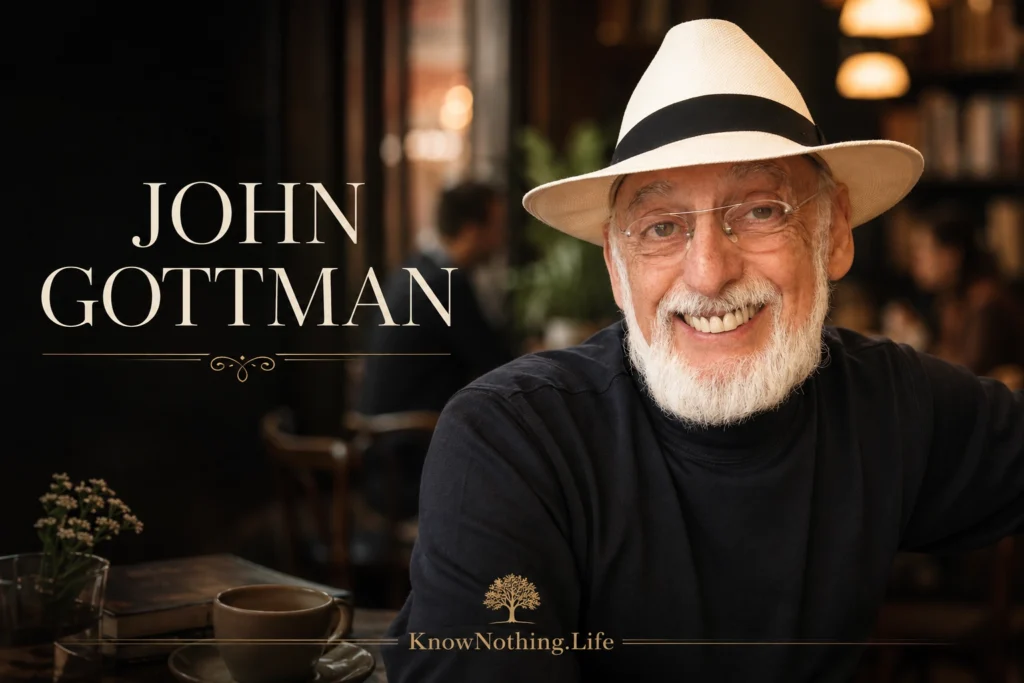
John Mordechai Gottman is an American psychologist whose research transformed the scientific study of romantic relationships, marriage, communication, and emotional connection. For more than five decades, Gottman has examined why some couples build lasting, satisfying partnerships while others gradually drift toward resentment, conflict, and separation. Rather than relying primarily on interviews or theoretical assumptions, he combined behavioral observation, longitudinal research, physiological measurement, and statistical analysis to identify patterns that reliably predict relationship success or failure. His work demonstrated that healthy relationships are not built upon the absence of conflict but upon the ways couples manage disagreement, express affection, and maintain emotional trust over time.
Gottman’s research has influenced psychology, counseling, family therapy, education, and popular discussions of marriage. His books, including The Seven Principles for Making Marriage Work, Why Marriages Succeed or Fail, The Relationship Cure, The Science of Trust, What Makes Love Last?, Eight Dates, and Fight Right, have translated decades of scientific research into practical guidance for couples. Throughout his career, Gottman has argued that relationships flourish through countless small moments of connection rather than dramatic romantic gestures. His work remains among the most influential bodies of relationship research ever conducted.
Early Life and Academic Career
John Gottman was born on April 26, 1942, in the Dominican Republic to Orthodox Jewish parents who had fled Europe during the Second World War. After spending part of his childhood abroad, his family eventually settled in the United States. Gottman later described growing up in an intellectually curious household where conversation and learning were deeply valued. His early experiences with family relationships and human behavior contributed to an enduring fascination with how people form emotional bonds and resolve interpersonal conflict.
Gottman earned a bachelor’s degree in mathematics from Fairleigh Dickinson University before completing a master’s degree in mathematics and psychology. He later received his doctorate in clinical psychology from the University of Wisconsin–Madison in 1971. His mathematical background strongly influenced his research style. Rather than approaching relationships primarily through philosophical reflection, he emphasized careful measurement, statistical modeling, and observable behavior. After joining the University of Washington faculty, he established what would become one of the world’s leading research programs devoted to marriage and family relationships.
Building a Science of Relationships
During the 1970s and 1980s, Gottman began conducting longitudinal studies that followed couples over many years. Instead of asking participants only how satisfied they felt, researchers videotaped conversations, monitored facial expressions, analyzed language, recorded heart rate, blood pressure, skin conductance, and other physiological indicators while couples discussed areas of disagreement. These detailed observations allowed Gottman to examine interaction patterns that unfolded second by second rather than relying solely on retrospective memory.
One of his greatest innovations was demonstrating that relatively brief observations could predict future relationship outcomes with remarkable accuracy. By studying communication patterns, emotional responses, and physiological reactions, Gottman’s laboratory developed models capable of identifying couples who were likely to remain together or eventually divorce. Although popular accounts often exaggerated these predictions as nearly perfect, the broader finding proved highly influential: everyday interaction patterns reveal far more about relationship health than isolated arguments or grand romantic declarations.
The Four Horsemen of the Apocalypse
Among Gottman’s best-known contributions is the concept of the “Four Horsemen,” four communication patterns that strongly predict relationship deterioration when they become habitual. These patterns are criticism, contempt, defensiveness, and stonewalling. Criticism attacks a partner’s character rather than addressing a specific behavior. Contempt expresses superiority through mockery, sarcasm, eye-rolling, or ridicule. Defensiveness shifts responsibility instead of acknowledging concerns, while stonewalling involves emotional withdrawal and disengagement from communication.
Gottman identified contempt as the single strongest predictor of relationship failure because it communicates disrespect and moral superiority. He often summarized this finding by saying, “Contempt is sulfuric acid for love.” Once contempt becomes a dominant pattern, couples increasingly interpret one another’s actions through suspicion and hostility. Gottman’s research emphasized that replacing these destructive habits with appreciation, responsibility, emotional responsiveness, and respectful communication significantly improves long-term relationship stability.
Emotional Intelligence and the Sound Relationship House
As his research expanded, Gottman developed the Sound Relationship House Theory, a comprehensive framework describing the foundations of healthy relationships. The model includes building love maps by understanding a partner’s inner world, expressing fondness and admiration, turning toward bids for emotional connection, maintaining positive perspectives, managing conflict constructively, supporting life dreams, and creating shared meaning. These interconnected levels represent skills that couples can actively strengthen rather than fixed personality traits.
Central to Gottman’s thinking is the concept of emotional bids. Partners constantly make small attempts to connect through questions, humor, observations, physical affection, or requests for attention. Healthy couples generally notice and respond positively to these bids, reinforcing emotional security over thousands of daily interactions. Gottman famously observed, “Small things often.” Rather than emphasizing dramatic expressions of love, he argued that stable relationships are built through consistent responsiveness to ordinary moments of connection.
Trust, Conflict, and Repair
One of Gottman’s most influential findings is that conflict itself does not determine relationship quality. Every long-term relationship experiences disagreements because partners inevitably differ in personalities, values, habits, and expectations. What distinguishes successful couples is not the absence of conflict but their ability to repair emotional ruptures before resentment becomes permanent. Humor, affection, empathy, apologies, compromise, and expressions of understanding all function as repair attempts that interrupt escalating negativity.
In The Science of Trust, Gottman argued that trust develops through repeated decisions to prioritize the relationship over immediate self-interest. Partners continually ask, consciously or unconsciously, whether the other person will respond with reliability, honesty, and care. Trust accumulates gradually through countless interactions rather than a single dramatic event. Gottman summarized this principle with a simple observation: “Trust is built in very small moments.” Those moments determine whether relationships become increasingly secure or progressively fragile.
Major Works and the Gottman Method
Gottman’s research has generated dozens of influential books for both professionals and general readers. Why Marriages Succeed or Fail introduced many of his early findings about communication patterns. The Seven Principles for Making Marriage Work distilled decades of research into practical strategies for couples. The Relationship Cure expanded these principles beyond marriage to friendships, families, and workplace relationships. Later works such as The Science of Trust, What Makes Love Last?, Eight Dates, and Fight Right, coauthored with his wife and fellow psychologist Julie Schwartz Gottman, further developed evidence-based approaches to strengthening relationships.
Together, John and Julie Gottman founded The Gottman Institute, which trains therapists, educators, and counselors throughout the world. The Gottman Method of Couples Therapy combines scientific assessment with practical interventions designed to improve friendship, communication, emotional regulation, conflict management, and shared meaning. Unlike many therapeutic approaches developed primarily from clinical intuition, the Gottman Method remains closely connected to decades of empirical research, making it one of the most extensively studied approaches to couples therapy.
Lasting Legacy
John Gottman’s influence extends far beyond psychology laboratories. His research has shaped marriage counseling, family therapy, relationship education, conflict resolution, parenting programs, and communication training. Many concepts that have entered everyday language—including the Four Horsemen, emotional bids, repair attempts, and love maps—originated from his scientific investigations. His work has also encouraged therapists to integrate behavioral observation, physiology, and longitudinal evidence into relationship research.
Perhaps Gottman’s greatest contribution is demonstrating that healthy relationships are understandable without becoming mechanical. Love cannot be reduced to formulas, yet enduring partnerships display recognizable patterns of kindness, curiosity, respect, and emotional responsiveness. His research suggests that successful relationships depend less upon finding a perfect partner than upon continually creating an environment where trust, friendship, affection, and mutual understanding can grow. By bringing rigorous scientific methods to one of humanity’s most personal experiences, John Gottman permanently changed how psychologists understand love, commitment, and lasting connection.