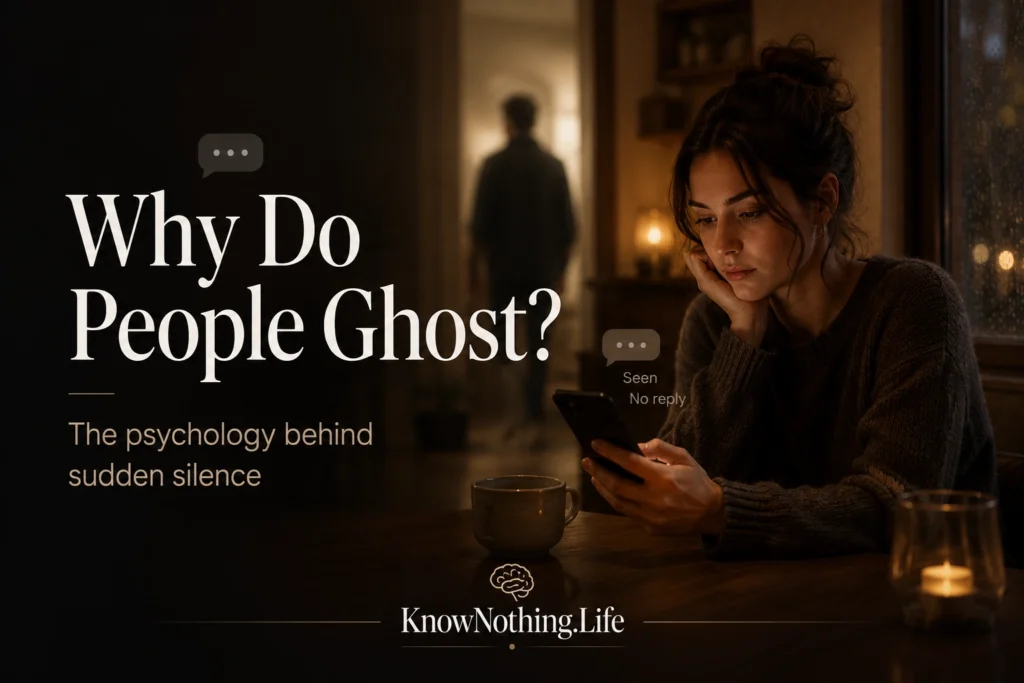
Ghosting occurs when someone abruptly ends communication without offering an explanation and then ignores attempts to reestablish contact. It is most commonly associated with online dating, but it also happens in friendships, family relationships, professional networks, and workplaces. Unlike a direct rejection, ghosting leaves the relationship’s status unstated. The person who disappears may consider the connection finished, while the other person remains uncertain about whether something has gone wrong, whether communication will resume, or whether the silence itself is the answer. Researchers therefore describe ghosting as both a relationship-dissolution strategy and a form of social exclusion.
People ghost for many different reasons. Some want to avoid confrontation, guilt, awkwardness, or an emotionally difficult conversation. Others lose interest, feel overwhelmed by the number of online contacts available to them, fear an aggressive response, or conclude that a relationship was never serious enough to require a formal ending. Ghosting can sometimes be careless or self-protective, but it can also be a deliberate attempt to control a situation through silence. Understanding why people ghost requires looking beyond simple explanations such as selfishness or cowardice and examining avoidance, attachment, communication technology, safety, and beliefs about relationships.
Avoiding an Uncomfortable Conversation
One of the most common reasons people ghost is that direct rejection is uncomfortable. Telling another person that attraction has faded, a friendship no longer feels satisfying, or a relationship has no future can provoke guilt and anxiety. The person ending the relationship may anticipate crying, anger, persuasion, demands for an explanation, or accusations of wrongdoing. Silence offers a way to escape these immediate reactions. By not sending a final message, the ghoster avoids witnessing the emotional consequences of the decision.
Ghosting therefore functions as an avoidance strategy. It removes short-term discomfort without resolving the interpersonal situation openly. Research on mobile dating experiences has identified several reported motives for ghosting, including diminished interest, convenience, undesirable interactions, and concerns about how the other person might respond. The person who ghosts may tell themselves that gradually disappearing is kinder than delivering an explicit refusal, although the absence of an answer often transfers the emotional burden to the person being ignored.
Digital Communication Makes Disappearance Easier
Ghosting existed before dating apps and social media, but digital communication has made it easier to perform. People can meet, flirt, become emotionally involved, and end contact without sharing a physical community. In earlier social environments, disappearing from a relationship might have required avoiding mutual friends, changing routines, or risking damage to one’s local reputation. Online, a person can stop replying, unmatch, block an account, or move on to another conversation with a few taps.
Dating apps can also produce an impression that social connections are plentiful and replaceable. When several conversations are occurring at once, individuals may invest less deeply in any single interaction. A match may be treated as a possibility rather than a relationship carrying mutual obligations. Research on online dating rejection found ghosting to be among the most frequently experienced forms of rejection, even after substantial message exchanges. Technology does not force people to ghost, but it reduces the practical and social costs of leaving without explanation.
Attachment and Emotional Distance
Attachment patterns may influence how people approach relationship endings. Individuals higher in attachment avoidance tend to feel less comfortable with emotional dependence, vulnerability, and intense intimacy. When a relationship begins to require difficult disclosure or emotional accountability, withdrawal can provide a sense of control. Earlier research on breakup strategies found that attachment avoidance was associated with less direct methods of ending relationships, while subsequent ghosting research has examined similar connections between avoidant attachment and disappearing without explanation.
This does not mean that everyone who ghosts has an avoidant attachment style or that avoidantly attached people always ghost. Attachment describes broad tendencies rather than fixed rules. A generally secure person may ghost during a stressful or frightening situation, while an avoidant person may communicate clearly because of strong values or learned relationship skills. Still, ghosting can be appealing to someone who manages emotional discomfort by creating distance. Silence prevents negotiation and allows the person to leave before intimacy, conflict, guilt, or another person’s needs become harder to ignore.
Beliefs About Relationships and Compatibility
People’s beliefs about romantic compatibility can also shape their attitudes toward ghosting. Some hold strong “destiny beliefs,” meaning they tend to see relationships as either naturally meant to work or fundamentally wrong. If chemistry feels absent or a partner appears incompatible, there may seem to be little reason to discuss problems or work through disappointment. The relationship is interpreted as a failed match rather than something requiring communication and negotiation.
Gili Freedman and colleagues examined the relationship between these implicit theories and ghosting. Their studies found that stronger destiny beliefs were associated with more positive attitudes toward ghosting and greater reported intentions to use it. By contrast, people who hold stronger “growth beliefs” tend to view relationships as capable of developing through communication and effort. Such individuals may be more inclined to explain their concerns, although beliefs alone do not determine behavior.
Fear, Safety, and Self-Protection
Not all ghosting is motivated by convenience or emotional immaturity. Some people disappear because direct rejection feels unsafe. A person may have encountered controlling behavior, sexual pressure, threats, stalking, repeated boundary violations, or intense anger. In such situations, offering an explanation can invite further contact or create an opportunity for manipulation. Blocking and ending communication without warning may be a reasonable protective response.
Research has found that safety concerns can increase willingness to use ghosting as a rejection strategy. This distinction matters because advice about communication should not assume that everyone is owed continued access or a final conversation. Direct closure is generally more considerate when a relationship has been respectful and safe, but personal safety takes priority. Ghosting someone who has behaved threateningly is fundamentally different from silently abandoning a caring partner or close friend simply to avoid discomfort.
Ghosting as a Learned Social Behavior
People who have been ghosted may later ghost others. Repeated exposure can normalize the behavior by making it seem like an ordinary feature of dating or friendship. Someone who once found unexplained silence cruel may eventually decide that disappearing is simply how casual relationships end. Research examining individual and relational factors has found associations between experiencing ghosting, ghosting others, and intentions to use ghosting in the future.
This does not necessarily mean that victims consciously seek revenge. Social behavior is often learned through observation and repetition. When a community lacks clear norms about when an explanation is expected, people rely on what they see others doing. The boundary between losing touch and deliberately ghosting can also become unclear. Two acquaintances may mutually stop communicating without either experiencing rejection, whereas ghosting usually involves one person unilaterally withdrawing while knowing that the other expects continued contact.
Why Being Ghosted Hurts
Being ghosted is painful because it combines rejection with uncertainty. A direct ending provides unpleasant information, but ghosting withholds even that. The person left behind may repeatedly review conversations, search for mistakes, check social media, and imagine possible explanations. Because there is no clear ending, hope and rejection can coexist. This ambiguity can make it difficult to decide whether to wait, reach out again, become angry, or begin grieving the relationship.
Research by Christina Leckfor and colleagues characterizes ghosting as a form of ostracism that can threaten four fundamental psychological needs: belonging, self-esteem, control, and meaningful existence. A 2024 study comparing emotional accounts found that people who were ghosted expressed more sadness and hurt and experienced greater threats to these needs, while ghosters were more likely to describe guilt and relief. The distress is therefore not caused only by losing the relationship. It also comes from being denied participation in the relationship’s ending.
What Ghosting Reveals About the Ghoster
Ghosting does not provide a complete psychological profile of the person who disappears. It may indicate avoidance, low interest, poor communication skills, fear, emotional overload, conflicting priorities, or a belief that the connection was too limited to require explanation. Some research has also explored associations between ghosting and personality traits such as psychopathy, narcissism, and Machiavellianism, but such findings should not be used to diagnose every person who fails to reply.
The behavior often reveals more about how someone handles discomfort than about the worth of the person being ghosted. A ghoster may choose immediate emotional relief over clarity, accountability, and compassion. Even when the decision to leave is justified, the method of leaving can show an unwillingness or inability to manage another person’s disappointment. At the same time, people can recognize the harm they have caused. Research suggests that ghosters may experience guilt, and ghosting friends has been associated with increased depressive tendencies over time, indicating that disappearing does not always provide lasting emotional escape.
Why People Choose Silence
People ghost because silence can feel easier than honesty. It eliminates an immediate confrontation, preserves emotional distance, and allows someone to leave without explaining motives that may be difficult to articulate. Digital platforms make this exit readily available, while attachment patterns, safety concerns, relationship beliefs, and learned social norms influence who is most likely to use it. The same action can therefore arise from very different psychological circumstances.
Ghosting is not always equally harmful or unjustified. Leaving an unsafe interaction without explanation can be necessary, while disappearing from a respectful, established relationship usually causes avoidable pain. What makes ghosting so powerful is not simply that contact ends, but that one person controls the ending by refusing to acknowledge it. A brief, clear message cannot remove the disappointment of rejection, but in safe relationships it can replace prolonged uncertainty with an understandable boundary. Ghosting avoids the discomfort of saying goodbye, yet it often leaves the other person carrying the conversation that never happened.