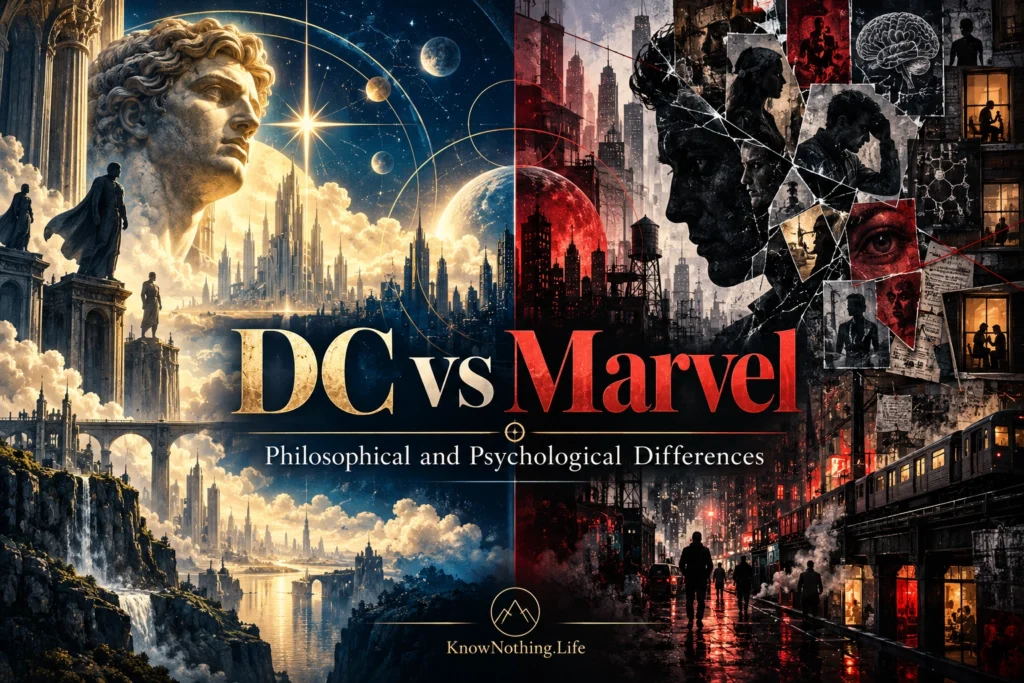
DC and Marvel have spent generations telling stories about gods, monsters, vigilantes, aliens, mutants, scientists, soldiers, and ordinary people suddenly forced to live with extraordinary abilities. Their characters frequently overlap in obvious ways. Both universes contain billionaires, cosmic entities, speedsters, sorcerers, artificial intelligences, alien civilizations, troubled teenagers, secret societies, and heroes capable of destroying cities. Both have also changed dramatically across decades, making almost any sweeping distinction vulnerable to exceptions. Batman can be psychologically intimate. Daredevil can be mythic. Superman struggles with identity, while Thor can be painfully human. There is no philosophical rule that every DC story follows and every Marvel story rejects.
Yet broad differences remain visible because the two universes were shaped by different historical moments and storytelling traditions. DC’s foundational heroes—Superman, Batman, Wonder Woman, the Flash, Green Lantern—largely emerged from the Golden Age and were repeatedly refined into cultural icons. Marvel’s defining transformation arrived during the 1960s through creators such as Stan Lee, Jack Kirby, Steve Ditko, and their collaborators, who placed extraordinary characters inside arguments, financial problems, romantic failures, prejudice, insecurity, and ordinary urban life. The philosophical contrast is therefore not simply “DC heroes are gods and Marvel heroes are humans.” It is better described as a difference in emphasis. DC often asks what ideals would look like if they became people. Marvel often asks what people would become if extraordinary power were added to their existing problems.
DC Tends Toward Myth, Marvel Toward Personality
One of the most useful ways to understand DC is through mythology. Cultural critic Umberto Eco famously examined Superman in “The Myth of Superman,” arguing that the character exists between two narrative forms. The mythic hero embodies something permanent and universal, while the protagonist of a modern novel changes through events and becomes part of history. Superman somehow has to be both. He represents ideals large enough to become symbolic while simultaneously remaining Clark Kent, a person who lives, works, loves, worries, and makes choices.
Comic-book scholar Richard Reynolds developed the connection further in Super Heroes: A Modern Mythology, examining superheroes as modern cultural myths that dramatize authority, morality, identity, and social order. Grant Morrison makes an even stronger version of the argument in Supergods, treating enduring characters such as Superman and Batman as contemporary embodiments of ancient symbolic types. Superman resembles the sky god, the sun hero, and the benevolent protector. Batman descends into an underworld of crime and fear. Wonder Woman emerges directly from Greek mythology while functioning as an ideal of compassion joined to strength.
Marvel’s classic characters were often designed to disrupt precisely this distance between reader and icon. Peter Parker is bitten by a radioactive spider, but his transformation does not remove humiliation, money problems, romantic confusion, guilt, or loneliness. The Fantastic Four receive astonishing powers and then argue like a family. Bruce Banner becomes one of the strongest beings alive while fearing the creature within himself. The X-Men can perform miracles but remain vulnerable to social rejection. Marvel’s innovation was not the invention of flawed heroes—flawed heroes existed long before Marvel—but the systematic placement of personal imperfection near the center of superhero storytelling.
The result is a different psychological invitation. DC frequently asks the reader to look upward toward an archetype and consider what it represents. Marvel more often invites the reader to look sideways and recognize someone who feels psychologically familiar despite possessing impossible abilities.
DC Often Begins With the Ideal; Marvel Begins With the Problem
The difference becomes clearer when considering how heroism is morally framed. Superman is commonly organized around questions of restraint, responsibility, hope, and the ethical use of overwhelming power. Wonder Woman combines warrior ability with an aspiration toward truth, compassion, and peace. Batman attempts to transform childhood trauma into a disciplined mission without crossing certain moral boundaries. Their stories regularly ask how an ideal survives contact with an imperfect world.
This gives many DC stories an almost Platonic structure. Plato‘s philosophy distinguishes changing particular things from the ideal forms by which those things become intelligible. DC heroes sometimes function similarly in the cultural imagination. Superman is not merely someone who performs hopeful actions; he becomes a symbol of hope. Batman becomes something larger than Bruce Wayne, an idea intended to frighten criminals. Wonder Woman becomes an embodiment of truth and justice extending beyond the individual woman carrying the name. Stories such as Kingdom Come by Mark Waid and Alex Ross make this symbolic function explicit by treating superheroes almost as a displaced pantheon debating what power, justice, and responsibility should mean.
Marvel’s heroes more often discover their morality through failure. Spider-Man’s central ethical insight follows selfishness and irreversible loss. Amazing Fantasy #15 famously concludes with the lesson that “with great power there must also come—great responsibility.” The crucial point is that Peter Parker does not begin as an ideal person. The moral principle becomes meaningful because he first fails to live by it. Tony Stark’s best stories repeatedly involve confronting the consequences of ego, technology, ambition, addiction, or attempts at control. Daredevil’s morality is inseparable from anger, Catholic guilt, punishment, forgiveness, and the temptation to become what he fights. Marvel heroism often emerges from the process of becoming better rather than the preservation of an already recognizable ideal.
The Secret Identity Means Something Different in Each Universe
Superheroes also dramatize a psychological problem everyone experiences: the tension between different versions of the self. Psychologist William James observed in The Principles of Psychology that a person can possess multiple social selves because we appear differently within different relationships. Modern social psychology similarly treats identity as contextual. Someone can simultaneously be a parent, employee, friend, competitor, citizen, and private individual, with different roles activating different expectations.
DC’s secret identities often amplify a question about essence. Is Superman fundamentally Kal-El, Clark Kent, or Superman? Is Batman Bruce Wayne’s disguise, or has Bruce Wayne become the disguise protecting Batman? Wonder Woman complicates the structure further because Diana’s identity often combines divine or mythological origin, Amazon culture, public heroism, and life in the wider human world. These identities encourage almost existential questions about whether the authentic self exists underneath our roles or is created through them.
Marvel tends to make identity conflict socially messier. Peter Parker’s superhero life damages his relationships because responsibility in one role creates failure in another. Bruce Banner does not simply put on another identity; the Hulk embodies rage, dissociation, fear, and aspects of self Banner cannot easily integrate. Moon Knight stories push fragmented identity much further. The X-Men make identity political: a mutant cannot necessarily remove mutation at the end of the day and return to an uncomplicated civilian self.
Marvel therefore frequently treats the secret identity as a problem of psychological integration. DC more often turns it into a question of symbolism and self-definition. Again, neither tendency is exclusive, but the emotional texture differs.
Trauma Becomes Mission in DC and an Ongoing Wound in Marvel
Batman provides perhaps the clearest example of DC transforming trauma into myth. The murder of Thomas and Martha Wayne is psychologically devastating, but within the structure of the Batman legend it becomes an origin ritual. Bruce takes private suffering and turns it into mission, symbolism, discipline, and identity. Frank Miller and David Mazzucchelli’s Batman: Year One emphasizes the construction of that mission; other stories continually ask whether the transformation saves Bruce or prevents him from ever leaving the traumatic moment behind.
Psychologists Richard Tedeschi and Lawrence Calhoun developed the concept of post-traumatic growth to describe positive psychological changes that some people report following severe adversity, including increased meaning, changed priorities, stronger relationships, or new perceptions of personal strength. Post-traumatic growth does not mean trauma is beneficial or that everyone grows from suffering. But it provides a useful framework for superhero narratives because hero origins frequently turn catastrophe into purpose. DC tends to monumentalize this transformation: trauma becomes the beginning of a legend.
Marvel often refuses to let transformation become so clean. Peter Parker’s guilt about Uncle Ben does not simply produce responsibility and disappear; it remains an emotional pressure throughout his life. Matt Murdock’s suffering repeatedly challenges his identity rather than stabilizing it. Bruce Banner’s trauma and anger are continually renegotiated through the Hulk. The X-Men experience prejudice not as a single origin event but as a recurring social reality.
In psychological terms, Marvel often portrays the self as something under continuous revision. DC frequently asks how a person becomes a symbol after suffering. Marvel asks what happens when the suffering keeps following the person who became a hero.
DC’s Society Looks Up at Heroes; Marvel’s Society Argues With Them
The public position of superheroes also differs. DC’s major heroes often occupy explicitly symbolic relationships with society. Metropolis can admire Superman as its protector. Gotham interprets Batman through fear, rumor, controversy, and legend. Wonder Woman can operate as an ambassador between radically different cultures. The Justice League resembles an assembly of mythological champions dealing with threats beyond ordinary institutions.
Marvel’s heroes are more often caught inside social conflict. The Fantastic Four become celebrities. Spider-Man is publicly attacked by J. Jonah Jameson. Mutants are feared as a population rather than merely judged as individual heroes. Civil War by Mark Millar and Steve McNiven turns superhero identity into a political argument about registration, security, autonomy, and state authority. X-Men stories such as Chris Claremont and Brent Anderson’s God Loves, Man Kills confront prejudice, ideology, and persecution directly.
Social identity theory, developed by Henri Tajfel and John Turner, helps explain why the X-Men in particular became such a powerful psychological metaphor. People classify themselves and others into groups, and those categories can shape loyalty, prejudice, self-concept, and perceptions of threat. Mutants constitute an identity category that cannot be reduced to individual morality: society can fear an entire group regardless of whether particular mutants behave heroically.
DC certainly explores prejudice and political conflict, while Marvel contains universally admired heroes. But Marvel’s foundational social imagination often treats the superhero as a person forced to negotiate membership in ordinary society. DC frequently asks whether society can live up to its heroes; Marvel asks whether society will accept them at all.
Gotham and Metropolis Are Symbols; Marvel’s New York Is a Social Environment
The geography of the two universes reinforces their psychological differences. Gotham City and Metropolis are fictional places, but precisely because they are fictional they can become concentrated psychological environments. Gotham embodies corruption, fear, Gothic decay, inequality, obsession, and the possibility of order emerging from darkness. Metropolis frequently represents technological optimism, visibility, movement, and the future. The cities become extensions of the heroes who inhabit them.
This resembles the philosophical role of imagined cities from Plato’s Republic onward. A fictional city can isolate ideas more clearly than an ordinary place because it is built around thematic concerns. Gotham does not need to correspond perfectly to Chicago or New York because its purpose is psychological as well as geographic. It externalizes Batman’s world. Metropolis externalizes much of Superman’s.
Marvel’s classic universe placed an unusual amount of superhero activity in recognizable New York City. Peter Parker comes from Queens. Daredevil is tied to Hell’s Kitchen. The Fantastic Four occupy Manhattan. Doctor Strange lives in Greenwich Village. The physical reality of the city narrows the distance between fantasy and ordinary existence. A superhero can fight an interdimensional monster and still worry about making rent on the same streets familiar to readers.
The distinction reflects two approaches to imagination. DC often constructs a world worthy of the symbol. Marvel inserts the symbol into a world that already feels socially inhabited.
DC Asks What We Should Become; Marvel Asks Whether We Can Live With Ourselves
The psychological appeal of each universe can be understood through research on narrative identity. Psychologists Dan McAdams and Kate McLean describe narrative identity as the evolving story people construct to connect the remembered past with an imagined future. These personal narratives provide some degree of coherence, meaning, and purpose. Research in this tradition has found that stories emphasizing agency, exploration, and redemption can be associated with psychological adaptation and maturity.
DC’s strongest heroes often provide aspirational narratives. Superman can represent the question: What would I do if I were powerful enough to act according to my highest values? Wonder Woman asks whether strength and compassion can coexist. Batman asks whether fear and suffering can be transformed into discipline rather than destruction. These characters function as ideals against which the self can be measured.
Marvel offers a different form of identification: not “Could I become like a god?” but “Could someone with my problems still become heroic?” Peter Parker remains insecure. The Thing dislikes what has happened to his body. Hulk struggles with anger. Tony Stark’s brilliance coexists with profound weaknesses. The X-Men experience being different as both gift and burden.
A 2013 study by Ariana Young, Shira Gabriel, and Jordan Hollar illustrates how psychologically meaningful superhero identification can become. Men who had formed a parasocial bond with a superhero responded differently to exposure to an idealized muscular image of that hero than men without such a bond; identification could alter how the comparison affected body satisfaction and even measured physical strength. The specific experiment was not comparing DC with Marvel, but it demonstrates the larger point: superheroes are not merely watched. They can become incorporated into how people perceive themselves.
The Difference Is Also Between Moral Elevation and Moral Recognition
Psychologists Scott Allison and George Goethals have argued that hero narratives satisfy needs for wisdom, meaning, hope, inspiration, and psychological growth. Research on moral elevation by scholars including Mary Beth Oliver has similarly found that portrayals of moral virtue in entertainment can produce feelings of inspiration and motivations toward prosocial behavior. Superhero stories therefore matter psychologically partly because they dramatize better ways of being.
DC traditionally excels at moral elevation. A classic Superman story works when the reader does not merely believe Superman is powerful but wants the world to deserve him. All-Star Superman by Grant Morrison and Frank Quitely is largely about what extraordinary goodness looks like when power is combined with mortality. Wonder Woman at her best makes compassion appear courageous rather than naive.
Marvel often produces moral recognition first. Peter Parker may inspire precisely because readers recognize his selfishness, anxiety, resentment, guilt, and exhaustion. The moral movement occurs from identification toward improvement. The reader thinks, in effect, if someone this imperfect can keep choosing responsibility, perhaps imperfection does not disqualify me either.
Neither strategy is inherently superior. One elevates by giving us an image above ourselves. The other elevates by beginning where we already are.
Superhero Psychology Is More Complicated Than Either Universe’s Ideals
There is an important caution. Superhero stories do not automatically teach virtue simply because heroes defeat villains. Research on children and superhero media has produced mixed and sometimes uncomfortable findings. Sarah Coyne and colleagues followed preschool children and found that greater engagement with superhero media was associated with later physical and relational aggression rather than clearly increased prosocial or defending behavior. A later five-year longitudinal study of 430 children similarly found associations between some forms of superhero engagement and aggressive behavior.
Other research has found more nuanced outcomes depending on age, context, identification, and whether heroic content is violent or nonviolent. An experimental study by Drew Cingel and colleagues involving older adolescents found some prosocial effects under particular conditions without corresponding increases in hostility. The lesson is that audiences do not simply absorb the explicit moral message of heroic stories. Violence, identification, age, context, and interpretation all matter.
This is philosophically significant because superhero universes are laboratories rather than instruction manuals. Batman’s refusal to kill does not automatically tell us whether vigilantism is justified. Captain America’s morality does not settle the ethics of patriotism. The X-Men metaphor cannot perfectly reproduce real-world prejudice. The value of these stories lies partly in their ability to make contradictions vivid enough for readers to think about them.
Two Different Routes to the Same Human Question
The familiar claim that “DC makes gods human while Marvel makes humans into gods” survives because it contains a useful insight, but it becomes misleading when treated as a strict rule. Superman is profoundly human. Spider-Man can become mythic. Batman may be more psychologically damaged than many Marvel characters, while Thor can embody divine archetype as directly as Wonder Woman. Decades of writers have continually borrowed from, challenged, and reversed the tendencies of both publishers.
The deeper distinction is one of narrative gravity. DC tends to pull its greatest characters toward symbol, archetype, legacy, and ideal. Marvel tends to pull its greatest characters toward personality, social conflict, contradiction, and psychological consequence. DC asks what justice, hope, fear, truth, and responsibility would look like if those ideas could walk into a room. Marvel asks what happens when a frightened, angry, lonely, ambitious, or insecure person suddenly becomes capable of changing the world.
Both approaches eventually arrive at the same philosophical question: what should human beings do with the power they possess? DC often answers by showing us who we might aspire to become. Marvel often answers by reminding us that whoever we become, we will probably bring our problems with us.
And somewhere between Superman looking down from the sky and Peter Parker trying to make it through another terrible day lies the enduring psychological appeal of the superhero itself: the hope that power does not have to make us less human—and that being painfully human does not prevent us from becoming heroic.