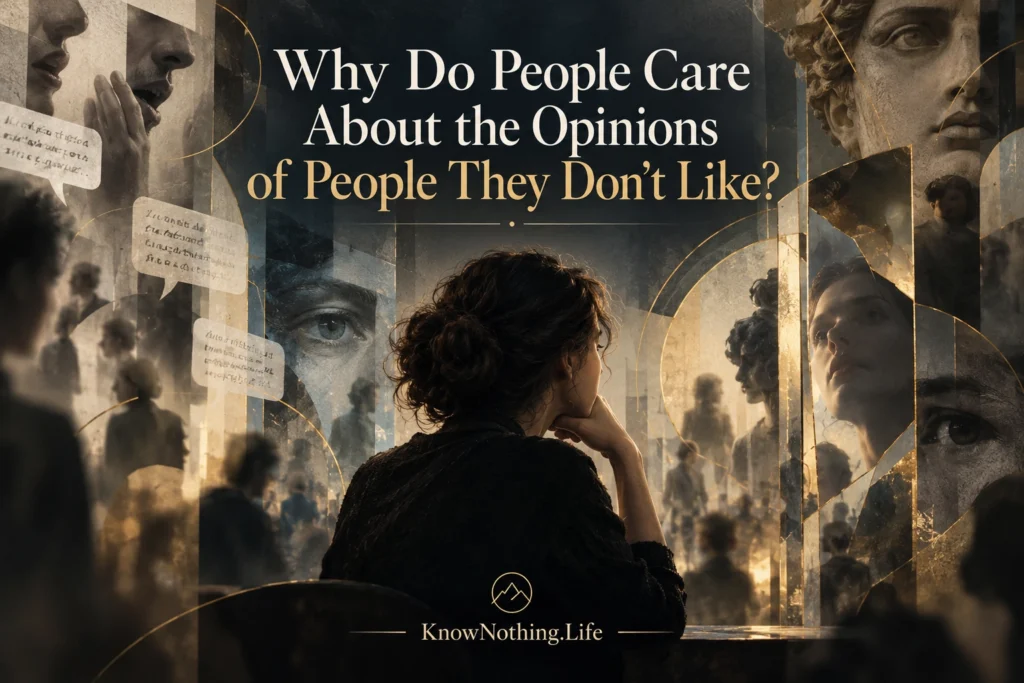
It seems irrational that someone we dislike can still get under our skin. We may consider a person rude, shallow, dishonest, arrogant, or simply incompatible with us, yet their criticism can replay in our minds for hours. A dismissive comment from a stranger may bother us more than praise from several people we respect. An insult from someone whose judgment we consciously reject can still trigger embarrassment, anger, defensiveness, or the sudden urge to prove them wrong. The puzzle is obvious: if we do not value the person, why should we value their opinion?
The answer is that human beings do not evaluate social judgment only by asking whether we like the person doing the judging. Our minds also monitor belonging, reputation, status, identity, fairness, and how we appear from perspectives outside our own. Philosophers recognized this long before modern psychology. David Hume wrote about the “love of fame,” Adam Smith analyzed our dependence on spectators, the Stoics warned against surrendering tranquility to reputation, and Jean-Paul Sartre examined the unsettling experience of seeing ourselves through another person’s gaze. Modern research on belonging, ostracism, social evaluation, and self-esteem reaches a similar conclusion: we care about other people’s opinions partly because social judgment has consequences far beyond affection.
We Are Built to Care About Social Evaluation
Human beings are an unusually social species. For most of human history, survival depended heavily on other people—for protection, food sharing, cooperation, child-rearing, information, and access to a group. Being regarded as trustworthy, competent, useful, or acceptable could therefore matter materially. Modern evolutionary accounts of cooperation continue to emphasize reputation as an important mechanism through which people decide whom to trust, help, punish, or choose as partners. In systems of indirect reciprocity, what one person thinks of you can matter because that judgment may influence how other people treat you later. Reputation is not merely vanity; in social groups it can function as information with real consequences.
This helps explain why dislike does not automatically switch off concern. Your brain does not simply ask, Do I admire this person? It may also ask, Can this person damage my standing? Does their criticism contain information? Will other people believe them? Are they seeing something others see too? Roy Baumeister and Mark Leary‘s influential 1995 review argued that the desire to form and maintain stable interpersonal bonds is a fundamental human motivation. Mark Leary and colleagues’ sociometer theory went further, proposing that self-esteem partly functions as a monitor of social inclusion and exclusion. Even people we dislike can activate that system because they remain members of the social environment capable of accepting, rejecting, judging, or influencing us.
Hume and Smith: Other People Help Construct the Self
The philosopher David Hume understood this problem remarkably well. In A Treatise of Human Nature, he devoted an entire section to what he called the “love of fame.” Hume argued that the opinions of others exert enormous influence over pride and humility. He wrote that “Our reputation, our character, our name” carry tremendous psychological weight and observed that even sensible people find it difficult to remain entirely unmoved by the judgments surrounding them. For Hume, this was not an accidental weakness. Human beings are creatures of sympathy: other people’s attitudes enter our own emotional life.
Adam Smith developed a related idea in The Theory of Moral Sentiments. Smith argued that people learn to judge themselves partly by imaginatively taking the standpoint of a spectator. We gradually internalize social evaluation and form what he famously called the impartial spectator, an imagined viewpoint from which we assess our own conduct. Smith noted how strongly people desire “the love, the gratitude, the admiration of mankind.” The implication is profound: the social audience does not remain outside us. Over time, we build part of our self-understanding by anticipating how we appear to others. That machinery does not disappear simply because the current spectator is someone we dislike.
The Person You Dislike May Still Be Holding Up a Mirror
Sometimes criticism hurts because it collides with an uncertainty we already carry. If a person insults you in a way that seems completely absurd, it may be easy to dismiss. But if they accuse you of something you privately fear might be true—being selfish, unintelligent, insecure, boring, incompetent, unattractive, or difficult—the source suddenly matters less than the possibility that the criticism has discovered something real. The mind begins investigating: Why did they say that? Has anyone else thought it? Am I missing something about myself?
Psychologists call beliefs about how others see us metaperceptions. Research suggests that people possess some genuine insight into their reputations, although they are far from perfectly accurate. David Kenny and Bella DePaulo reviewed studies showing that people are generally better at estimating how others see them overall than at predicting the unique impression held by one particular person. Later work by Erika Carlson, Simine Vazire, and R. Michael Furr similarly found that people can distinguish, at least to some degree, between their own self-view and others’ perceptions of them. A disliked critic can therefore become psychologically compelling because their judgment raises an epistemic question: What if this is information about me rather than merely information about them?
This is one reason the phrase “I don’t care what they think” can be sincere at one level and false at another. You may not want the critic’s friendship, approval, or values, yet still care whether they have accurately identified a weakness. The desire to know ourselves is different from the desire to be liked. Even negative feedback can feel important when it appears relevant to a self-concept we are trying to protect, revise, or understand.
Sartre and the Disturbing Power of Being Seen
Jean-Paul Sartre gave this experience one of its deepest philosophical interpretations in Being and Nothingness. In his analysis of the Look, Sartre argues that another person’s gaze changes the structure of self-consciousness. I normally experience myself from the inside—as the one who acts, chooses, intends, and interprets. But when another person sees me, I also become an object in their world. Their judgment can define me in ways I cannot completely control. Sartre’s famous discussions of shame arise from this unsettling discovery: another consciousness is capable of seeing a version of me that exists independently of my preferred self-description.
That explains why the opinion of an enemy may sometimes bother us more than the opinion of a friend. Friends often interpret us charitably. Someone who dislikes us may not. Their view feels uncontrolled, unfiltered, and beyond our ability to negotiate. Sartre regarded relations between consciousnesses as fundamentally tense because each person is simultaneously a subject trying to define the world and an object appearing within someone else’s definition of it. We may reject another person’s verdict, but we cannot erase the fact that the verdict exists. This is a deeper problem than wanting to be popular. It is the uncomfortable realization that we do not have exclusive authorship over who we are socially.
Negative Opinions Receive Disproportionate Attention
Another piece of the puzzle is that negative information often captures attention more readily than positive information. Studies of attention have repeatedly found that negative stimuli can receive preferential processing, although the effect depends on context. From an adaptive perspective this makes sense: ten people thinking you are harmless may be less urgent than one person who appears hostile, because potential threats demand investigation. A compliment usually requires no response. Criticism may require correction, defense, withdrawal, or preparation.
Social judgment can also produce measurable stress responses. Sally Dickerson and Margaret Kemeny’s major meta-analysis of 208 laboratory studies found that tasks involving social-evaluative threat—situations in which important aspects of the self could be negatively judged by others—were especially likely to produce cortisol responses. The strongest responses occurred when social evaluation was combined with uncontrollability. This matters because a hostile person’s opinion often contains exactly those ingredients: someone is judging you, and you cannot fully control what they conclude. The nervous system may therefore react before your reflective mind has finished deciding that the person’s opinion “shouldn’t matter.”
Rejection Hurts Even When We Do Not Want the Rejecter
Research on ostracism makes the paradox even clearer. Kipling Williams’ extensive work shows that being excluded threatens several basic psychological needs, including belonging, self-esteem, control, and meaningful existence. A meta-analysis of 120 Cyberball studies involving 11,869 participants found a large average effect of experimental ostracism across many different conditions. The human response to exclusion appears fast and relatively indiscriminate.
Perhaps most revealingly, acknowledgment can matter even when it is unpleasant. In four studies, researchers found that acknowledgment following ostracism improved need satisfaction—even when the acknowledgment itself was hostile. Being negatively noticed could, under some conditions, feel psychologically preferable to being completely ignored. That finding helps explain why the opinion of someone we dislike can remain strangely powerful. We are not merely approval-seeking organisms. We are recognition-seeking organisms. To be judged negatively is painful, but to be treated as socially nonexistent can be painful in another way.
Sometimes We Care Because We Want the Critic to Be Wrong
There is also a form of concern that has very little to do with wanting approval. Sometimes we obsess over a disliked person’s opinion because we want to defeat it. If someone we admire misunderstands us, we may want reconciliation. If someone we dislike misunderstands us, we may want vindication. The emotional goal is different, but the person still occupies attention. We imagine conversations, prepare rebuttals, collect evidence, or fantasize about future success proving them mistaken. Ironically, the desire not to care can become a new form of caring.
Leon Festinger‘s classic theory of social comparison helps explain part of this process. People frequently evaluate themselves relative to others when objective standards are unclear. The people used as comparison targets do not have to be loved. Rivals, competitors, critics, coworkers, former partners, and ideological opponents can all become psychologically important because they provide reference points. Once someone becomes a reference point, their judgments can influence self-evaluation even if the relationship is antagonistic.
Criticism can become especially sticky when it touches an unstable self-belief. Research associated with self-verification theory, developed by William Swann and others, suggests that people sometimes seek or attend to feedback that confirms existing self-conceptions—even when those self-conceptions are negative. The literature is debated and should not be interpreted to mean that everyone secretly wants criticism, but it demonstrates a counterintuitive point: people are not motivated only by praise. They also care about whether social feedback feels coherent with what they already believe about themselves.
The Stoic Answer: Reputation Is Not Yours to Control
The Stoics confronted this problem directly. Epictetus opens the Enchiridion by distinguishing what is within our control from what is not. Our judgments, intentions, and choices belong to us; external things—including “reputation”—do not. His argument is not that reputation has no practical consequences. It is that psychological dependence on controlling other people’s judgments places our tranquility in hands that are not ours. If peace requires everyone to understand us correctly, respect us, or approve of us, then peace becomes nearly impossible.
Yet the Stoic solution is subtler than “never care what anyone thinks.” Human beings need feedback. Other people sometimes see faults that we cannot. Reputation can affect work, relationships, and social trust. A rational person therefore distinguishes between using another person’s judgment as evidence and granting that judgment authority over one’s worth. The first is compatible with wisdom; the second is what the Stoics resist. A critic can contain useful information without becoming your judge, jury, and definition.
The Goal Is Not to Become Completely Indifferent
Total indifference to others would not be psychological maturity. Someone who genuinely cared nothing about anyone’s judgment would also lose important sources of moral correction, empathy, cooperation, and self-knowledge. Hume and Smith understood that sensitivity to social evaluation helps create moral communities. Modern research similarly shows that reputation and social image contribute to cooperation. Concern about what others think is therefore not merely insecurity; it is part of the machinery that makes social life possible.
The healthier goal is selective concern. Ask whether the person has knowledge relevant to the criticism. Ask whether independent evidence supports it. Ask whether you would take the same claim seriously if it came from someone you respected. Ask whether the judgment threatens your values or merely your pride. Most importantly, separate being disliked from being wrong. Sometimes an enemy sees something accurately. Sometimes a friend does not. Truth does not inherit the character of the person who speaks it.
So why do people care about the opinions of people they don’t like? Because the human mind was never designed to treat social judgment as meaningless simply because its source is unpleasant. Other people’s opinions can signal rejection, reputational danger, identity threat, hidden information, competition, or the existence of a version of ourselves that we cannot completely control. Hume saw reputation entering pride, Smith placed the spectator inside moral consciousness, Sartre showed how the Other’s gaze turns us into objects, and Epictetus warned against allowing reputation to govern inner life.
The philosophical challenge is therefore not learning to say, “I don’t care what anyone thinks.” It is learning to say something more difficult: “I will consider what you think without letting it decide who I am.”