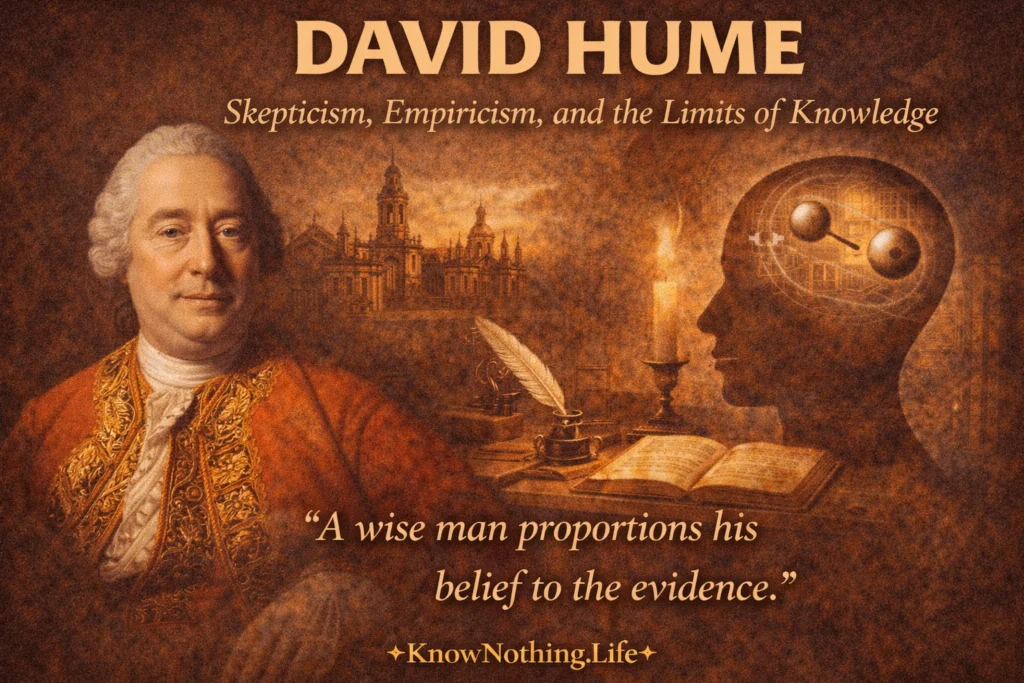
The philosophy of David Hume represents one of the most influential and unsettling developments in Enlightenment thought. Known for his rigorous skepticism and commitment to empiricism, Hume challenged the foundations of knowledge, causation, and even the self. His work forced philosophers to confront a troubling possibility: that many of the beliefs we take for granted may lack rational justification.
Born in 1711 in Edinburgh, Hume emerged during a period defined by confidence in reason and scientific progress. Yet rather than reinforcing this optimism, he turned a critical eye toward the limits of human understanding. His philosophy does not reject knowledge outright, but it reveals how much of it rests on habit, custom, and psychological tendencies rather than logical certainty.
Early Life and Intellectual Formation
Hume’s early life was marked by intellectual intensity and personal independence. He entered the University of Edinburgh at a young age, where he studied classics, philosophy, and science. However, he soon abandoned formal education, choosing instead to pursue his own course of study. This decision reflects his broader approach to philosophy—one that prioritized independent inquiry over established systems.
During his early twenties, Hume experienced what he later described as a “philosophical breakthrough,” developing ideas that would form the basis of his first major work. He spent several years in France, where he wrote and refined these ideas in relative isolation. This period of intense reflection culminated in a work that would challenge the intellectual landscape of his time.
Despite his intellectual achievements, Hume struggled to gain recognition early in his career. His ideas were often seen as controversial or even dangerous, particularly in their implications for religion and metaphysics. Nevertheless, he persisted, continuing to develop and refine his philosophy.
A Treatise of Human Nature
Hume’s first major work, A Treatise of Human Nature, represents a bold attempt to apply empirical methods to the study of human psychology. In this work, he argues that all knowledge is derived from experience, distinguishing between impressions (direct sensory experiences) and ideas (faint copies of impressions).
This distinction forms the foundation of his empiricism. For Hume, the mind does not possess innate ideas; it constructs knowledge from sensory input. This perspective challenges rationalist philosophies that emphasize the role of reason independent of experience. By grounding knowledge in perception, Hume redefines the scope and limits of human understanding.
Despite its originality, the Treatise was initially unsuccessful, receiving little attention upon publication. Hume later remarked that it “fell dead-born from the press.” However, its ideas would later gain recognition and influence, shaping the course of modern philosophy.
Skepticism and the Problem of Causation
One of Hume’s most significant contributions is his analysis of causation. He argues that we do not perceive causation directly; instead, we observe sequences of events and develop expectations based on repeated patterns. For example, we see one billiard ball strike another and expect the second to move, but we do not perceive a necessary connection between the two events.
This insight leads to what is known as the problem of induction. Hume questions how we can justify the assumption that the future will resemble the past. While we rely on this assumption in everyday life, he argues that it cannot be logically proven. Our belief in causation, therefore, is not based on reason, but on habit.
Hume’s skepticism extends beyond causation to other areas of knowledge, including the existence of the self. He suggests that the self is not a fixed entity, but a bundle of perceptions that change over time. This view challenges traditional notions of identity and continuity, raising profound questions about the nature of human existence.
Religion and Critique of Belief
Hume’s philosophy also includes a critical examination of religion. In works such as Dialogues Concerning Natural Religion, he explores arguments for the existence of God, particularly the design argument. While he does not outright deny the possibility of a divine being, he challenges the assumption that the complexity of the universe necessarily implies a designer.
He also examines the role of miracles in religious belief, arguing that extraordinary claims require extraordinary evidence. Since miracles contradict the regularity of natural laws, he maintains that they are inherently less credible than the evidence against them. This approach reflects his broader commitment to empirical reasoning.
Hume’s critique of religion was controversial in his time and contributed to his reputation as a skeptic. However, his arguments are not purely destructive; they aim to clarify the limits of human knowledge and encourage a more critical approach to belief.
Quotes and Key Ideas
Hume’s writings contain statements that capture the depth and subtlety of his thought. Among his most notable quotes:
- “Reason is, and ought only to be the slave of the passions.”
- “Custom is the great guide of human life.”
- “A wise man proportions his belief to the evidence.”
- “The life of man is of no greater importance to the universe than that of an oyster.”
These quotes reflect his emphasis on the role of emotion, habit, and evidence in shaping human behavior and belief. They reveal a philosophy that is both skeptical and grounded in observation.
Hume’s key ideas—empiricism, skepticism, the problem of induction, and the bundle theory of the self—have had a lasting impact on philosophy. They continue to influence discussions in epistemology, psychology, and the philosophy of science.
Later Works and Recognition
Following the limited success of the Treatise, Hume sought to present his ideas in a more accessible form. Works such as An Enquiry Concerning Human Understanding and An Enquiry Concerning the Principles of Morals refined and clarified his arguments, reaching a wider audience.
In addition to his philosophical writings, Hume achieved success as a historian. His History of England became widely read and established his reputation as a leading intellectual figure. This success provided him with both financial stability and broader recognition.
Despite ongoing criticism, Hume’s work gradually gained acceptance and influence. His ideas were taken seriously by later philosophers, including Immanuel Kant, who credited Hume with awakening him from his “dogmatic slumber.”
Legacy and Influence
Hume’s influence on modern philosophy is profound. His skepticism forced subsequent thinkers to address the limitations of human knowledge and the foundations of belief. His work laid the groundwork for developments in empiricism, analytic philosophy, and the philosophy of science.
In psychology, his emphasis on habit and association anticipated later theories of learning and cognition. His insights into human behavior remain relevant in contemporary discussions of decision-making and perception.
Hume’s legacy is not limited to philosophy. His ideas have shaped broader intellectual traditions, encouraging a critical and evidence-based approach to knowledge. His work continues to challenge assumptions and inspire inquiry.
Conclusion
David Hume stands as one of the most important and challenging thinkers of the Enlightenment. His philosophy reveals the limits of reason and the role of experience in shaping knowledge, offering a perspective that is both skeptical and deeply insightful. Through his analysis of causation, belief, and the self, Hume invites us to reconsider the foundations of our understanding.
His work does not provide definitive answers, but it encourages a more critical and reflective approach to the world. In an era defined by uncertainty and complexity, Hume’s insights remain as relevant as ever. They remind us that knowledge is not absolute, but constructed—and that understanding requires both curiosity and humility.