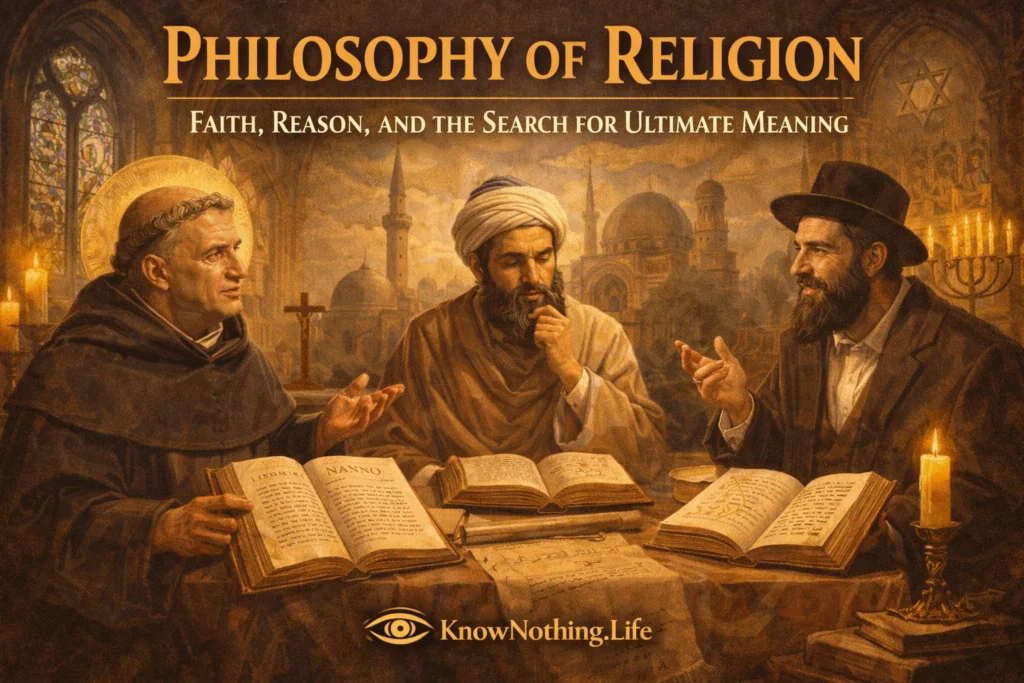
The philosophy of religion is a branch of philosophy concerned with the fundamental questions surrounding religious belief, practice, and experience. It explores issues such as the existence and nature of God, the relationship between faith and reason, the problem of evil, and the meaning of religious language. Unlike theology, which often begins from within a particular religious tradition, the philosophy of religion approaches these questions through critical analysis and rational argument, seeking clarity and coherence across different perspectives.
At its core, the philosophy of religion examines how human beings make sense of the transcendent. It asks whether religious beliefs can be justified, whether they are compatible with reason and evidence, and what role they play in shaping human life. These questions are not merely abstract; they touch on deeply personal and cultural concerns, influencing ethics, politics, and identity. By engaging with diverse traditions and arguments, the philosophy of religion provides a framework for understanding one of the most enduring aspects of human experience.
Arguments for the Existence of God
One of the central concerns of the philosophy of religion is the question of whether God exists. Throughout history, philosophers have developed a range of arguments attempting to demonstrate the existence of a divine being. Among the most influential is the ontological argument, first articulated by Anselm of Canterbury in Proslogion. Anselm argues that God, defined as the greatest conceivable being, must exist in reality because existence in reality is greater than existence in the mind alone.
Another major line of reasoning is the cosmological argument, which seeks to explain the existence of the universe. Thomas Aquinas develops several versions of this argument in Summa Theologica, particularly in his “Five Ways.” Aquinas contends that the chain of causes in the universe must ultimately lead to a first cause, which he identifies as God. This argument emphasizes the need for an explanation of existence itself.
The teleological, or design, argument focuses on the apparent order and purpose in the natural world. William Paley famously compares the universe to a watch, arguing in Natural Theology that just as a watch implies a watchmaker, the complexity of nature implies a designer. While these arguments have been subject to extensive debate and criticism, they remain central to discussions about the rational basis of religious belief.
Faith and Reason
The relationship between faith and reason is a defining issue in the philosophy of religion. Some thinkers argue that faith and reason are compatible, while others see them as fundamentally distinct or even opposed. Augustine of Hippo famously suggests that belief precedes understanding, asserting, “I believe in order to understand.” For Augustine, faith provides a foundation upon which reason can build.
Thomas Aquinas offers a more integrated view, arguing that reason can demonstrate certain truths about God while revelation provides knowledge beyond human comprehension. This perspective reflects the scholastic effort to harmonize philosophical inquiry with religious doctrine, emphasizing the complementary roles of faith and reason.
In contrast, Søren Kierkegaard emphasizes the subjective and existential nature of faith. In works such as Fear and Trembling, he argues that faith involves a “leap” beyond rational evidence, requiring personal commitment and risk. This view highlights the limits of reason in addressing religious questions, suggesting that faith operates in a different domain.
The Problem of Evil
One of the most enduring challenges to religious belief is the problem of evil: how can a benevolent, omnipotent, and omniscient God allow suffering and injustice in the world? This question has generated extensive philosophical debate, with various attempts to reconcile the existence of evil with the concept of a good God.
Augustine of Hippo addresses this issue by arguing that evil is not a substance but a privation of good—a lack or corruption of what is inherently good. This view suggests that evil arises from the misuse of free will rather than from divine creation. Augustine’s approach preserves the goodness of God while explaining the presence of evil as a consequence of human freedom.
Later thinkers, such as Gottfried Wilhelm Leibniz, develop theodicies that attempt to justify the existence of evil. In Essays on Theodicy, Leibniz argues that the world we inhabit is “the best of all possible worlds,” balancing goods and evils in a way that maximizes overall perfection. Critics, however, question whether such explanations adequately address the reality of suffering, highlighting the ongoing tension between philosophical reasoning and existential experience.
Religious Language and Meaning
Another key area of inquiry in the philosophy of religion concerns the nature of religious language. How can human language, which is limited and finite, describe a transcendent and infinite reality? Philosophers have developed various theories to address this question, examining whether religious statements are literal, metaphorical, or symbolic.
Thomas Aquinas introduces the concept of analogical language, suggesting that terms applied to God are neither entirely literal nor entirely metaphorical but function through analogy. This allows for meaningful discourse about the divine while acknowledging the limits of human understanding.
In the twentieth century, analytic philosophers such as Ludwig Wittgenstein explore the role of language in shaping meaning. In Philosophical Investigations, Wittgenstein argues that meaning arises from use within specific forms of life. This perspective suggests that religious language should be understood within the context of religious practices and communities rather than evaluated solely by empirical criteria.
Religious Experience and Evidence
Religious experience is often cited as evidence for the existence of the divine, raising questions about its reliability and significance. Experiences of awe, transcendence, or encounter with the sacred are reported across cultures, suggesting a universal dimension of human consciousness. Philosophers examine whether these experiences provide valid grounds for belief or whether they can be explained through psychological or cultural factors.
William James, in The Varieties of Religious Experience, analyzes a wide range of religious experiences, emphasizing their transformative effects on individuals. James argues that the value of these experiences lies in their practical consequences, suggesting that their truth may be assessed in terms of their impact on human life.
Skeptics, however, question the evidential value of religious experience, pointing to the diversity and inconsistency of such experiences across traditions. These debates highlight the complexity of evaluating subjective phenomena and the challenges of integrating them into philosophical arguments.
Contemporary Debates in Philosophy of Religion
In the modern era, the philosophy of religion continues to evolve, addressing new challenges and perspectives. Debates about the compatibility of religion with science, the nature of secularism, and the role of religion in public life reflect changing cultural and intellectual contexts. Philosophers engage with issues such as religious pluralism, exploring how different traditions can coexist and whether any single perspective can claim ultimate truth.
Contemporary discussions also examine the ethical implications of religious belief, including questions about morality, human rights, and social justice. These debates highlight the ongoing relevance of the philosophy of religion, demonstrating its capacity to address both timeless questions and contemporary concerns.
The diversity of approaches within the field reflects its complexity and richness. From analytic philosophy to existential and phenomenological perspectives, the philosophy of religion continues to offer insights into the nature of belief and the human search for meaning.
The Enduring Significance of the Philosophy of Religion
The philosophy of religion remains a vital area of inquiry because it addresses some of the most profound questions about existence, meaning, and value. By examining the foundations of religious belief, it provides a framework for understanding the role of religion in human life and its impact on culture and society.
At the same time, the philosophy of religion encourages critical reflection, inviting individuals to question assumptions and engage with diverse perspectives. Its emphasis on reasoned argument and open inquiry ensures that discussions about religion remain dynamic and evolving.
Ultimately, the philosophy of religion is not merely about proving or disproving the existence of God. It is about exploring the ways in which human beings seek to understand the ultimate nature of reality and their place within it. Through this exploration, it continues to illuminate the complexities of belief and the enduring quest for truth.