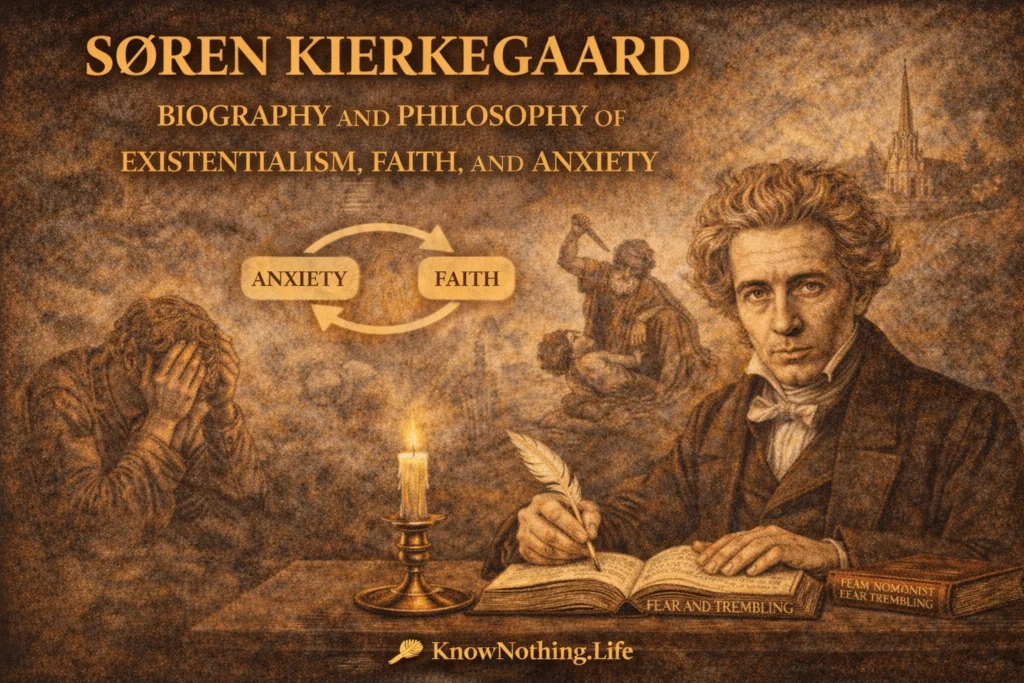
Few thinkers have explored the inner life of the individual with as much intensity and originality as Søren Kierkegaard. Often regarded as the father of existentialism, Kierkegaard challenged the abstract systems of his time, insisting that truth is not merely something to be understood intellectually, but something to be lived. His philosophy centers on the individual—on choice, responsibility, and the deeply personal nature of existence.
Writing in 19th-century Denmark, Kierkegaard reacted against the dominant philosophical system of Georg Wilhelm Friedrich Hegel, which sought to explain reality through universal structures. Kierkegaard rejected this approach, arguing that it overlooked the most important aspect of human life: the subjective experience of being an individual. His work continues to resonate because it speaks directly to the anxieties, dilemmas, and decisions that define human existence.
Early Life and Personal Struggles
Søren Kierkegaard was born in 1813 in Copenhagen into a deeply religious and introspective household. His father, Michael Kierkegaard, was a stern and melancholic figure who instilled in his son a profound sense of guilt, responsibility, and spiritual seriousness. This upbringing left a lasting imprint on Kierkegaard’s thought, shaping his preoccupation with sin, faith, and the inner life.
Kierkegaard’s early years were marked by intellectual brilliance and emotional complexity. He pursued studies in theology at the University of Copenhagen, yet his interests extended far beyond formal academic disciplines. He immersed himself in philosophy, literature, and psychology, developing a style of writing that blended rigorous analysis with literary creativity.
One of the most defining events of Kierkegaard’s life was his broken engagement to Regine Olsen. This personal decision, which he regarded as necessary for his intellectual and spiritual mission, became a central theme in his work. It exemplified the tension between personal desire and higher purpose, a conflict that would recur throughout his philosophy.
The Critique of Systematic Philosophy
Kierkegaard’s philosophy is often understood as a reaction against the systematic ambitions of thinkers like Hegel. While Hegel sought to construct a comprehensive account of reality, Kierkegaard argued that such systems fail to capture the lived experience of individuals. For him, truth is not an objective structure to be discovered, but a subjective reality to be embraced.
This emphasis on subjectivity is encapsulated in one of his most famous statements: “Subjectivity is truth.” By this, Kierkegaard did not mean that all opinions are equally valid, but that the most important truths—those concerning existence, faith, and meaning—must be experienced personally. They cannot be reduced to abstract propositions or universal laws.
Kierkegaard’s critique extends beyond philosophy to encompass society as a whole. He believed that modern life encourages conformity and superficiality, discouraging individuals from confronting the deeper questions of existence. His work calls for a return to authenticity, urging individuals to take responsibility for their own lives and beliefs.
Major Works and Philosophical Contributions
Kierkegaard’s ideas are expressed through a series of works that combine philosophical insight with literary innovation. In Either/Or, he explores the contrast between two modes of life: the aesthetic, characterized by pleasure and immediacy, and the ethical, defined by commitment and responsibility. This work introduces the idea that individuals must choose how they live, a choice that shapes their entire existence.
Another central text, Fear and Trembling, examines the nature of faith through the story of Abraham. Kierkegaard presents faith as a paradox that transcends rational understanding, requiring a “leap” beyond the limits of reason. This concept of the leap of faith has become one of his most enduring contributions.
In The Sickness Unto Death, Kierkegaard delves into the nature of despair, describing it as a condition of the self that arises from a failure to reconcile different aspects of identity. Across these works, Kierkegaard develops a rich and multifaceted account of human existence, emphasizing the importance of choice, faith, and self-understanding.
The Stages of Life: Aesthetic, Ethical, and Religious
One of Kierkegaard’s most influential ideas is his theory of the stages of life, which describes different ways of existing. The aesthetic stage is characterized by the pursuit of pleasure and avoidance of commitment. Individuals in this stage seek immediate satisfaction, often leading to a sense of emptiness and dissatisfaction.
The ethical stage represents a higher level of existence, in which individuals commit to moral principles and take responsibility for their actions. This stage involves a recognition of duty and the importance of consistency in one’s life. However, Kierkegaard believed that even the ethical stage is not the ultimate form of existence.
The highest stage is the religious, which involves a personal relationship with the divine that transcends both aesthetic pleasure and ethical duty. This stage requires a leap of faith, embracing the paradoxes and uncertainties of religious belief. Through this progression, Kierkegaard illustrates the complexity of human development and the challenges of achieving authentic existence.
Anxiety, Despair, and the Human Condition
Kierkegaard’s exploration of anxiety and despair offers a profound insight into the human condition. He viewed anxiety not as a purely negative experience, but as a reflection of human freedom. Anxiety arises from the awareness of possibility—the realization that we are free to choose and that our choices have consequences.
In this sense, anxiety is both a burden and an opportunity. It reveals the depth of human freedom, while also confronting individuals with the responsibility that comes with it. Kierkegaard’s analysis anticipates modern existentialist thought, highlighting the tension between freedom and uncertainty.
Despair, on the other hand, is a condition in which individuals fail to fully become themselves. It arises when there is a disconnect between who we are and who we ought to be. Kierkegaard’s examination of despair is both philosophical and psychological, offering a nuanced understanding of the struggles that define human life.
Faith, Paradox, and the Leap
Faith occupies a central place in Kierkegaard’s philosophy, yet it is not presented as a simple or straightforward concept. For Kierkegaard, faith involves embracing paradox and uncertainty, going beyond what can be justified by reason alone. This idea is most vividly illustrated in his analysis of Abraham’s willingness to sacrifice his son, an act that defies ethical norms yet exemplifies absolute faith.
Kierkegaard’s notion of the “leap of faith” captures this movement beyond rationality. It is not a rejection of reason, but an acknowledgment of its limits. Faith requires a personal commitment that cannot be fully explained or justified, making it both deeply individual and profoundly challenging.
This conception of faith has had a lasting impact on theology and philosophy, influencing thinkers who grapple with the relationship between reason and belief. Kierkegaard’s emphasis on the personal nature of faith underscores his broader commitment to individuality and authenticity.
Legacy and Influence
Søren Kierkegaard’s influence extends far beyond his own time, shaping the development of existentialism and modern philosophy. Thinkers such as Jean-Paul Sartre and Martin Heidegger drew on his ideas to explore questions of existence, freedom, and meaning.
Kierkegaard’s impact is also evident in theology, where his emphasis on personal faith and the limitations of reason has inspired new approaches to religious thought. His work continues to resonate with readers who seek to understand the complexities of human existence, offering insights that remain relevant in contemporary discussions.
Despite the challenges posed by his writing, Kierkegaard’s ideas have endured because they address fundamental aspects of the human experience. His focus on individuality, choice, and the inner life ensures that his philosophy remains a vital and influential force.
Final Thoughts
Søren Kierkegaard stands as one of the most profound and original thinkers in the history of philosophy. His exploration of subjectivity, faith, and the human condition offers a powerful alternative to abstract and impersonal systems of thought. By emphasizing the importance of lived experience, he invites readers to engage with philosophy not as a distant discipline, but as a deeply personal endeavor.
His famous assertion that “life can only be understood backwards; but it must be lived forwards” captures the essence of his philosophy. Kierkegaard challenges us to confront the uncertainties of existence with courage and authenticity, recognizing that meaning is not given, but created through the choices we make.