The philosophy of Jean-Paul Sartre stands as one of the most powerful expressions of human freedom and responsibility in modern thought. As the leading figure of existentialism, Sartre argued that human beings are not defined by any predetermined essence, but must create themselves through their choices. His work confronts the individual with a profound and often unsettling truth: we are entirely responsible for what we become.
Born in 1905 in Paris, Sartre lived through the upheavals of the 20th century, including two world wars and the occupation of France. These experiences shaped his philosophy, grounding it in the realities of human struggle, conflict, and moral ambiguity. His ideas extend beyond abstract theory, engaging directly with literature, politics, and everyday life.
Early Life and Intellectual Formation
Sartre’s early life was marked by intellectual intensity and a deep engagement with literature. Raised in a middle-class family, he developed a passion for reading and writing at a young age. His education at the prestigious École Normale Supérieure introduced him to a wide range of philosophical traditions, including the works of Immanuel Kant and Edmund Husserl.
A pivotal influence on Sartre’s development was Martin Heidegger, whose exploration of existence and being provided a foundation for Sartre’s own ideas. However, Sartre adapted these concepts in a distinctly human-centered direction, emphasizing freedom and choice rather than ontological structures.
During this period, Sartre formed a lifelong intellectual partnership with Simone de Beauvoir. Their relationship was both personal and philosophical, characterized by mutual influence and collaboration. Together, they explored questions of freedom, ethics, and identity, contributing to the development of existentialist thought.
Being and Nothingness
Sartre’s most important philosophical work, Being and Nothingness, presents a comprehensive analysis of human existence. In this text, he distinguishes between two modes of being: being-in-itself (the existence of objects) and being-for-itself (the existence of conscious beings).
Human consciousness, according to Sartre, is characterized by its ability to negate and transcend. Unlike objects, which simply exist, humans are aware of their own existence and can imagine possibilities beyond their current state. This capacity for self-reflection and projection defines human freedom.
Central to this analysis is the concept of “nothingness.” Sartre argues that consciousness introduces a gap between what we are and what we could be. This gap allows for freedom, but also creates anxiety, as individuals must confront the responsibility of shaping their own lives without predetermined guidance.
Freedom and Responsibility
For Sartre, freedom is not a choice—it is the fundamental condition of human existence. He famously declares that “man is condemned to be free,” meaning that we cannot escape the responsibility of making choices. Even refusing to choose is itself a choice.
This radical freedom brings with it a profound sense of responsibility. Since there are no fixed values or essences to guide us, individuals must create their own meaning through their actions. This responsibility extends beyond the individual, as our choices implicitly define what we believe humans should be.
Sartre’s emphasis on responsibility challenges the tendency to attribute actions to external forces or circumstances. He rejects excuses based on nature, society, or fate, insisting that individuals are always accountable for their choices. This perspective demands a high degree of self-awareness and ethical engagement.
Bad Faith and Authenticity
One of Sartre’s most influential concepts is “bad faith,” a form of self-deception in which individuals deny their own freedom. In bad faith, people attempt to escape responsibility by pretending that they are determined by external factors or fixed roles.
For example, a person might identify entirely with a social role, such as a waiter or a teacher, and deny their capacity to act beyond it. Sartre argues that this is a form of dishonesty, as it ignores the fundamental freedom that defines human existence.
Authenticity, in contrast, involves recognizing and embracing this freedom. It requires acknowledging the absence of predetermined meaning and taking responsibility for one’s choices. While this can be unsettling, it also offers the possibility of genuine self-creation.
Existentialism and Literature
Sartre’s philosophy is not confined to theoretical works; it is also expressed through literature, particularly in novels and plays. His novel Nausea explores the experience of existential realization, depicting a protagonist who becomes acutely aware of the contingency and absurdity of existence.
His plays, such as No Exit, dramatize existential themes, including the famous line “Hell is other people.” This statement reflects Sartre’s analysis of interpersonal relationships, where individuals become objects in the gaze of others, creating tension and conflict.
Through literature, Sartre makes his philosophical ideas accessible and vivid, illustrating the lived experience of existential concepts. His work demonstrates the power of storytelling to convey complex ideas and engage with the human condition.
Quotes and Key Ideas
Sartre’s writings include statements that capture the intensity and clarity of his thought. Among his most notable quotes:
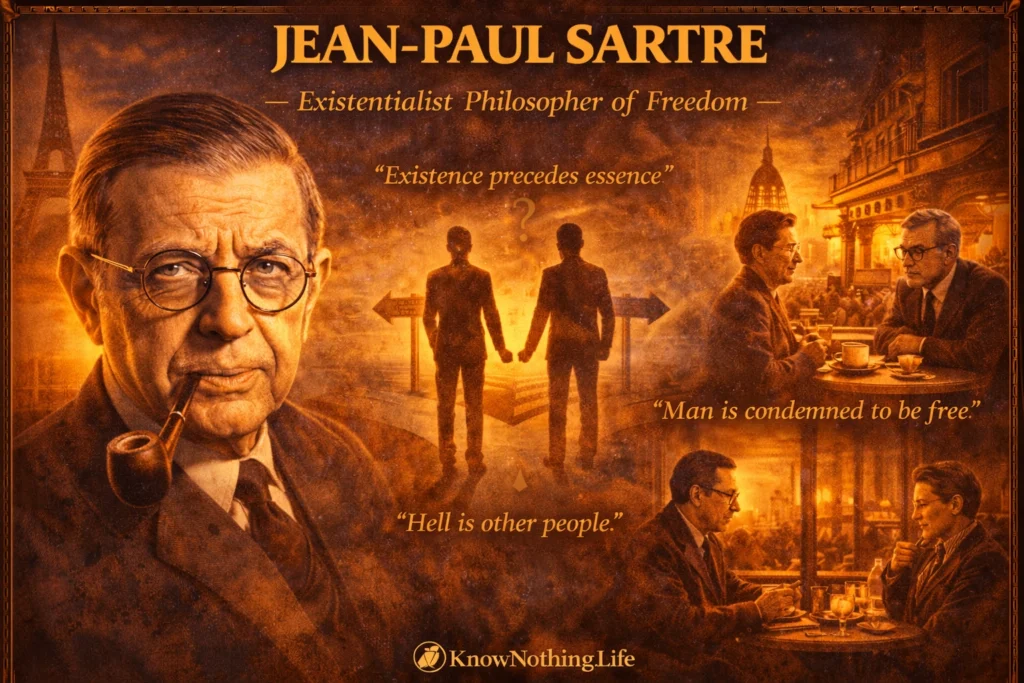
- “Existence precedes essence.”
- “Man is condemned to be free.”
- “Hell is other people.”
- “Freedom is what you do with what’s been done to you.”
These statements reflect his emphasis on freedom, responsibility, and the absence of predetermined meaning. They highlight a philosophy that challenges individuals to confront the realities of existence.
Sartre’s key ideas—existential freedom, bad faith, authenticity, and the nature of consciousness—have become central to modern philosophy. They continue to influence discussions of identity, ethics, and human behavior.
Political Engagement and Later Life
Sartre’s philosophy extends into the political realm, where he engaged with issues of social justice, colonialism, and human rights. He was an outspoken critic of oppression and inequality, using his platform to advocate for change.
His involvement in political movements reflects his belief that philosophy should not be detached from real-world concerns. For Sartre, the responsibility of the individual includes engagement with society and the pursuit of justice.
In recognition of his contributions, Sartre was awarded the Nobel Prize in Literature in 1964, which he famously declined. This decision reflects his commitment to independence and his refusal to be institutionalized or categorized.
Legacy and Influence
Sartre’s influence on philosophy, literature, and culture is profound. His ideas shaped the development of existentialism and influenced thinkers such as Albert Camus, although their relationship was marked by disagreement. Beyond philosophy, Sartre’s work has impacted psychology, political theory, and the arts.
His emphasis on freedom and responsibility resonates in contemporary discussions of identity and agency. Sartre’s legacy lies in his ability to articulate the challenges and possibilities of human existence. His work continues to inspire reflection and debate, offering insights into the nature of freedom and the human condition.
Conclusion
Jean-Paul Sartre stands as one of the most influential philosophers of the modern era, offering a powerful vision of human freedom and responsibility. His philosophy challenges individuals to confront the realities of existence, emphasizing the absence of predetermined meaning and the necessity of choice.
Through his analysis of consciousness, freedom, and authenticity, Sartre provides a framework for understanding the human condition. His work invites us to take responsibility for our lives and to engage with the world in a meaningful way.
In a world marked by uncertainty and complexity, Sartre’s ideas remain deeply relevant. They remind us that while we may not choose the conditions of our existence, we are always responsible for what we make of them.