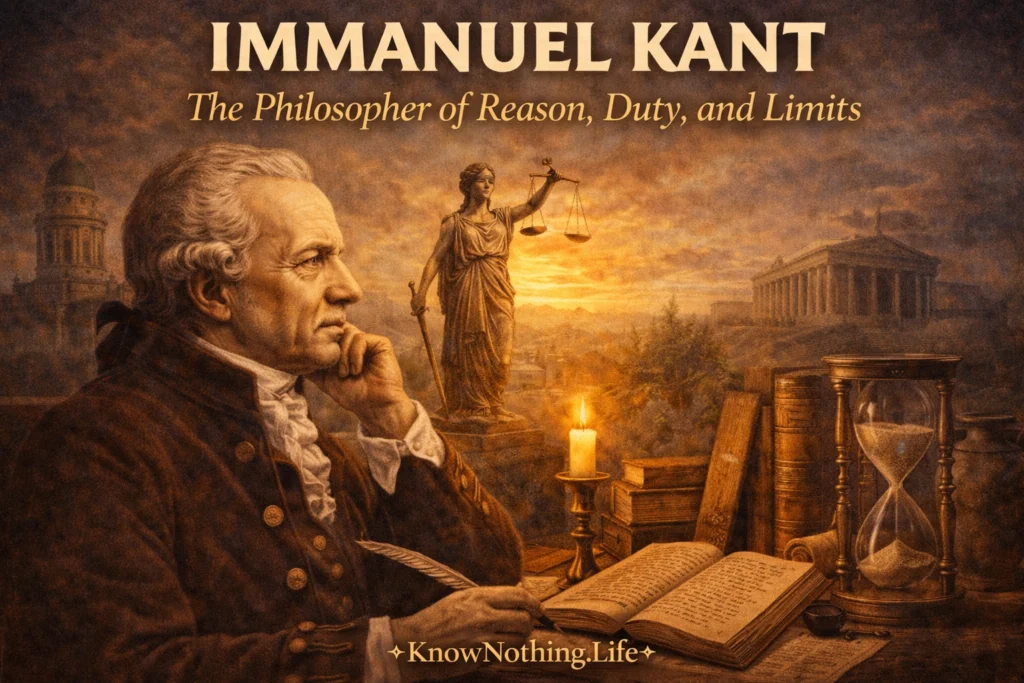
The philosophy of Immanuel Kant represents one of the most decisive turning points in intellectual history. Writing in the late 18th century, Kant sought to answer a question that had divided thinkers for generations: how can human beings possess knowledge that is both reliable and meaningful? His work did not merely contribute to existing debates—it redefined their terms, establishing a new framework for understanding reason, morality, and the limits of human cognition.
Born in 1724 in Königsberg, Kant lived his entire life within a relatively small geographic area, yet his ideas reached far beyond it. He emerged during the Age of Enlightenment, a period marked by confidence in reason and scientific progress. However, Kant did not simply embrace Enlightenment optimism; he subjected reason itself to critical examination, asking not only what we can know, but how knowledge is possible at all. His philosophy is both ambitious and restrained—seeking certainty while acknowledging the boundaries of human understanding.
Early Life and Intellectual Development
Kant was raised in a modest, deeply religious household shaped by Pietism, a movement that emphasized personal devotion and moral discipline. This upbringing instilled in him a strong sense of duty and ethical seriousness, themes that would later become central to his moral philosophy. Despite financial limitations, he demonstrated exceptional intellectual ability and pursued studies at the University of Königsberg, where he engaged with philosophy, mathematics, and natural science.
In his early career, Kant worked as a private tutor before securing a position at the university. His initial writings focused largely on scientific and metaphysical topics, reflecting the influence of thinkers such as Isaac Newton and Gottfried Wilhelm Leibniz. During this period, he attempted to reconcile competing philosophical traditions, particularly rationalism and empiricism, which offered conflicting accounts of knowledge.
A pivotal intellectual shift occurred when Kant encountered the work of David Hume. Hume’s skepticism about causation and knowledge challenged Kant’s assumptions, leading him to famously remark that Hume “awakened me from my dogmatic slumber.” This awakening set the stage for Kant’s critical philosophy, in which he sought to resolve the tensions between reason and experience.
The Critical Philosophy and the “Copernican Revolution”
Kant’s most significant contribution lies in what he described as a philosophical “Copernican revolution.” Just as Nicolaus Copernicus transformed astronomy by placing the sun at the center of the system, Kant proposed that objects must conform to the structures of human cognition, rather than the mind conforming passively to external reality. This shift fundamentally altered the study of knowledge.
In his landmark work Critique of Pure Reason, Kant argues that human experience is shaped by innate categories of understanding—such as space, time, and causality—that organize sensory input. These structures make knowledge possible, but they also impose limits. We can know phenomena (things as they appear to us), but not noumena (things as they are in themselves). This distinction establishes both the power and the boundaries of human reason.
Kant’s critical philosophy thus occupies a middle ground between rationalism and empiricism. He rejects the idea that knowledge arises solely from reason, while also denying that it comes entirely from experience. Instead, he proposes that knowledge is a synthesis of both, structured by the mind’s inherent capacities. This framework has had a lasting impact on philosophy, influencing fields as diverse as epistemology, psychology, and cognitive science.
Major Works and Philosophical Contributions
Kant’s philosophical system is developed across several major works, each addressing different aspects of human inquiry. In addition to the Critique of Pure Reason, his ethical theory is presented in Groundwork of the Metaphysics of Morals and Critique of Practical Reason. These texts establish his theory of morality based on duty and rationality, rather than consequences or emotions.
In Critique of Judgment, Kant explores aesthetics and teleology, examining how we perceive beauty and purpose in the world. This work bridges the gap between his theoretical and practical philosophy, offering insights into art, nature, and human creativity. Together, these three critiques form a comprehensive system addressing knowledge, ethics, and judgment.
Kant’s writing style is often dense and complex, reflecting the depth of his ideas. However, his influence is undeniable. His works have shaped subsequent philosophical movements, including German Idealism, and continue to be studied as foundational texts in modern philosophy.
Ethics and the Categorical Imperative
Kant’s moral philosophy is centered on the concept of the categorical imperative, a principle that defines moral action as that which can be universally applied. Unlike hypothetical imperatives, which depend on personal goals or desires, the categorical imperative is unconditional. It demands that individuals act according to maxims that could be willed as universal laws.
One formulation of this principle states: “Act only according to that maxim whereby you can, at the same time, will that it should become a universal law.” This idea emphasizes consistency and rationality in ethical decision-making. Another formulation highlights the intrinsic value of human beings: individuals must always be treated as ends in themselves, never merely as means to an end.
Kant’s ethics represent a shift away from consequentialist thinking, focusing instead on intention and duty. For him, the moral worth of an action lies not in its outcome, but in the motive behind it. This perspective underscores the importance of autonomy and rationality, positioning morality as a matter of principle rather than preference.
Quotes and Key Ideas
Kant’s writings contain numerous statements that capture the essence of his philosophy. Among his most notable quotes:
- “Sapere aude! Have courage to use your own understanding.”
- “Two things fill the mind with ever new and increasing admiration and awe: the starry heavens above me and the moral law within me.”
- “Act in such a way that you treat humanity… always at the same time as an end and never merely as a means.”
- “Thoughts without content are empty, intuitions without concepts are blind.”
These quotes reflect the central themes of his work: intellectual independence, moral responsibility, and the interplay between reason and experience. They encapsulate his vision of philosophy as both a theoretical and practical endeavor.
Kant’s key ideas—transcendental idealism, the categorical imperative, and the limits of reason—continue to shape contemporary discussions in ethics, epistemology, and political theory. His emphasis on autonomy and dignity has influenced modern concepts of human rights and justice.
Later Life and Legacy
Kant lived a remarkably disciplined and structured life, famously adhering to a strict daily routine. He spent most of his career teaching at the University of Königsberg, where he became known for his engaging lectures and intellectual rigor. Despite his relatively quiet existence, his work attracted attention across Europe, establishing him as one of the leading thinkers of his time.
In his later years, Kant’s health declined, and he gradually withdrew from public life. He died in 1804, leaving behind a body of work that would profoundly influence future generations. His final words, reportedly “Es ist gut” (“It is good”), reflect a sense of closure consistent with his philosophical outlook.
The impact of Kant’s philosophy extends far beyond his lifetime. He inspired a generation of German Idealists, including Georg Wilhelm Friedrich Hegel and Johann Gottlieb Fichte, who sought to expand his ideas. His influence can also be seen in modern debates about ethics, knowledge, and the nature of reality.
Conclusion
Immanuel Kant stands as one of the most important figures in the history of philosophy, bridging the gap between early modern thought and contemporary intellectual inquiry. His critical philosophy redefined the limits and possibilities of human reason, offering a framework that continues to shape how we understand knowledge and experience.
Through his ethical theory, he provided a vision of morality grounded in rationality and respect for human dignity. His insistence on autonomy and universal principles remains a cornerstone of modern ethical thought. At the same time, his recognition of the limits of reason serves as a reminder that not all questions can be answered through logic alone.
Kant’s legacy is one of balance—between skepticism and certainty, freedom and duty, knowledge and humility. To engage with his philosophy is to confront the fundamental conditions of human understanding, and to recognize both the power and the limits of reason itself.