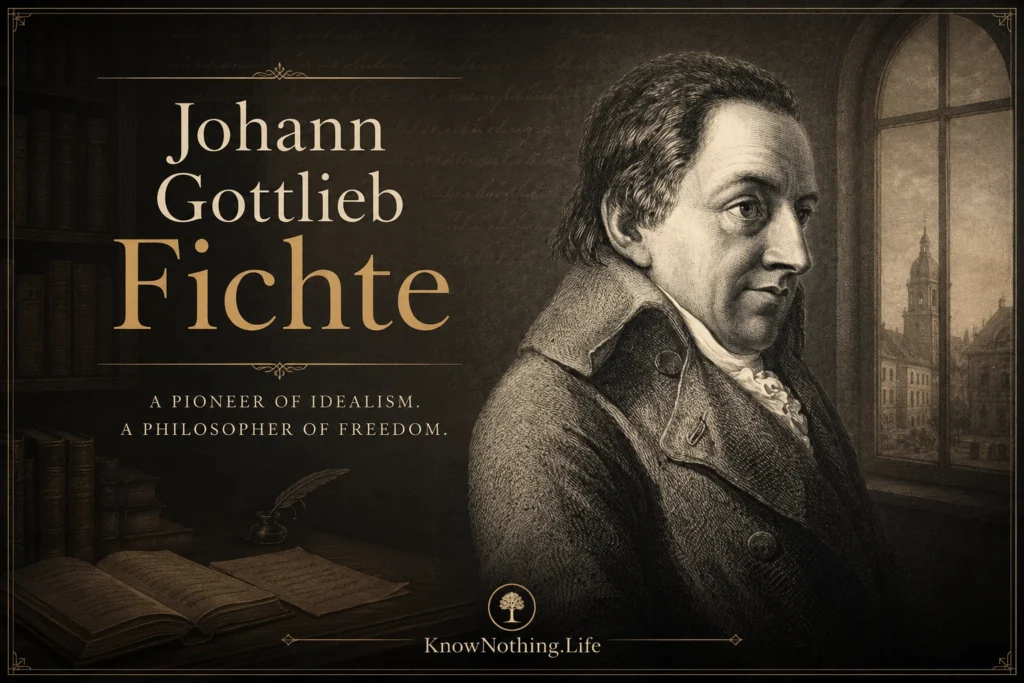
Johann Gottlieb Fichte was born on May 19, 1762, in Rammenau, a village in Saxony, into a poor and deeply religious family of ribbon weavers. His rise into philosophy was unlikely. He did not inherit wealth, rank, or academic security. According to the familiar story of his youth, his exceptional memory and intelligence attracted the attention of a local nobleman, who helped sponsor his education. Fichte was sent first to a pastor’s household, then to the famous Pforta boarding school, and later to the universities of Jena and Leipzig. His early life impressed on him a lasting sense that education was not decoration, but liberation.
After his patron’s death, Fichte’s studies were interrupted, and he was forced to earn a living as a private tutor, a profession he disliked. These years of instability mattered. Fichte’s later philosophy would treat freedom not as a comfortable abstraction, but as a moral demand placed on finite, struggling human beings. He knew dependence, poverty, humiliation, and the pressure to justify oneself. His thought was never merely theoretical. It was driven by the question of how a person can become free in a world of limitation.
Kant and Sudden Fame
Fichte’s intellectual turning point came in 1790, when he began studying Immanuel Kant. He later described this encounter as a revolution in his thinking. Before Kant, Fichte had been troubled by the conflict between moral aspiration and deterministic explanations of the world. Kant’s critical philosophy seemed to offer a way to defend freedom without abandoning rigor. Fichte saw in Kant not only a set of doctrines, but a mission: philosophy should show how moral agency is possible.
In 1791, Fichte traveled to Königsberg to meet Kant. The meeting was disappointing, but Fichte quickly wrote An Attempt at a Critique of All Revelation, a work applying Kantian principles to religion and revelation. When the book appeared anonymously in 1792, many readers initially thought Kant himself had written it. Once Fichte’s authorship became known, he was suddenly famous. The unknown tutor from Saxony had been mistaken for the greatest philosopher in Germany. That mistake opened the door to his public career.
Jena and the Wissenschaftslehre
In 1794, Fichte was called to the University of Jena, one of the major centers of German intellectual life. There he began developing the system that would make him one of the founding figures of German Idealism: the Wissenschaftslehre, usually translated as “Science of Knowledge,” “Doctrine of Science,” or simply left in German because no English phrase fully captures it. Fichte did not mean one single book by this term. He meant an entire philosophical project: a systematic account of knowledge, freedom, self-consciousness, nature, law, ethics, and religion from a single foundational standpoint.
His most important early systematic work was Foundation of the Entire Wissenschaftslehre, published in 1794–1795. Its famous starting point is the activity of the self: “the I posits itself.” This does not mean that the individual ego magically creates the world out of nothing. Fichte’s point is more subtle. Consciousness is not a passive container into which objects are dropped. Self-conscious activity is already involved in any experience of objectivity. The self is not first a thing; it is an act, a living structure of awareness, striving, and limitation.
Freedom, Selfhood, and the Moral World
Fichte’s philosophy is often difficult because it begins from the activity of the “I,” but his deepest concern was practical: freedom. He wanted to explain how human beings can be morally responsible while also existing within a world governed by necessity, objects, bodies, and social constraints. His answer was that the world we experience must be understood in relation to the activity of rational agency. Limitation is not simply an obstacle to freedom. It is the field in which freedom becomes real.
This is why Fichte could write that “the kind of philosophy one chooses depends upon the kind of person one is.” For him, philosophy was not a detached hobby. A system of thought reveals one’s orientation toward freedom, responsibility, and action. A person who begins from dead things may end in fatalism. A person who begins from moral agency can understand nature as the arena of duty. Fichte’s idealism was therefore not escapism. It was an argument that the human vocation is to shape the world according to reason.
The Scholar, Right, and Ethics
Fichte’s popular lectures Some Lectures Concerning the Scholar’s Vocation, delivered at Jena in 1794, show his view of the intellectual’s public responsibility. The scholar was not merely a specialist or career academic. The scholar was to be, in Fichte’s phrase, a “teacher of mankind,” someone devoted to truth and human improvement. In one of his most memorable declarations, he wrote, “I am a Priest of Truth; I am in her pay; I have bound myself to do all things, to venture all things, to suffer all things for her.” The sentence captures Fichte’s prophetic tone: knowledge demands courage.
During the Jena period, Fichte also extended his system into politics and ethics. Foundations of Natural Right appeared in 1796–1797, developing a theory of rights, recognition, embodiment, and social order. The System of Ethics, published in 1798, presented morality as the self’s task of determining itself freely under the demands of duty. These works show that Fichte’s idealism was never only about inner consciousness. Freedom requires institutions, mutual recognition, and disciplined action. The self becomes free not by withdrawing from the world, but by acting responsibly within it.
The Atheism Controversy
Fichte’s Jena career ended abruptly with the Atheism Controversy of 1798–1799. The dispute began after he published “On the Basis of Our Belief in a Divine Governance of the World,” where he argued that the divine should be understood in relation to the moral order rather than as an external being separate from duty. Critics accused him of atheism, and the controversy became a public scandal. German rulers threatened action against the University of Jena, and Fichte, after defending himself forcefully, was compelled to resign.
The controversy is important because it reveals both Fichte’s courage and his recklessness. He believed that philosophy had the right to clarify religion in terms of moral reason. His opponents believed he had dissolved God into ethics. Fichte did not think of himself as an atheist; he saw morality as the true access to the divine. But his language was provocative, and his temperament did not favor compromise. In 1799, he left Jena for Berlin, wounded but intellectually active.
Berlin, Popular Works, and National Addresses
In Berlin, Fichte wrote for a broader public. The Vocation of Man, published in 1800, is one of his most accessible and powerful works. Organized around doubt, knowledge, and faith, it dramatizes the movement from skepticism to moral commitment. “Not merely to know, but according to thy knowledge to do, is thy vocation,” he wrote. In another famous line, he declared, “Act! act!—it is to that end we are here.” These statements summarize the moral energy of his philosophy: thought finds its completion in action.
Fichte also wrote The Closed Commercial State in 1800, a bold and controversial work of political economy, and later delivered major popular lectures such as The Characteristics of the Present Age and The Way Towards the Blessed Life. His most politically famous work, Addresses to the German Nation, was delivered in Berlin in 1807–1808 during the French occupation after Napoleon’s victories. The speeches called for moral, cultural, and educational renewal. They later became important to the history of German nationalism, though their legacy is complex. Fichte’s call for national regeneration could inspire resistance and education, but it was also later used in ways that intensified exclusive nationalist interpretations.
Final Years and Legacy
Fichte helped found the new University of Berlin and became one of its early philosophical leaders. He continued revising the Wissenschaftslehre until the end of his life, producing later versions that shifted from the language of the self toward deeper accounts of knowing, being, and the absolute. In 1813, during the War of Liberation against Napoleon, his wife Johanna served as a nurse in a military hospital. Fichte contracted a fatal infection from her and died on January 29, 1814, in Berlin.
Johann Gottlieb Fichte’s legacy is immense. He stands between Kant and Hegel, but he should not be reduced to a bridge between greater names. He radicalized Kant’s philosophy of freedom, made self-consciousness central to German Idealism, influenced Schelling, Hegel, the Romantics, political theory, philosophy of education, and later theories of recognition. His writings can be difficult, severe, and sometimes politically troubling, but they remain alive because they ask one of philosophy’s permanent questions: what does it mean to be free? For Fichte, freedom was not a possession. It was a task. The self becomes itself only through striving, duty, truth, and action.