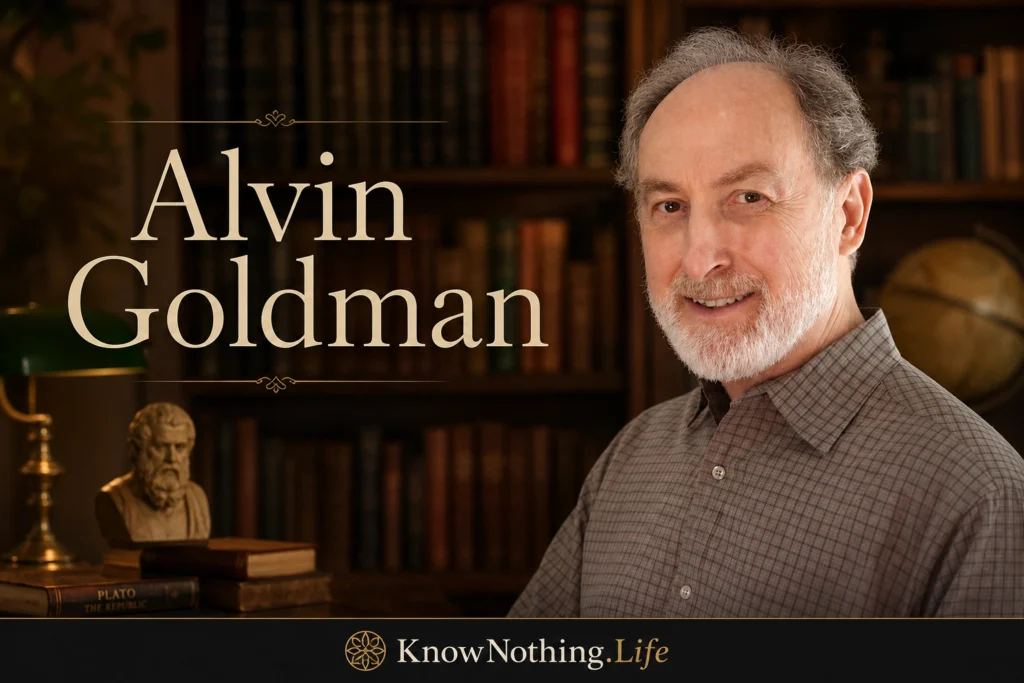
Alvin Ira Goldman was born on October 1, 1938, and became one of the most important American epistemologists of the late twentieth and early twenty-first centuries. He entered philosophy at a time when traditional theories of knowledge were under intense pressure. Edmund Gettier’s short 1963 paper had shown that justified true belief was not enough for knowledge, and philosophers were searching for a better account of what distinguishes genuine knowledge from lucky true belief. Goldman’s career would become one of the most influential responses to that problem.
Goldman earned his B.A. from Columbia University in 1960 and his Ph.D. from Princeton University in 1965. His early work already showed the pattern that would define his career: he wanted philosophy to be rigorous, but also connected to psychology, cognitive science, law, education, politics, and ordinary practices of inquiry. Unlike philosophers who treated epistemology as a purely armchair exercise, Goldman asked how actual belief-forming processes work and how they can succeed or fail in producing truth.
Action Theory and Early Philosophy
Before becoming most famous for epistemology, Goldman made an important contribution to the philosophy of action. His book A Theory of Human Action, published in 1970, examined what actions are, how they differ from mere bodily movements, and how actions can be explained. This early interest in action mattered because it connected agency, causation, intention, and responsibility. Goldman was already working against overly abstract accounts of the human mind. He wanted philosophical theories to fit the real structure of doing, choosing, perceiving, remembering, and knowing.
His action theory also prepared the way for his later epistemology. Believing is not exactly the same as acting, but beliefs have histories. They arise from perception, memory, inference, testimony, introspection, and other processes. Goldman’s key question became: which of these processes are good enough to make a belief epistemically justified or knowledgeable? That question shifted epistemology away from the inner feeling of certainty and toward the reliability of the method by which a belief is formed.
A Causal Theory of Knowing
Goldman’s 1967 paper “A Causal Theory of Knowing” was one of his early landmark works. In it, he responded to the Gettier problem by suggesting that knowledge requires an appropriate causal connection between the fact believed and the person’s belief. A belief is not knowledge merely because it is true and justified in some loose sense. It must be connected to the fact in the right way. If a person believes something true only by accident, coincidence, or misleading evidence, knowledge is absent.
Goldman described his paper as “another analysis” of “S knows that p,” one designed to avoid Gettier-style counterexamples. This causal approach did not become his final theory in exactly that form, but it marked a decisive turn. It showed Goldman’s interest in the processes by which belief is produced. Perception, memory, and inference matter because they can connect the mind to the world. Knowledge, in Goldman’s hands, became less a static relation between belief and justification and more a successful route from reality to belief.
Reliabilism and Justified Belief
Goldman’s most famous contribution is process reliabilism, developed especially in his 1979 paper “What Is Justified Belief?” and his 1986 book Epistemology and Cognition. Reliabilism holds that a belief is justified when it is produced by a reliable cognitive process, meaning a process that tends to produce true beliefs rather than false ones. Good perception in normal conditions, reliable memory, and sound reasoning are epistemically valuable because they are truth-conducive. Guessing, wishful thinking, hasty generalization, and superstition are poor because they are unreliable.
This view was revolutionary because it challenged internalism, the idea that justification depends entirely on what the subject can access from the inside. Goldman argued that a person may be justified because her belief actually arises from a reliable process, even if she cannot give a philosophical proof of that reliability. In his view, epistemology should not ignore the machinery of cognition. A theory of justification must ask how beliefs are formed, how often those methods succeed, and what makes one belief-forming process better than another.
Epistemology and Cognition
Epistemology and Cognition is one of Goldman’s major books and one of the central works of naturalized epistemology. It connected traditional questions about knowledge and justification with empirical work in psychology and cognitive science. Goldman did not reduce epistemology to psychology, but he argued that epistemology must pay attention to how the mind actually works. If the subject is human knowledge, then facts about human cognition are not optional decorations. They are central evidence.
In this book, Goldman also refined reliabilism by considering defeaters, cognitive architecture, and the difference between processes that merely produce beliefs and processes that produce them in epistemically responsible ways. He did not pretend that reliability solved every epistemological problem with one simple formula. Instead, he built a research program. The aim was to connect normative evaluation with real cognitive performance: not only what people believe, but how they come to believe it and whether those routes are truth-promoting.
Social Epistemology and Knowledge in a Social World
Goldman later became one of the leading figures in social epistemology, especially through Knowledge in a Social World, published in 1999. Traditional epistemology often pictured the knower as a solitary individual confronting the world alone. Goldman argued that this picture was incomplete. Much of what people know depends on testimony, experts, schools, courts, science, journalism, libraries, peer review, debate, technology, and public institutions. Human knowledge is deeply social.
Goldman’s social epistemology was “veritistic,” meaning that it evaluated social practices by their tendency to promote true belief and reduce error. He wrote that epistemology needs a social branch to complement its individual branch. This was not a rejection of truth in favor of social construction. It was the opposite: Goldman wanted to know which social systems actually help people find truth. Courts, media, education, scientific communities, and democratic deliberation can all be assessed by epistemic standards. Do they improve inquiry, or do they spread ignorance?
Mindreading, Simulation, and Cognitive Science
Goldman’s work also extended into philosophy of mind and cognitive science, especially through Simulating Minds: The Philosophy, Psychology, and Neuroscience of Mindreading, published in 2006. In that book, he explored how people understand the minds of others. How do we attribute beliefs, desires, emotions, intentions, and sensations to other people? Goldman became a major defender of simulation theory, the idea that we often understand others by using our own mental capacities as a model.
This work showed the interdisciplinary character of Goldman’s philosophy. He drew on developmental psychology, social psychology, neuroscience, and philosophy to explain how people grasp the mental lives of others. He did not treat empathy or mindreading as mystical powers. He asked how they operate, what evidence supports different models, and how mental attribution connects to imitation, imagination, and neural mirroring. Goldman’s later work helped make philosophy of mind more empirically engaged without surrendering philosophical clarity.
Rutgers, Later Work, and Influence
Goldman taught at the University of Michigan, the University of Illinois at Chicago, the University of Arizona, and finally Rutgers University, where he became Board of Governors Professor of Philosophy and Cognitive Science. He retired in 2018. His later books and essays continued to develop reliabilism, social epistemology, cognitive science, and interdisciplinary philosophy. Works such as Liaisons, Philosophical Applications of Cognitive Science, Pathways to Knowledge, and Reliabilism and Contemporary Epistemology show the breadth of his interests.
His influence was enormous because he changed the questions epistemologists ask. Instead of focusing only on whether a believer can defend a belief from the inside, Goldman asked whether the belief was formed by processes that connect us reliably to the world. Instead of imagining knowledge as solitary, he asked how social systems distribute truth and error. Instead of separating philosophy from cognitive science, he built bridges between them. His work helped make epistemology externalist, naturalistic, social, and practically relevant.
Death and Lasting Legacy
Alvin Goldman died on August 4, 2024. His passing marked the end of a career that helped reshape analytic philosophy across epistemology, philosophy of mind, action theory, and cognitive science. He was not merely a specialist in one technical debate. He gave philosophy a new way to think about knowledge as a living achievement of minds, methods, and institutions. Knowledge, for Goldman, was not just having the right proposition in one’s head. It was the product of reliable routes to truth.
Goldman’s lasting importance lies in his insistence that epistemology must answer to reality. Beliefs have causes, methods have track records, institutions have epistemic consequences, and minds are not detached from the processes that form them. His reliabilism remains debated, refined, and criticized, but it cannot be ignored. His social epistemology is even more urgent in an age of misinformation, algorithmic media, expertise crises, and polarized trust. Alvin Goldman remains essential because he taught philosophers to ask not only what knowledge is, but what actually helps human beings get it.