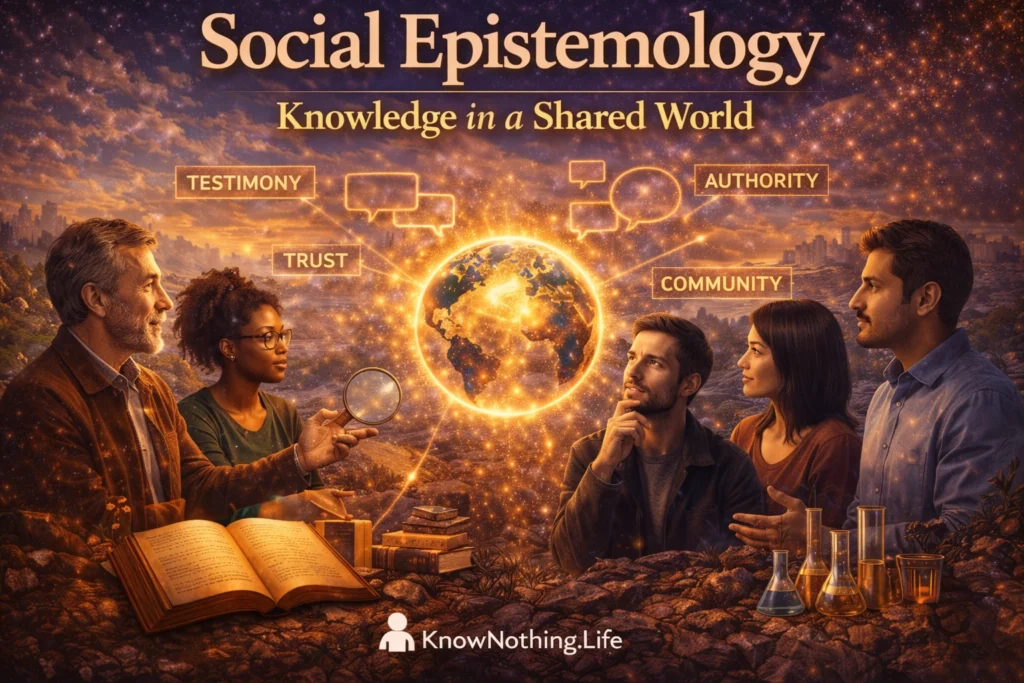
Social epistemology examines how knowledge is produced, distributed, and evaluated within social contexts. While traditional epistemology often focuses on the individual knower, social epistemology shifts attention to the collective dimensions of knowledge—how people depend on one another for information, how institutions shape belief, and how social dynamics influence what is accepted as true.
In everyday life, much of what we know does not come from direct experience or individual reasoning but from the testimony of others. We rely on experts, institutions, media, and communities to inform our beliefs about the world. This reliance raises important questions: When is testimony trustworthy? How do social structures affect the credibility of knowledge claims? What role do power and authority play in determining what is believed?
Philosophers such as Alvin Goldman, Thomas Reid, Miranda Fricker, and Jürgen Habermas have contributed to the development of social epistemology. Their work highlights the importance of understanding knowledge not as an isolated achievement but as a fundamentally social process shaped by interaction, communication, and shared practices.
The Nature of Social Knowledge
Social epistemology begins with the recognition that knowledge is often a collective achievement. Individuals rarely acquire knowledge independently; instead, they rely on information provided by others. This reliance is especially evident in areas such as science, history, and current events, where direct verification is often impossible.
Thomas Reid was one of the earliest philosophers to emphasize the importance of testimony as a source of knowledge. He argued that trust in others is a fundamental aspect of human cognition, not something that must be justified from scratch. Without this trust, the acquisition of knowledge would be severely limited.
The social nature of knowledge also raises questions about the division of epistemic labor. In complex societies, individuals specialize in different areas of expertise, making it necessary to rely on others’ knowledge. This division allows for the accumulation of vast amounts of information, but it also introduces challenges related to trust, credibility, and verification.
Testimony and Trust
Testimony is one of the central topics in social epistemology. It refers to the knowledge we gain from the statements of others. While testimony is a pervasive and indispensable source of knowledge, it also raises concerns about reliability and trustworthiness.
Philosophers have debated whether testimony requires independent justification or whether it can be accepted as a basic source of knowledge. Thomas Reid argued for the latter, suggesting that humans have a natural disposition to trust others. This view contrasts with more skeptical approaches that require evidence for the reliability of testimony.
In contemporary philosophy, Alvin Goldman has explored the role of testimony within a broader framework of social epistemology. In works such as Knowledge in a Social World, Goldman examines how information is transmitted through social networks and how individuals can evaluate the credibility of sources. His work highlights the importance of developing methods for assessing testimony in an increasingly complex information environment.
Epistemic Injustice and Power
One of the most significant developments in social epistemology is the concept of epistemic injustice, introduced by Miranda Fricker in Epistemic Injustice. Fricker argues that individuals can be wronged specifically in their capacity as knowers, often due to social power dynamics.
Fricker identifies two main types of epistemic injustice: testimonial injustice and hermeneutical injustice. Testimonial injustice occurs when a speaker’s credibility is unfairly diminished due to prejudice, while hermeneutical injustice arises when individuals lack the conceptual resources to make sense of their experiences. These forms of injustice highlight how social factors can distort the production and recognition of knowledge.
The concept of epistemic injustice underscores the importance of fairness and inclusivity in epistemic practices. It challenges the assumption that knowledge is purely objective, showing how social biases and inequalities can influence what is accepted as true. Addressing these issues requires not only philosophical analysis but also practical efforts to promote equitable participation in knowledge production.
Institutions and the Production of Knowledge
Knowledge is often produced and validated within institutions such as universities, scientific communities, and media organizations. These institutions play a crucial role in shaping what is accepted as knowledge, establishing standards of evidence, and disseminating information.
Jürgen Habermas has emphasized the importance of communication and discourse in the production of knowledge. In works such as The Theory of Communicative Action, Habermas argues that knowledge emerges through rational dialogue in which participants aim to reach mutual understanding. This ideal of communicative rationality highlights the role of open and inclusive discourse in achieving knowledge.
However, institutions are not immune to bias or error. The credibility of knowledge-producing institutions depends on their ability to maintain standards of objectivity and transparency. In an era of misinformation and declining trust, the role of institutions in social epistemology has become increasingly significant.
Collective Knowledge and Group Epistemology
Social epistemology also explores the concept of collective knowledge—the idea that groups can possess knowledge that is not reducible to the knowledge of individual members. This raises questions about how groups form beliefs, make decisions, and evaluate evidence.
Group epistemology examines phenomena such as consensus, disagreement, and collective reasoning. It considers how groups can achieve reliable outcomes through processes such as deliberation, peer review, and collaboration. These processes are central to scientific inquiry, where knowledge is often the result of collective effort.
At the same time, group dynamics can introduce challenges, such as groupthink or the spread of misinformation. Understanding how groups function epistemically is essential for addressing these issues and improving the reliability of collective knowledge.
Technology and the Modern Epistemic Landscape
The rise of digital technology has transformed the way knowledge is produced and shared, making social epistemology more relevant than ever. The internet, social media, and artificial intelligence have created new channels for information dissemination, but they have also introduced new challenges.
One of the most pressing issues is the spread of misinformation and disinformation. In a digital environment where information is abundant and easily accessible, evaluating the credibility of sources becomes increasingly difficult. Social epistemology provides tools for understanding how information spreads and how individuals can navigate complex information networks.
Philosophers such as Alvin Goldman have explored how technology affects the reliability of knowledge systems. These developments highlight the need for critical thinking, media literacy, and institutional accountability in maintaining the integrity of knowledge in the digital age.
Conclusion
Social epistemology reveals that knowledge is not merely an individual achievement but a collective endeavor shaped by social interactions, institutions, and cultural contexts. From the foundational insights of Thomas Reid to the contemporary analyses of Miranda Fricker and Alvin Goldman, the field has expanded our understanding of how knowledge operates in a shared world.
By examining testimony, trust, power, and collective reasoning, social epistemology provides a framework for addressing the challenges of knowledge in modern society. It highlights the importance of fairness, inclusivity, and critical evaluation in the pursuit of truth.
As Habermas suggests, knowledge emerges through communication and mutual understanding. This insight captures the essence of social epistemology: that the search for truth is not a solitary endeavor but a collaborative process that depends on the contributions of many.