Human reasoning is often celebrated as the foundation of knowledge, decision-making, and progress. It allows individuals to analyze information, draw conclusions, and navigate complex situations. Yet reasoning is not a flawless process. It is shaped by biases—systematic tendencies that influence how information is perceived, interpreted, and evaluated. These biases can distort judgment, leading to errors even in seemingly rational contexts.
The study of bias and reasoning lies at the intersection of philosophy, psychology, and cognitive science. It challenges the assumption that humans are purely rational agents, revealing instead a more nuanced picture in which reasoning is both powerful and limited. By examining how biases arise and how they affect thought, philosophers seek to understand the structure of reasoning and the conditions under which it succeeds or fails. This inquiry is essential for improving judgment, fostering critical thinking, and navigating an increasingly complex world.
Historical Foundations of Rational Thought
Philosophical inquiry into reasoning has a long history, rooted in the pursuit of truth and logical clarity. In ancient Greece, Aristotle developed formal logic as a system for analyzing arguments and identifying valid inferences. His work established the idea that reasoning can be evaluated according to objective standards, providing a foundation for rational thought.
In the early modern period, philosophers such as René Descartes emphasized the importance of doubt and systematic reasoning. Descartes sought to eliminate error by grounding knowledge in clear and distinct ideas, suggesting that rationality could overcome uncertainty. Similarly, Immanuel Kant explored the structures of thought that make reasoning possible, highlighting the role of the mind in organizing experience.
Despite these efforts to establish rationality as a reliable guide, philosophers have also recognized its limitations. David Hume argued that human reasoning is influenced by habit and custom, rather than purely logical principles. This insight foreshadowed modern understandings of bias, suggesting that reasoning is shaped by underlying tendencies that may not align with objective truth.
The Nature of Cognitive Bias
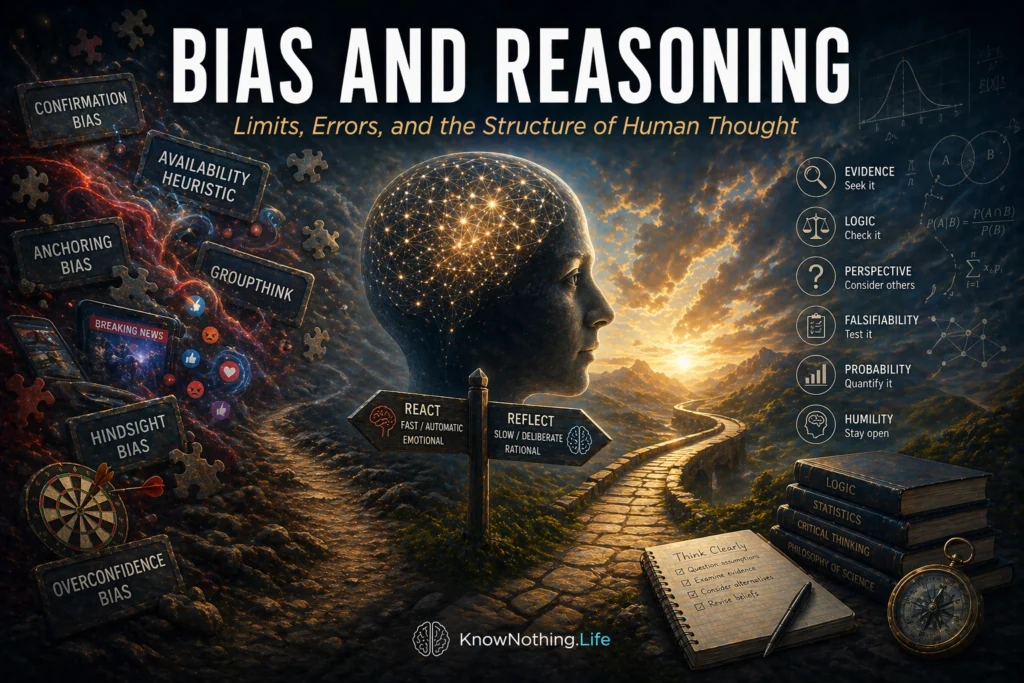
Cognitive biases are systematic patterns of deviation from rational judgment. They arise from the way the mind processes information, often simplifying complex situations through shortcuts known as heuristics. While these shortcuts can be efficient, they can also lead to predictable errors, particularly in situations involving uncertainty or ambiguity.
Biases are not random; they reflect underlying cognitive structures that prioritize speed and efficiency over accuracy. For example, individuals may rely on readily available information, overestimate the importance of recent events, or interpret evidence in ways that confirm existing beliefs. These tendencies illustrate how reasoning is influenced by factors beyond conscious control.
Philosophically, the existence of bias challenges the ideal of pure rationality. If reasoning is systematically influenced by bias, then the ability to achieve objective knowledge becomes more complex. Understanding bias requires examining both its cognitive origins and its implications for truth and justification, highlighting the need for critical reflection in the pursuit of knowledge.
Heuristics and Bounded Rationality
The concept of bounded rationality provides a framework for understanding how biases arise. Rather than assuming that individuals have unlimited cognitive resources, this perspective recognizes that reasoning operates within constraints. Time, information, and computational capacity are limited, leading individuals to rely on heuristics to make decisions.
Heuristics are mental shortcuts that simplify complex problems, enabling quick judgments. For example, the availability heuristic involves judging the likelihood of events based on how easily examples come to mind. While useful in many cases, such heuristics can lead to systematic errors, as they do not always reflect objective probabilities.
Philosophers and cognitive scientists have debated whether these shortcuts undermine rationality or represent a practical adaptation to cognitive limitations. Some argue that heuristics are rational in context, as they allow individuals to function effectively despite constraints. Others emphasize their potential to distort judgment, highlighting the need for awareness and correction. This debate reflects broader questions about the nature of rationality in real-world conditions.
Bias and Belief Formation
Bias plays a significant role in the formation and maintenance of beliefs. Individuals tend to favor information that supports their existing views while dismissing or reinterpreting conflicting evidence. This tendency, often referred to as confirmation bias, illustrates how reasoning can be influenced by prior commitments.
Philosophically, this raises questions about epistemic responsibility. To what extent are individuals responsible for their beliefs if those beliefs are shaped by unconscious biases? The challenge lies in balancing the recognition of cognitive limitations with the expectation of rational inquiry. While biases may be unavoidable, individuals can take steps to mitigate their influence through critical reflection and openness to alternative perspectives.
The impact of bias on belief formation also has broader implications for knowledge and communication. In social contexts, shared biases can reinforce groupthink and polarization, making it difficult to achieve consensus or engage in constructive dialogue. Addressing these issues requires not only individual awareness but also collective efforts to promote critical thinking and intellectual humility.
Reasoning, Emotion, and Context
Reasoning does not occur in isolation from other aspects of cognition. Emotions, social influences, and contextual factors all play a role in shaping how individuals think and decide. While traditional accounts often emphasize the separation of reason and emotion, contemporary perspectives highlight their interaction.
Emotions can both enhance and distort reasoning. They provide information about value and significance, guiding attention and motivation. At the same time, strong emotional responses can lead to biased judgments, particularly in situations involving fear, anger, or desire. Understanding the interplay between emotion and reasoning is essential for developing a more comprehensive account of cognitive processes.
Context also influences reasoning, as individuals interpret information within specific frameworks. Cultural norms, social roles, and environmental factors shape how problems are perceived and addressed. This context-dependence suggests that reasoning is not a purely abstract process but one embedded in lived experience, influenced by a wide range of factors.
Overcoming Bias: Critical Thinking and Reflection
While biases are an inherent part of human cognition, they are not insurmountable. Philosophers and educators emphasize the importance of critical thinking as a means of identifying and mitigating bias. This involves questioning assumptions, evaluating evidence, and considering alternative perspectives.
One approach to overcoming bias is to adopt systematic methods of reasoning, such as formal logic or scientific inquiry. These methods provide structured frameworks for evaluating arguments and testing hypotheses, reducing the influence of subjective tendencies. However, they require effort and discipline, as they often conflict with intuitive ways of thinking.
Self-awareness is also crucial in addressing bias. By recognizing the tendencies that influence their reasoning, individuals can take steps to counteract them. This may involve seeking diverse viewpoints, reflecting on emotional responses, and being open to revising beliefs. While complete elimination of bias may be impossible, these strategies can enhance the reliability of reasoning.
Bias and Reasoning in Contemporary Society
In the modern world, the study of bias and reasoning has taken on increased significance. The rapid flow of information, the influence of media, and the complexity of global issues create environments in which biases can have far-reaching consequences. Misinformation, polarization, and decision-making under uncertainty highlight the importance of understanding cognitive processes.
Technological advancements also play a role in shaping reasoning. Algorithms and data-driven systems can both mitigate and amplify bias, depending on how they are designed and used. This raises ethical questions about the responsibility of individuals and institutions in managing bias, as well as the role of technology in supporting rational decision-making.
Philosophical inquiry into bias and reasoning thus extends beyond individual cognition to encompass broader social and technological contexts. It emphasizes the need for critical engagement with information and the cultivation of intellectual virtues that support thoughtful and informed judgment.
Conclusion
Bias and reasoning are deeply interconnected aspects of human cognition, reflecting both the strengths and limitations of the mind. While reasoning provides a powerful tool for understanding and navigating the world, it is shaped by biases that can lead to systematic errors. Recognizing these influences is essential for developing a more accurate and nuanced understanding of thought.
Philosophical exploration reveals that rationality is not an idealized state of perfect logic but a practical process that operates within constraints. By examining the nature of bias, philosophers and scientists seek to improve reasoning, enhancing its reliability and effectiveness. This involves not only identifying errors but also cultivating habits of critical reflection and openness.
Ultimately, the study of bias and reasoning highlights the complexity of human thought. It underscores the importance of self-awareness, intellectual humility, and continuous inquiry in the pursuit of knowledge. By understanding the limits of reasoning, individuals can better navigate the challenges of decision-making and contribute to a more thoughtful and informed society.