Human thinking is often celebrated for its capacity to reason, analyze, and solve complex problems. Yet, beneath this apparent rationality lies a system shaped by shortcuts, assumptions, and systematic errors. Cognitive biases and heuristics are central to understanding how people actually think, rather than how they ideally should think. These mental processes allow individuals to make quick judgments in uncertain environments, but they also introduce predictable distortions in perception and decision-making.
The modern study of cognitive biases and heuristics was pioneered by Daniel Kahneman and Amos Tversky, whose groundbreaking research in the 1970s challenged the traditional view of humans as rational actors. In their influential work Judgment under Uncertainty: Heuristics and Biases (1974), they demonstrated that people rely on mental shortcuts that can lead to consistent errors. Kahneman later summarized this insight in Thinking, Fast and Slow (2011), noting that “we are prone to overestimate how much we understand about the world.”
Understanding cognitive biases and heuristics is essential not only for psychology but also for fields such as economics, law, medicine, and public policy. These mental processes influence everything from everyday decisions to high-stakes judgments. By examining how biases arise and how heuristics function, researchers aim to better understand human behavior and develop strategies for improving decision-making.
Heuristics: The Architecture of Mental Shortcuts
Heuristics are cognitive strategies that simplify decision-making by reducing the complexity of information processing. Rather than analyzing every detail of a situation, individuals rely on rules of thumb that allow for quick and efficient judgments. These shortcuts are often adaptive, enabling people to navigate environments where time and information are limited.
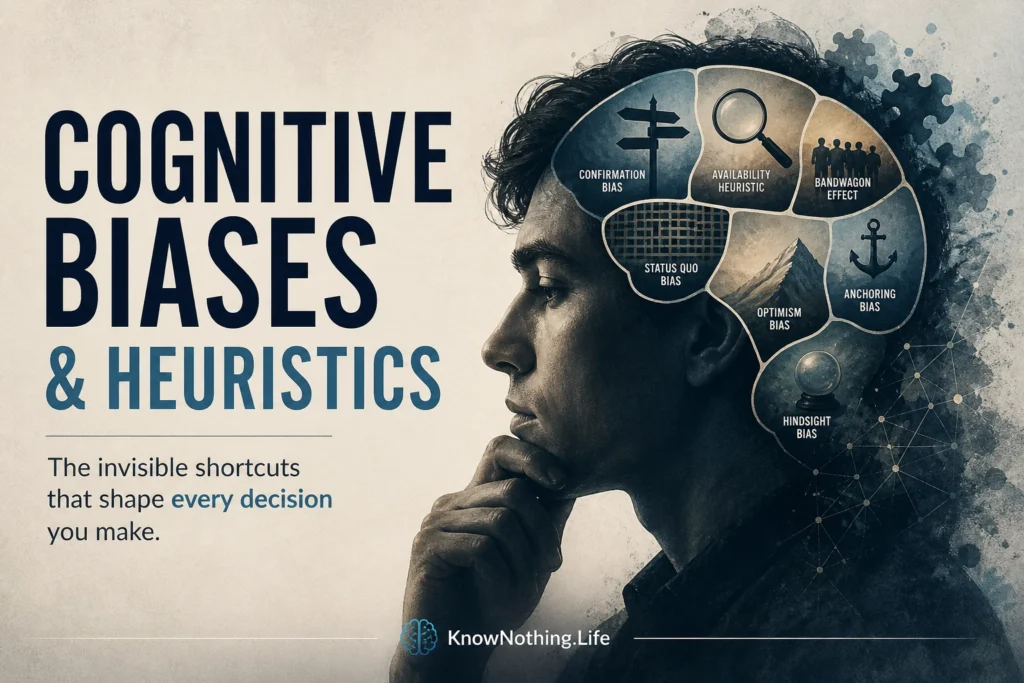
One of the most well-known heuristics is the availability heuristic, in which individuals estimate the likelihood of an event based on how easily examples come to mind. For instance, people may overestimate the frequency of dramatic events, such as plane crashes, because such incidents receive extensive media coverage. This heuristic reflects the brain’s reliance on accessible information, even when it may not accurately represent reality.
Another important heuristic is the representativeness heuristic, where judgments are based on how closely something matches a mental prototype. This can lead to errors when individuals ignore statistical information in favor of perceived similarity. Tversky and Kahneman illustrated this with classic experiments showing that people often neglect base rates when making probability judgments. While heuristics are essential for efficient thinking, their reliance on simplification can produce systematic biases.
Cognitive Biases: Systematic Errors in Judgment
Cognitive biases arise when heuristics lead to consistent deviations from rational judgment. These biases are not random mistakes but predictable patterns of thinking that affect how individuals perceive and interpret information. One of the most pervasive biases is confirmation bias, the tendency to seek, interpret, and remember information in ways that support existing beliefs.
Confirmation bias can reinforce preconceived notions, making it difficult for individuals to consider alternative perspectives. Once a belief is formed, people may selectively attend to evidence that confirms it while dismissing contradictory information. This bias has significant implications in areas such as science, politics, and legal decision-making, where objective evaluation of evidence is critical.
Another prominent bias is anchoring, where initial information serves as a reference point that influences subsequent judgments. For example, the first price offered in a negotiation can shape expectations, even if it is arbitrary. Kahneman described anchoring as a phenomenon where “people start from an initial value that is adjusted to yield the final answer.” These biases highlight the limitations of human judgment and the influence of context on decision-making.
Dual-Process Theory and Cognitive Systems
The framework of dual-process theory provides a useful way to understand how heuristics and biases operate. According to this theory, human cognition involves two systems: a fast, intuitive system and a slow, analytical system. Kahneman referred to these as System 1 and System 2. System 1 operates automatically and quickly, relying on heuristics and producing immediate judgments. System 2, in contrast, is deliberate and effortful, capable of more complex reasoning.
Most everyday decisions are governed by System 1, which allows for rapid responses but is prone to error. System 2 can override these intuitive judgments, but it requires time, attention, and cognitive resources. As a result, individuals often rely on heuristics even when more careful analysis would lead to better outcomes. Kahneman noted that “System 1 runs automatically and System 2 is normally in a comfortable low-effort mode.”
The interaction between these systems explains why biases persist even when individuals are aware of them. Recognizing a bias does not necessarily eliminate it, as intuitive responses can still influence judgment. Understanding dual-process theory provides insight into the mechanisms underlying cognitive biases and highlights the challenges of achieving rational decision-making.
Biases in Social and Real-World Contexts
Cognitive biases extend beyond individual thinking to influence social interactions and societal outcomes. In social contexts, biases can affect how individuals perceive others, make judgments, and form relationships. For example, the fundamental attribution error leads people to attribute others’ behavior to internal characteristics while underestimating situational factors. This bias can contribute to misunderstandings and conflict.
In professional and institutional settings, biases can have significant consequences. In medicine, diagnostic errors may arise from biases such as availability or anchoring, where physicians rely on recent cases or initial impressions. In finance, overconfidence bias can lead to risky decisions and market instability. Behavioral economics, influenced by the work of Richard Thaler, has shown how biases affect economic behavior, challenging traditional models of rational choice.
The impact of cognitive biases is also evident in legal systems, where jurors, judges, and investigators may be influenced by heuristics and biases. These effects highlight the importance of designing systems and procedures that account for human limitations. By understanding how biases operate in real-world contexts, it becomes possible to develop strategies for mitigating their effects.
Debiasing and Improving Decision-Making
Given the pervasive influence of cognitive biases, researchers have sought ways to reduce their impact and improve decision-making. One approach is to increase awareness of biases, helping individuals recognize when they may be relying on faulty reasoning. However, awareness alone is often insufficient, as biases are deeply ingrained in cognitive processes.
Another strategy involves designing environments that promote better decisions. For example, “nudges,” a concept popularized by Richard Thaler and Cass Sunstein in Nudge (2008), involve structuring choices in ways that guide behavior without restricting freedom. By presenting options in a certain way, it is possible to encourage more rational or beneficial decisions.
Analytical tools and structured decision-making processes can also help mitigate biases. Techniques such as checklists, statistical analysis, and peer review provide safeguards against intuitive errors. In high-stakes environments, such as aviation and medicine, these methods are used to enhance accuracy and reduce risk. While it may not be possible to eliminate biases entirely, these approaches can significantly improve decision-making outcomes.
Conclusion
Cognitive biases and heuristics reveal the complexity of human thought, challenging the notion of humans as purely rational decision-makers. While heuristics enable efficient processing of information, they also give rise to systematic errors that shape perception and judgment. The work of Daniel Kahneman and Amos Tversky has fundamentally transformed our understanding of these processes, highlighting the interplay between intuition and analysis.
By examining the mechanisms and effects of biases, researchers have gained valuable insights into how decisions are made in everyday life and across various domains. These insights have practical implications for improving judgment, designing better systems, and promoting more informed choices. Ultimately, the study of cognitive biases and heuristics underscores a central lesson: that understanding the limitations of the mind is essential for making better decisions.
As research continues to evolve, the challenge lies in applying these insights to real-world contexts, balancing the efficiency of heuristics with the need for accuracy. In doing so, it becomes possible to harness the strengths of human cognition while mitigating its weaknesses, leading to more effective and rational outcomes.