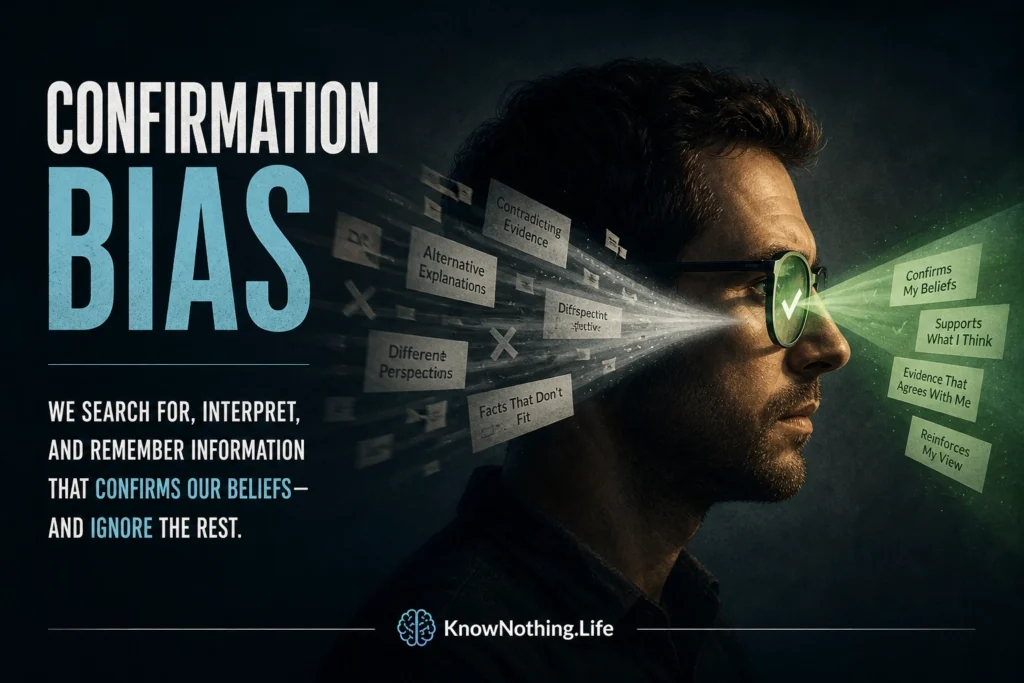
Confirmation bias is one of the most pervasive and influential cognitive biases shaping human thought. It refers to the tendency to seek, interpret, and remember information in ways that confirm preexisting beliefs while disregarding or minimizing contradictory evidence. This bias operates across a wide range of contexts, from everyday decision-making to scientific reasoning, political judgment, and legal evaluation. While often subtle, its effects can be profound, reinforcing existing viewpoints and making it difficult for individuals to revise their beliefs in light of new information.
The systematic study of confirmation bias can be traced to the work of Peter Wason, whose experiments in the 1960s demonstrated how individuals preferentially test hypotheses by seeking confirmatory evidence. In his famous selection task, participants consistently failed to consider disconfirming information, revealing a fundamental asymmetry in reasoning. Wason concluded that people tend to “seek evidence that confirms rather than challenges their hypotheses,” a finding that has since been replicated across numerous studies.
Understanding confirmation bias is essential for grasping the limits of human rationality. While individuals often believe they are evaluating information objectively, their judgments are shaped by underlying cognitive tendencies that favor consistency and coherence. This article explores the psychological mechanisms of confirmation bias, its manifestations across different domains, and the challenges it presents for critical thinking and decision-making.
Cognitive Mechanisms of Confirmation Bias
Confirmation bias arises from the interaction of several cognitive processes that influence how information is processed and evaluated. At its core is the human tendency to maintain cognitive consistency. Beliefs are not isolated pieces of information but are embedded within broader mental frameworks, or schemas, that organize knowledge. When new information aligns with these schemas, it is easily integrated; when it conflicts, it creates cognitive dissonance—a state of psychological discomfort.
The theory of cognitive dissonance, developed by Leon Festinger, provides insight into why individuals avoid disconfirming evidence. In A Theory of Cognitive Dissonance (1957), Festinger argued that people are motivated to reduce inconsistency between beliefs and actions. One way to achieve this is by selectively attending to information that supports existing views while ignoring or rationalizing conflicting data. This process allows individuals to maintain a sense of coherence and stability in their beliefs.
Memory also plays a crucial role in confirmation bias. Individuals are more likely to remember information that supports their beliefs and to forget or distort information that contradicts them. This selective recall reinforces existing attitudes over time, creating a feedback loop that strengthens confirmation bias. Together, these cognitive mechanisms contribute to the persistence and resilience of biased thinking.
Confirmation Bias in Perception and Interpretation
Confirmation bias influences not only what information individuals seek but also how they interpret it. Ambiguous evidence is often construed in ways that support prior beliefs, leading to divergent interpretations of the same data. This phenomenon is particularly evident in domains where evidence is complex or uncertain, such as politics, science, and law.
Research by Charles Lord, Lee Ross, and Mark Lepper demonstrated how individuals evaluate evidence differently depending on their preexisting attitudes. In their study on capital punishment, participants were presented with mixed evidence about the effectiveness of the death penalty. Rather than converging toward a common conclusion, participants became more polarized, interpreting the same evidence in ways that reinforced their initial positions. This effect, known as attitude polarization, highlights the interpretive nature of confirmation bias.
Perceptual processes are also affected by bias. Expectations can shape what individuals perceive, leading them to notice details that align with their beliefs while overlooking others. This selective perception underscores the extent to which cognition is influenced by prior knowledge and expectations. Confirmation bias, therefore, operates not only at the level of reasoning but also at the level of perception itself.
Social and Cultural Reinforcement
Confirmation bias is amplified by social and cultural factors that shape how information is shared and consumed. Individuals tend to associate with others who hold similar beliefs, creating echo chambers in which ideas are reinforced rather than challenged. These environments provide a steady stream of confirmatory information, strengthening existing viewpoints and reducing exposure to alternative perspectives.
The rise of digital media has further intensified this phenomenon. Algorithms designed to maximize engagement often present users with content that aligns with their preferences, creating personalized information environments. While this can enhance user experience, it also increases the likelihood of encountering information that confirms existing beliefs. As a result, confirmation bias becomes embedded within the structure of information systems.
Social identity also plays a role in reinforcing confirmation bias. Beliefs are often tied to group membership, and challenging those beliefs can threaten an individual’s sense of belonging. This dynamic can make individuals more resistant to disconfirming evidence, as accepting such information may have social consequences. The interplay between cognitive processes and social influences highlights the complexity of confirmation bias and its persistence in collective contexts.
Confirmation Bias in Decision-Making
The impact of confirmation bias extends to decision-making across various domains. In scientific research, for example, researchers may unconsciously favor data that supports their hypotheses, leading to biased interpretations or selective reporting. This issue has been addressed through methodological safeguards such as peer review and replication, which aim to minimize bias and promote objectivity.
In legal contexts, confirmation bias can affect investigators, attorneys, and jurors. Once a suspect is identified, investigators may focus on evidence that supports guilt while overlooking exculpatory information. This can lead to wrongful convictions and miscarriages of justice. As Daniel Kahneman noted, “People can maintain an unshakable belief in any proposition, however absurd, when they are sustained by a community of like-minded believers.”
In everyday life, confirmation bias influences choices related to health, finance, and relationships. Individuals may seek advice that aligns with their preferences, interpret outcomes in ways that justify their decisions, and resist changing course even when evidence suggests they should. These patterns highlight the practical significance of confirmation bias and its role in shaping behavior.
Strategies for Mitigating Confirmation Bias
Given its pervasive nature, mitigating confirmation bias is a significant challenge. One approach is to actively seek out disconfirming evidence, deliberately considering alternative perspectives and counterarguments. This practice, known as “considering the opposite,” can help individuals evaluate information more objectively and reduce the influence of bias.
Structured decision-making processes can also aid in mitigating bias. Techniques such as checklists, formal analysis, and collaborative review encourage systematic evaluation of evidence and reduce reliance on intuition. In scientific and professional settings, these methods are used to enhance accuracy and minimize error.
Education and critical thinking skills play a crucial role in addressing confirmation bias. By understanding how bias operates, individuals can become more aware of their own cognitive tendencies and take steps to counteract them. However, as research has shown, awareness alone is not always sufficient. Effective mitigation requires both knowledge and practice, as well as supportive environments that encourage open inquiry and critical evaluation.
Conclusion
Confirmation bias is a fundamental aspect of human cognition, reflecting the mind’s tendency to favor consistency and coherence over objectivity. While it serves certain adaptive functions, such as simplifying decision-making and maintaining stable beliefs, it also introduces significant distortions that can affect judgment and behavior. The work of researchers such as Peter Wason, Leon Festinger, and Daniel Kahneman has provided valuable insights into the mechanisms and consequences of this bias.
Understanding confirmation bias is essential for improving critical thinking and decision-making. By recognizing its influence and adopting strategies to counteract it, individuals can approach information more objectively and make more informed choices. In a world characterized by complexity and uncertainty, the ability to question one’s own assumptions is a vital skill.
Ultimately, confirmation bias highlights both the strengths and limitations of human cognition. It reminds us that the pursuit of truth requires not only knowledge and evidence but also a willingness to challenge our own beliefs. By embracing this challenge, individuals and societies can move toward more accurate and balanced understanding.