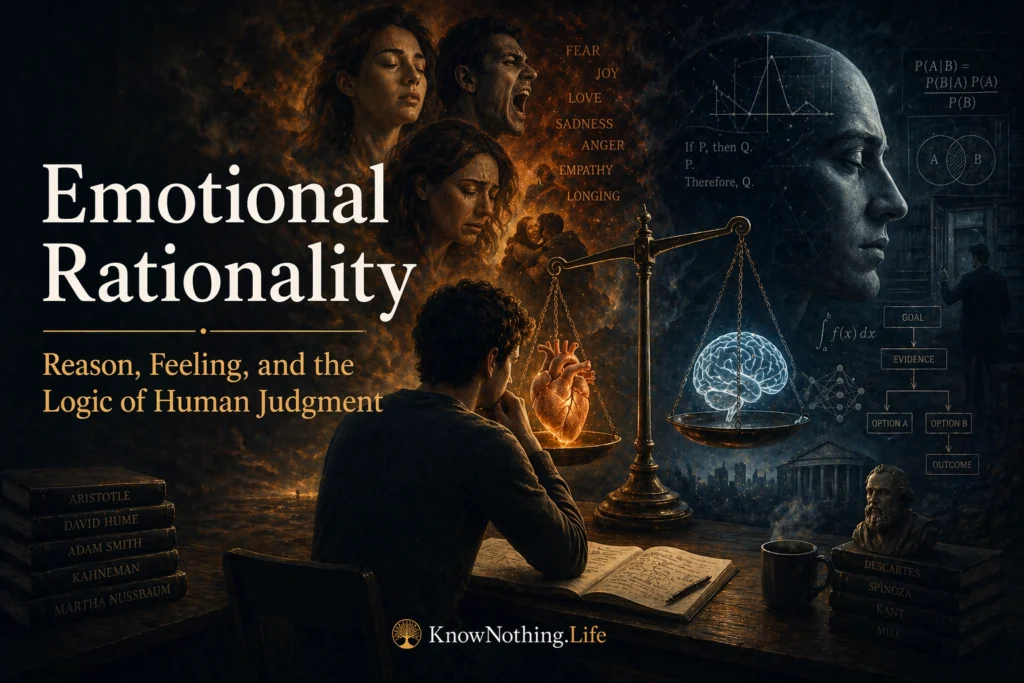
For much of philosophical history, emotion and reason were treated as opposing forces. Reason was associated with clarity, objectivity, and truth, while emotion was often viewed as disruptive, irrational, and prone to error. Yet this stark division has gradually given way to a more nuanced understanding. Increasingly, philosophers and scientists recognize that emotions are not merely obstacles to rationality but can themselves be rational—responsive to reasons, sensitive to evidence, and integral to sound judgment.
The concept of emotional rationality challenges traditional assumptions by suggesting that emotions have their own form of logic. They are not random or chaotic responses but structured reactions to perceived significance. Fear responds to danger, anger to injustice, and compassion to suffering. These responses can be appropriate or inappropriate, justified or misguided, depending on how accurately they reflect the world. Exploring emotional rationality involves examining how feelings relate to beliefs, values, and decisions, revealing the deep interconnection between affect and cognition.
Historical Roots of Emotional Rationality
The idea that emotions can be rational has deep philosophical roots, even though it was often overshadowed by views that emphasized their irrationality. In ancient Greece, Aristotle offered a framework in which emotions could be evaluated in terms of appropriateness. For Aristotle, emotions are not inherently irrational; they become problematic only when they are excessive or misdirected. Virtue involves feeling the right emotion, at the right time, toward the right object, and in the right way. This perspective recognizes that emotions can align with reason when properly cultivated.
In contrast, Plato maintained a more hierarchical view, placing reason above emotion. While he acknowledged the importance of emotional elements within the soul, he emphasized the need for rational control. This tension between regulation and integration continued into later philosophical traditions, shaping debates about the role of emotion in rational life.
The early modern period introduced further complexity. David Hume argued that reason alone cannot motivate action, asserting that it is “the slave of the passions.” This claim challenged the dominance of reason, suggesting that emotions play a central role in guiding behavior. Rather than being opposed to rationality, emotions may be essential to it, providing the motivational force that reason lacks.
Emotions as Evaluative Judgments
One of the most influential approaches to emotional rationality is the view that emotions are evaluative judgments. According to this perspective, emotions involve assessments of the world, reflecting beliefs about what is significant, valuable, or threatening. Fear, for example, is not merely a feeling but a judgment that something poses a danger. Anger reflects a perception of wrongdoing, while gratitude expresses recognition of benefit.
This evaluative structure allows emotions to be assessed in rational terms. An emotion is rational if it accurately reflects the situation and irrational if it is based on false or distorted judgments. For instance, fear of a harmless object may be considered irrational, while fear of a genuine threat is appropriate. This framework aligns emotions with reasoning processes, suggesting that they are subject to evaluation and revision.
Philosophers such as Martha Nussbaum have developed this idea further, arguing that emotions are deeply connected to values and beliefs about well-being. Emotions reveal what individuals care about, highlighting the importance of certain aspects of life. In this sense, emotional rationality involves not only accuracy but also coherence with one’s broader system of values.
The Integration of Emotion and Reason
Rather than existing in opposition, emotion and reason are increasingly understood as complementary aspects of cognition. Emotional responses provide information about the significance of events, guiding attention and decision-making. Reason, in turn, helps to evaluate and regulate these responses, ensuring that they align with evidence and long-term goals.
Philosophers such as Immanuel Kant emphasized the role of reason in moral judgment, but even within such frameworks, emotions play a crucial role in motivating action. Without emotional engagement, rational principles may remain abstract and ineffective. This interplay suggests that rationality is not purely cognitive but involves the integration of feeling and thought.
Contemporary research supports this integrated view. Studies in neuroscience have shown that individuals with impaired emotional processing often struggle with decision-making, even when their cognitive abilities remain intact. This evidence suggests that emotions contribute essential information, helping individuals navigate complex situations. Emotional rationality, therefore, involves the harmonious interaction of affective and cognitive processes.
Emotional Bias and Irrationality
While emotions can be rational, they are also susceptible to bias and distortion. Emotional responses are influenced by past experiences, cultural norms, and cognitive shortcuts, which can lead to errors in judgment. For example, fear may be exaggerated due to past trauma, or anger may be misdirected due to misunderstanding. These distortions highlight the limits of emotional rationality and the need for critical reflection.
Philosophers have long recognized the potential for emotional bias. Baruch Spinoza argued that emotions can cloud understanding, leading individuals to act against their own interests. However, he also believed that understanding the causes of emotions can lead to greater clarity and freedom. By examining the origins of emotional responses, individuals can reduce their susceptibility to bias.
The challenge lies in distinguishing between rational and irrational emotions. This requires evaluating both the accuracy of the underlying judgment and the proportionality of the response. Emotional rationality is not about eliminating emotion but about refining it, ensuring that feelings are aligned with reality and guided by reflection.
Emotional Rationality in Moral and Practical Life
Emotional rationality plays a crucial role in moral and practical decision-making. Emotions such as empathy, guilt, and compassion provide the foundation for ethical behavior, guiding individuals toward actions that promote well-being and justice. Without these emotional capacities, moral reasoning would lack depth and motivation.
Philosophers like Adam Smith emphasized the importance of sympathy in moral judgment, suggesting that the ability to share in the feelings of others is essential for ethical understanding. This perspective highlights the role of emotion in connecting individuals and fostering social cooperation.
In practical life, emotional rationality influences everyday decisions, from personal relationships to professional choices. Emotions help individuals assess risks, evaluate opportunities, and respond to changing circumstances. When aligned with reason, they enhance decision-making by providing insight into what matters most. However, when misaligned, they can lead to impulsive or misguided actions. Developing emotional rationality involves cultivating awareness and balance, allowing emotions to inform rather than dominate judgment.
Contemporary Perspectives and Challenges
Modern philosophy and science continue to explore the nature of emotional rationality, incorporating insights from psychology, neuroscience, and cognitive science. These fields have revealed the complexity of emotional processes, highlighting their role in perception, memory, and decision-making. Emotional rationality is increasingly seen as a fundamental aspect of human cognition rather than a secondary or optional feature.
At the same time, contemporary life presents new challenges for emotional rationality. The rapid pace of information, the influence of media, and the pressures of modern society can amplify emotional responses, sometimes leading to polarization and conflict. Navigating these challenges requires a deeper understanding of how emotions operate and how they can be guided by reason.
Emerging technologies also raise questions about the role of emotion in artificial intelligence and decision-making systems. Can machines exhibit emotional rationality, or is it uniquely human? These questions extend the philosophical inquiry into new domains, ensuring that the study of emotional rationality remains relevant and evolving.
Conclusion
Emotional rationality challenges the traditional division between feeling and thought, revealing a more integrated understanding of human cognition. Emotions are not merely irrational impulses but structured responses that can be evaluated in terms of accuracy, coherence, and appropriateness. When aligned with reason, they enhance judgment, guide action, and enrich understanding.
Philosophical exploration shows that emotional rationality involves both potential and limitation. Emotions can provide valuable insight into the world and our values, but they can also be distorted by bias and error. The task is not to eliminate emotion but to refine it, cultivating responses that are both informed and reflective.
Ultimately, emotional rationality highlights the complexity of human experience. It underscores the idea that reason and emotion are not opposing forces but interconnected aspects of the same cognitive system. In understanding this relationship, we gain a deeper appreciation of how individuals think, feel, and navigate the world.