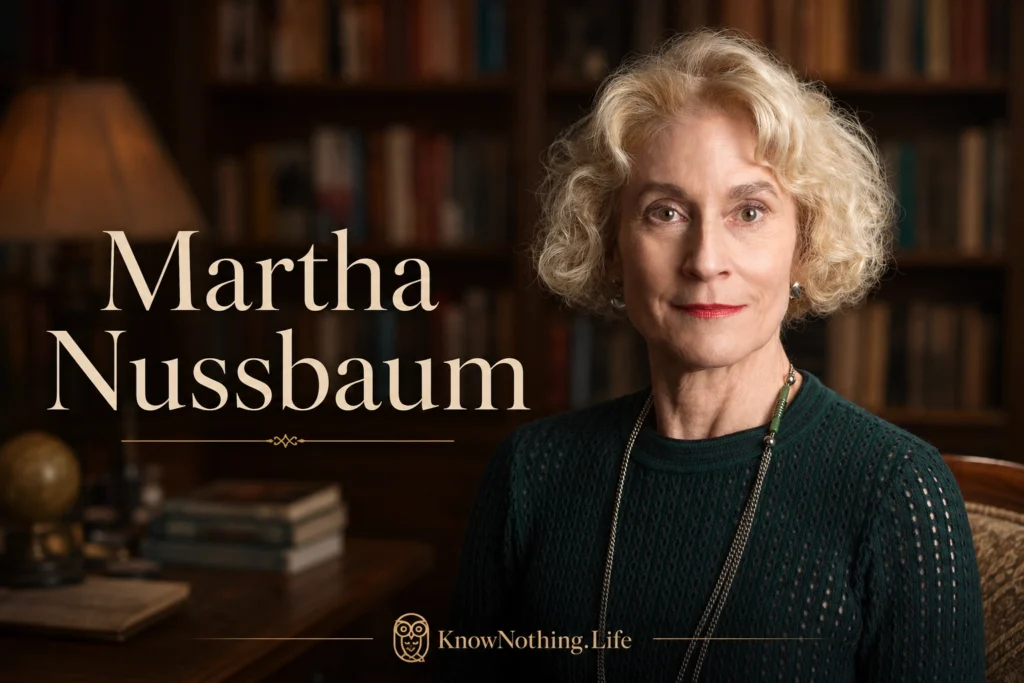
Martha Craven Nussbaum was born on May 6, 1947, in New York City, and grew up in a world of education, discipline, culture, and social expectation. Her father, George Craven, was a lawyer, and her childhood moved through the privileged but often constricting settings of East Coast professional life. That background became one of the pressures her philosophy would later examine: how social class, gender, education, family expectation, and inherited ideals shape what people are encouraged to become. Nussbaum’s work never treats philosophy as an escape from life. It treats life itself as the evidence philosophy must answer.
She earned her B.A. from New York University and completed her M.A. and Ph.D. at Harvard University, where she trained in classics and philosophy. Her early work was deeply rooted in ancient Greek thought, especially Aristotle, tragedy, ethics, and the question of human flourishing. This classical formation mattered permanently. Even when she later wrote about feminism, constitutional law, disability, animal justice, education, religion, sexuality, emotions, and global development, her basic question remained recognizably ancient: what does it mean for a human life to go well?
Ancient Philosophy and The Fragility of Goodness
Nussbaum first became widely known as a scholar of ancient Greek philosophy and literature. Her early book on Aristotle’s De Motu Animalium showed her technical command of Greek texts, but her broader reputation grew with The Fragility of Goodness, published in 1986. That book examined luck and ethics in Greek tragedy and philosophy, especially the conflict between human aspiration and vulnerability. Against moral theories that imagine goodness as perfectly self-sufficient, Nussbaum argued that even excellent people remain exposed to chance, loss, politics, love, illness, and dependency.
The title itself captures one of her central insights: goodness is fragile because human beings are fragile. A life can be noble and still vulnerable to catastrophe. Greek tragedy, for Nussbaum, is not merely literature; it is moral philosophy in dramatic form. It shows that human beings are not gods, machines, or isolated rational wills. They are embodied, dependent, passionate, social, and finite. This tragic awareness would later shape her work on compassion, justice, disability, aging, and animal life.
Love’s Knowledge and Philosophy Through Literature
In Love’s Knowledge, published in 1990, Nussbaum argued that literature can disclose moral truths that abstract theory often misses. Novels and plays do not merely decorate ethical thought; they train perception. They show the texture of motives, the complexity of love, the difficulty of judgment, and the way small details can carry moral meaning. For Nussbaum, a philosophical style that ignores narrative may become too thin to understand actual human beings.
This interest in literature also explains her enduring defense of the humanities. She has argued that democratic citizens need more than technical skill and economic training. They need imagination, sympathy, history, art, and the ability to see other people as fully real. One of her memorable claims is that “philosophy breaks out wherever people are encouraged to think for themselves.” The sentence reflects a lifelong commitment to public education: philosophy is not the private property of specialists, but a practice of critical freedom.
Capabilities and Human Development
Nussbaum’s most influential political idea is the capabilities approach, developed in conversation with Amartya Sen but given her own distinctive form. Instead of measuring justice only through wealth, utility, preference satisfaction, or gross domestic product, the capabilities approach asks a more human question: what is each person actually able to do and to be? A society can be wealthy and still unjust if many people lack bodily security, education, political voice, health, imagination, emotional development, or control over their environment.
In Women and Human Development and Creating Capabilities, Nussbaum offered a list of central human capabilities, including life, bodily health, bodily integrity, senses and imagination, emotions, practical reason, affiliation, relation to other species, play, and control over one’s political and material environment. The list is not a luxury catalog. It is a threshold account of dignity. A minimally just society must secure real opportunities for people to live lives worthy of human beings. This made Nussbaum one of the most important philosophers of global justice, feminism, development ethics, and human rights.
Feminism, Law, and Social Equality
Nussbaum’s feminism is universalist, liberal, and deeply concerned with material conditions. She rejects the idea that appeals to universal human dignity must erase cultural difference, but she also rejects the view that culture can excuse systematic deprivation. In Sex and Social Justice, she argued that gender, sexuality, tradition, and law often work together to deny women and sexual minorities basic opportunities for flourishing. Her feminism does not begin with abstract sameness. It begins with the concrete question of whether people have the real freedom to live, move, learn, work, love, participate, and speak.
Her legal writings bring the same concerns into constitutional and public life. In books such as Hiding from Humanity, From Disgust to Humanity, Liberty of Conscience, and The New Religious Intolerance, she examines shame, disgust, religion, sexuality, fear, and equality before the law. Nussbaum is especially suspicious of disgust as a political emotion because it often turns vulnerable groups into objects of contamination or exclusion. Law, in her view, should protect dignity rather than ratify social stigma.
Emotions and Political Life
Few contemporary philosophers have done more than Nussbaum to restore emotions to serious philosophical discussion. In Upheavals of Thought, she argued that emotions are not blind surges opposed to reason. They are intelligent appraisals of what matters to us. Grief, fear, anger, compassion, love, and hope reveal our attachments and judgments. Because human beings care, they are vulnerable; because they are vulnerable, emotions are central to moral and political life.
Her later books, including Political Emotions, Anger and Forgiveness, and The Monarchy of Fear, extend this project into democracy. Nussbaum does not think politics can be purified of emotion. The real question is which emotions a society cultivates. Fear can produce scapegoating, disgust can justify exclusion, and anger can harden into revenge. But love, compassion, hope, and civic friendship can support justice. Her work asks democratic societies to educate the emotions rather than pretend they do not exist.
Education, Humanities, and Democracy
In Cultivating Humanity and Not for Profit, Nussbaum defended liberal education against narrow economic models of schooling. She warned that democracies damage themselves when they treat students only as future workers rather than as future citizens. A decent education should develop critical thinking, historical understanding, global awareness, and imaginative sympathy. Without these capacities, citizens may become technically competent but morally and politically passive.
Her defense of the humanities is not nostalgic. It is civic. Literature, philosophy, history, and the arts help people examine inherited prejudice, understand unfamiliar lives, and resist authoritarian simplification. Nussbaum’s famous line that “philosophy should not be written in detachment from real life” applies here with special force. Education matters because democracy depends on people who can think, question, listen, and imagine the humanity of others.
Later Work and Expanding Justice
Nussbaum’s later work has continued to expand the boundaries of justice. Frontiers of Justice examines disability, nationality, and species membership, challenging theories that assume citizens are roughly equal contractors. Justice for Animals extends her capabilities approach to nonhuman creatures, arguing that animals have characteristic forms of flourishing that human institutions must respect. Citadels of Pride addresses sexual abuse, accountability, and reconciliation, while The Republic of Love turns to opera as a source of political and emotional understanding.
This range can seem astonishing, but it is unified by a single concern: the conditions of flourishing. Nussbaum has described her career as a search for those conditions and for the catastrophes that obstruct them. Whether she is writing about Sophocles, women in development, constitutional law, Mozart, animals, aging, or fear in democracy, she asks how institutions and emotions can either support or damage lives. Her breadth is not scattered. It is the breadth of a philosopher trying to follow human vulnerability wherever it appears.
Honors and Lasting Legacy
Nussbaum has taught at Harvard, Brown, Oxford, and the University of Chicago, where she is the Ernst Freund Distinguished Service Professor of Law and Ethics, appointed in both the Law School and the Department of Philosophy. She has received many major honors, including the Kyoto Prize in Arts and Philosophy, the Berggruen Prize for Philosophy and Culture, the Holberg Prize, and the Balzan Prize. She has written dozens of books and hundreds of articles, influencing philosophy, law, classics, feminist theory, development economics, political theory, education, and animal ethics.
Martha Nussbaum’s lasting importance lies in her insistence that philosophy must answer to the full range of human life. She refuses to separate reason from emotion, justice from embodiment, law from dignity, or education from democracy. Her work asks not only whether institutions are efficient or traditions are old, but whether people have real opportunities to flourish. In that question, her classical training and modern commitments meet. Nussbaum remains essential because she has made philosophy a public defense of vulnerable life: human, animal, emotional, political, and deeply unfinished.