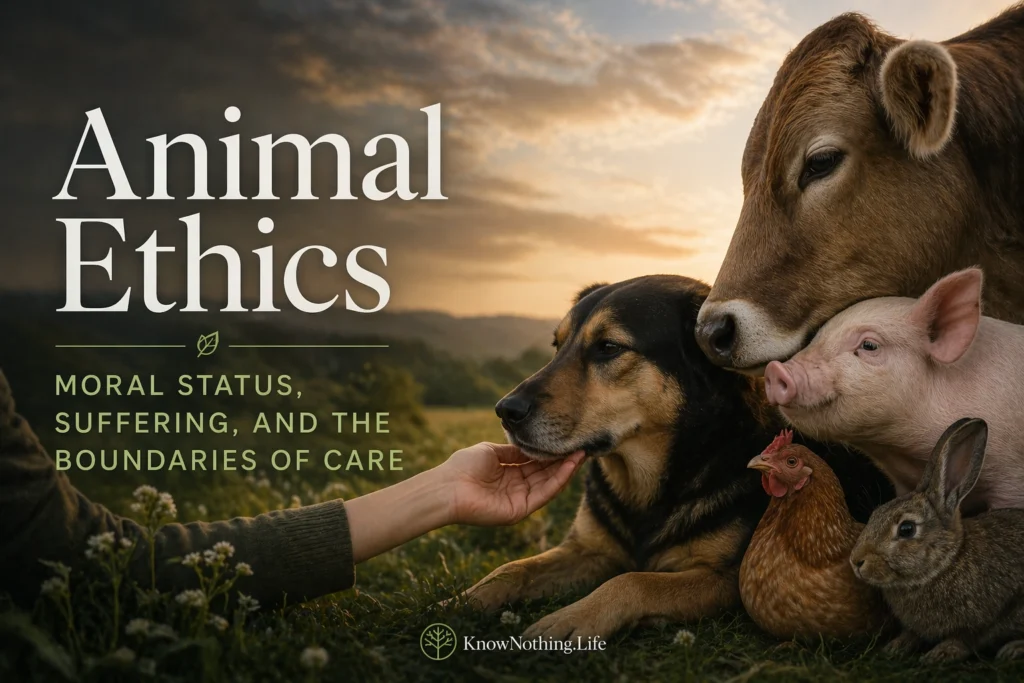
Animal ethics is a branch of moral philosophy that examines the status of non-human animals and the obligations humans have toward them. It asks whether animals matter morally, in what ways they matter, and how their interests should be weighed against human interests. These questions challenge long-standing assumptions about human superiority and force a reconsideration of practices embedded in everyday life, from food consumption to scientific research.
At its core, animal ethics raises a fundamental issue: what qualifies a being for moral consideration? Is it intelligence, the capacity for language, rationality, or the ability to suffer? As philosophical inquiry has progressed, many thinkers have shifted focus toward sentience—the capacity to experience pleasure and pain—as the most relevant criterion. This shift has profound implications, expanding the moral community beyond humans and demanding a more inclusive ethical framework.
Historical Foundations of Animal Ethics
Philosophical attitudes toward animals have varied widely across history. In ancient thought, Aristotle viewed animals as part of a natural hierarchy, with humans occupying a higher position due to their rational capacities. This perspective justified the use of animals for human purposes, framing them as instruments rather than moral subjects.
In the early modern period, René Descartes argued that animals lack consciousness and are essentially automata, incapable of true feeling. This view reinforced the idea that animals do not have moral standing, as they were seen as incapable of experiencing suffering in a meaningful sense. Such perspectives had lasting influence, shaping attitudes that prioritized human interests.
However, alternative views began to emerge. Jeremy Bentham famously argued that the capacity to suffer, not the ability to reason, is the key criterion for moral consideration. His question—“Can they suffer?”—marked a turning point in ethical thought, shifting attention toward the experiences of animals themselves. This insight laid the groundwork for modern animal ethics, emphasizing empathy and the reduction of suffering.
Sentience and Moral Consideration
The concept of sentience has become central to contemporary animal ethics. Sentience refers to the capacity to experience sensations, particularly pleasure and pain. Philosophers argue that if a being can suffer, then its suffering matters morally and should be taken into account in ethical decision-making.
This perspective challenges traditional boundaries of moral concern. By focusing on sentience, it includes a wide range of non-human animals within the moral community. This expansion raises important questions about how to weigh different interests and how to balance competing needs. For example, how should human benefits be evaluated against animal suffering, and what level of harm is permissible?
Philosophers such as Peter Singer have developed arguments based on the principle of equal consideration of interests. According to this view, similar interests—such as the interest in avoiding pain—should be given equal weight, regardless of the species of the being involved. This approach does not necessarily imply identical treatment but requires that moral decisions account for the experiences of all affected beings.
Rights and the Moral Status of Animals
Another major approach in animal ethics focuses on the concept of rights. While utilitarian perspectives emphasize consequences and the reduction of suffering, rights-based theories argue that animals possess inherent moral rights that must be respected. These rights may include the right not to be harmed, exploited, or treated merely as means to an end.
Tom Regan is a key figure in this tradition, arguing that animals are “subjects-of-a-life” with inherent value. According to Regan, animals have beliefs, desires, and experiences that give their lives significance. As a result, they are entitled to moral consideration that goes beyond the calculation of utility.
The rights-based approach raises challenging questions about how to apply these principles in practice. If animals have rights, what obligations do humans have in contexts such as agriculture, research, and entertainment? These questions highlight the tension between ethical ideals and practical realities, requiring careful consideration of how moral principles can be implemented.
Animal Welfare and Practical Ethics
Animal welfare focuses on improving the conditions in which animals live, aiming to reduce suffering and promote well-being. This approach is often more pragmatic than rights-based theories, seeking incremental improvements rather than radical changes. It addresses issues such as humane treatment, living conditions, and the minimization of pain in practices involving animals.
From a philosophical perspective, animal welfare raises questions about the adequacy of partial measures. Is it sufficient to reduce suffering, or should certain practices be eliminated altogether? Critics argue that welfare approaches may legitimize exploitation by making it more acceptable, while proponents emphasize the importance of achievable progress.
The debate between welfare and abolitionist perspectives reflects broader tensions in ethical theory. It highlights the challenge of balancing ideal principles with practical considerations, as well as the need to consider the effectiveness of different approaches in promoting change. Animal ethics thus engages with both theoretical and applied dimensions, addressing real-world issues while exploring deeper moral questions.
Human–Animal Relationships
Animal ethics also examines the broader relationship between humans and animals, exploring how cultural, social, and historical factors shape attitudes and practices. Different societies have varying views on the status of animals, influenced by traditions, beliefs, and economic conditions. These differences illustrate the complexity of ethical evaluation, as practices that are accepted in one context may be challenged in another.
Philosophers consider how these relationships can be reimagined in more ethical terms. This involves questioning assumptions about human dominance and exploring alternative models of coexistence. Concepts such as stewardship and partnership emphasize responsibility and care, suggesting that humans have a role in protecting and supporting other forms of life.
The study of human–animal relationships also raises questions about empathy and moral development. Recognizing the experiences of animals can foster a broader sense of compassion, influencing how individuals approach ethical issues more generally. This connection highlights the significance of animal ethics not only for animals themselves but for the development of moral character.
Environmental and Ecological Perspectives
Animal ethics intersects with environmental philosophy, particularly in considering the role of animals within ecosystems. While traditional animal ethics focuses on individual animals, ecological perspectives emphasize the importance of species, habitats, and ecological balance. This can lead to tensions between protecting individual animals and preserving broader systems.
For example, conservation efforts may involve actions that harm individual animals in order to protect ecosystems. Philosophers debate how to balance these considerations, exploring whether the value of ecological systems can justify harm to individuals. These questions highlight the complexity of ethical decision-making in environmental contexts.
Integrating animal ethics with ecological perspectives requires a broader framework that accounts for both individual well-being and systemic integrity. This approach reflects the interconnectedness of life, emphasizing the need for ethical principles that address multiple levels of value and responsibility.
Animal Ethics in Contemporary Context
In the modern world, animal ethics has gained increasing attention as awareness of animal suffering and environmental impact grows. Issues such as factory farming, animal experimentation, and wildlife conservation have become central topics of public debate. Philosophical analysis provides a framework for evaluating these practices and guiding ethical decision-making.
Technological and scientific developments have also influenced discussions of animal ethics. Advances in understanding animal cognition and emotion challenge earlier assumptions about their capacities, supporting arguments for greater moral consideration. At the same time, new technologies raise ethical questions about how animals are used and treated.
Contemporary animal ethics is characterized by its interdisciplinary nature, drawing on philosophy, science, law, and cultural studies. This integration reflects the complexity of the issues involved, as well as the need for comprehensive approaches to addressing them. As the field continues to evolve, it remains a vital area of inquiry in understanding the moral dimensions of human interaction with other forms of life.
Conclusion
Animal ethics represents a significant expansion of moral philosophy, challenging traditional boundaries and assumptions. By focusing on sentience, rights, and well-being, it raises fundamental questions about the nature of moral consideration and the obligations humans have toward other beings. These questions have far-reaching implications, influencing both individual behavior and societal practices.
The study of animal ethics reveals the complexity of moral decision-making, particularly in contexts where competing interests and values are involved. It highlights the need for careful reflection, balancing principles with practical considerations. At the same time, it emphasizes the importance of empathy and responsibility, encouraging a more inclusive approach to ethics.
Ultimately, animal ethics invites a rethinking of the human place in the world. It challenges the idea of human exceptionalism, suggesting that moral concern should extend beyond our species. In doing so, it offers a vision of a more compassionate and ethically grounded relationship with the living world.