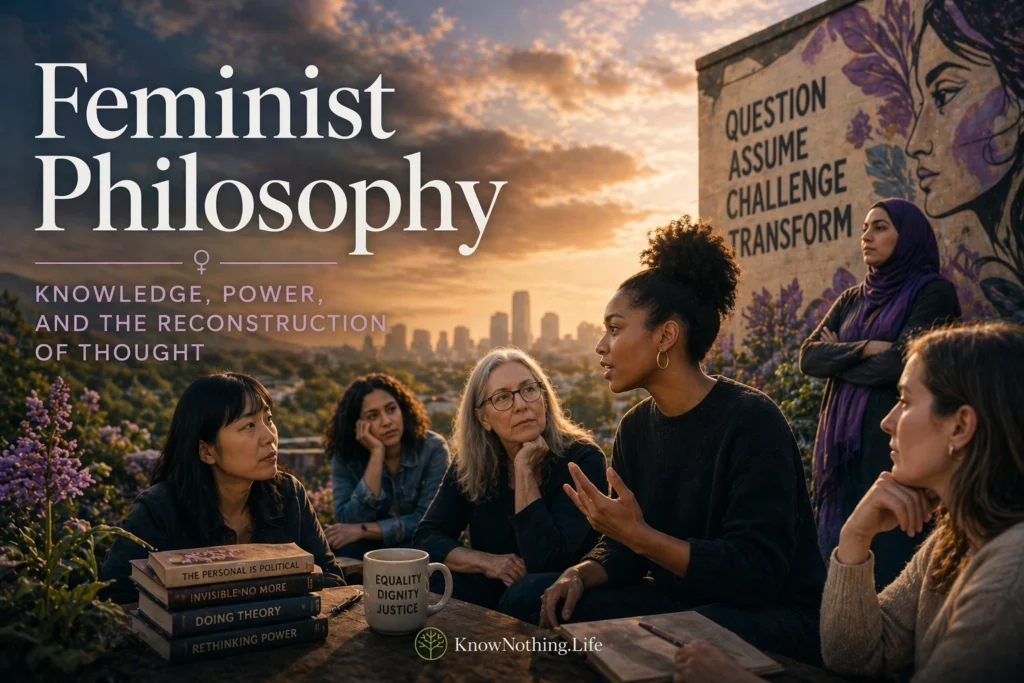
Feminist philosophy is a diverse and dynamic field that examines how gender shapes knowledge, power, and lived experience. It challenges traditional philosophical assumptions by exposing the ways in which dominant frameworks have historically excluded or marginalized women and other underrepresented groups. Rather than forming a single doctrine, feminist philosophy encompasses a range of approaches united by a commitment to analyzing inequality and rethinking foundational concepts in ethics, epistemology, politics, and metaphysics.
At its core, feminist philosophy asks how philosophical ideas are influenced by social context. It questions claims of neutrality and universality, arguing that perspectives are often shaped by power structures that privilege certain voices over others. By bringing attention to these dynamics, feminist philosophy seeks not only to critique existing systems of thought but also to reconstruct them in more inclusive and equitable ways. This project has far-reaching implications, transforming how philosophy understands knowledge, identity, and justice.
Historical Foundations and Early Voices
The roots of feminist philosophy can be traced to early thinkers who challenged prevailing assumptions about women’s roles and capacities. In the 18th century, Mary Wollstonecraft argued for the education and equality of women, criticizing social structures that limited their opportunities. Her work laid the groundwork for later feminist thought by emphasizing the importance of reason and autonomy for all individuals.
In the 19th century, John Stuart Mill and Harriet Taylor Mill advanced arguments for women’s rights, including legal and political equality. Their writings highlighted the ways in which social institutions perpetuate inequality, challenging the assumption that gender roles are natural or fixed. These early contributions demonstrate that feminist philosophy has long been concerned with both theoretical and practical issues.
The development of feminist philosophy in the 20th century marked a significant expansion of the field. Thinkers began to examine not only overt discrimination but also the deeper structures of power that shape knowledge and experience. This shift introduced new methodologies and perspectives, transforming feminist philosophy into a broad and interdisciplinary area of inquiry.
Epistemology and the Critique of Objectivity
One of the most influential contributions of feminist philosophy is its critique of traditional epistemology. Feminist epistemologists argue that claims of objectivity often mask underlying biases, reflecting the perspectives of dominant groups. This critique challenges the idea that knowledge can be entirely neutral, emphasizing the role of social context in shaping understanding.
Philosophers such as Sandra Harding have developed the concept of standpoint epistemology, which suggests that marginalized perspectives can provide unique insights into social reality. According to this view, individuals who experience oppression may be better positioned to recognize certain forms of injustice, as they are more directly affected by them. This approach redefines objectivity as a more inclusive and reflective process.
Feminist epistemology also addresses issues of credibility and authority. It examines how certain voices are privileged while others are dismissed, exploring the social dynamics that influence whose knowledge is recognized. By highlighting these patterns, feminist philosophy seeks to create more equitable conditions for the production and validation of knowledge.
Gender, Identity, and Social Construction
Feminist philosophy has played a central role in analyzing the concept of gender, challenging the idea that it is a fixed or purely biological category. Instead, many feminist thinkers argue that gender is socially constructed, shaped by cultural norms, expectations, and practices. This perspective emphasizes the variability of gender across different contexts, highlighting its dynamic and contingent nature.
Simone de Beauvoir famously argued that one is not born a woman but becomes one, emphasizing the role of socialization in shaping identity. This insight has been foundational for feminist theory, opening the door to further exploration of how gender intersects with other aspects of identity, such as race, class, and sexuality.
The concept of intersectionality, developed by thinkers like Kimberlé Crenshaw, extends this analysis by examining how different forms of oppression interact. Intersectionality highlights the complexity of identity, showing that experiences of inequality cannot be understood in isolation. Feminist philosophy thus provides a framework for analyzing the multifaceted nature of social identity and its implications for justice.
Ethics of Care and Relational Thinking
Feminist philosophy has also contributed significantly to ethical theory, particularly through the development of the ethics of care. This approach challenges traditional models of ethics that emphasize abstract principles and individual autonomy, instead focusing on relationships, empathy, and context.
Philosophers such as Carol Gilligan and Nel Noddings argue that moral reasoning is deeply connected to the capacity for care and responsiveness to others. This perspective emphasizes the importance of understanding individuals within their social and relational contexts, rather than treating them as isolated agents.
The ethics of care has broadened the scope of moral philosophy, highlighting aspects of ethical life that were previously overlooked. It underscores the significance of emotions, relationships, and vulnerability, offering a more holistic account of moral experience. This approach has influenced fields such as education, healthcare, and social policy, demonstrating the practical impact of feminist ethical theory.
Power, Language, and Representation
Feminist philosophy examines how power operates through language and representation, shaping how individuals understand themselves and others. Language is not a neutral medium but a tool that can reinforce or challenge social hierarchies. By analyzing linguistic practices, feminist philosophers reveal how certain assumptions about gender and identity are embedded in everyday discourse.
Philosophers such as Judith Butler have explored the performative nature of gender, arguing that identity is constituted through repeated actions and expressions. This perspective highlights the role of language and social practices in maintaining or disrupting norms, suggesting that change is possible through reimagining these practices.
The study of representation also extends to media, culture, and institutions, examining how images and narratives shape perceptions of gender. By critiquing these representations, feminist philosophy seeks to challenge stereotypes and promote more diverse and accurate portrayals of human experience.
Feminist Philosophy in Contemporary Context
In contemporary thought, feminist philosophy continues to evolve, addressing new challenges and incorporating diverse perspectives. It engages with issues such as globalization, technology, and environmental justice, expanding its scope to include a wide range of social and ethical concerns. This interdisciplinary approach reflects the complexity of modern life, where different forms of inequality intersect and interact.
Feminist philosophy also emphasizes inclusivity, incorporating voices from different cultural and social backgrounds. This diversity enriches the field, providing a more comprehensive understanding of human experience. By engaging with global perspectives, feminist philosophy contributes to a more nuanced and interconnected view of the world.
At the same time, the field faces ongoing challenges, including resistance to its critiques and the need to balance theoretical analysis with practical action. Nevertheless, its influence continues to grow, shaping debates in philosophy and beyond. Feminist philosophy remains a vital and transformative area of inquiry, offering tools for understanding and addressing inequality.
Conclusion
Feminist philosophy represents a profound rethinking of traditional philosophical frameworks, challenging assumptions about knowledge, identity, and power. By examining the ways in which gender and other social factors shape experience, it provides a more inclusive and critical approach to philosophical inquiry. Its contributions extend across multiple areas, from epistemology and ethics to politics and culture.
The field highlights the importance of perspective and context, showing that understanding the world requires attention to diverse experiences and voices. It also emphasizes the role of philosophy in addressing real-world issues, linking theoretical insights with practical concerns. Through its critiques and innovations, feminist philosophy has transformed how we think about fundamental questions.
Ultimately, feminist philosophy invites a deeper engagement with the structures that shape human life. It encourages reflection on how knowledge is produced, how identities are formed, and how justice can be achieved. In doing so, it offers a vision of philosophy as a tool for both understanding and change, grounded in a commitment to equality and inclusivity.