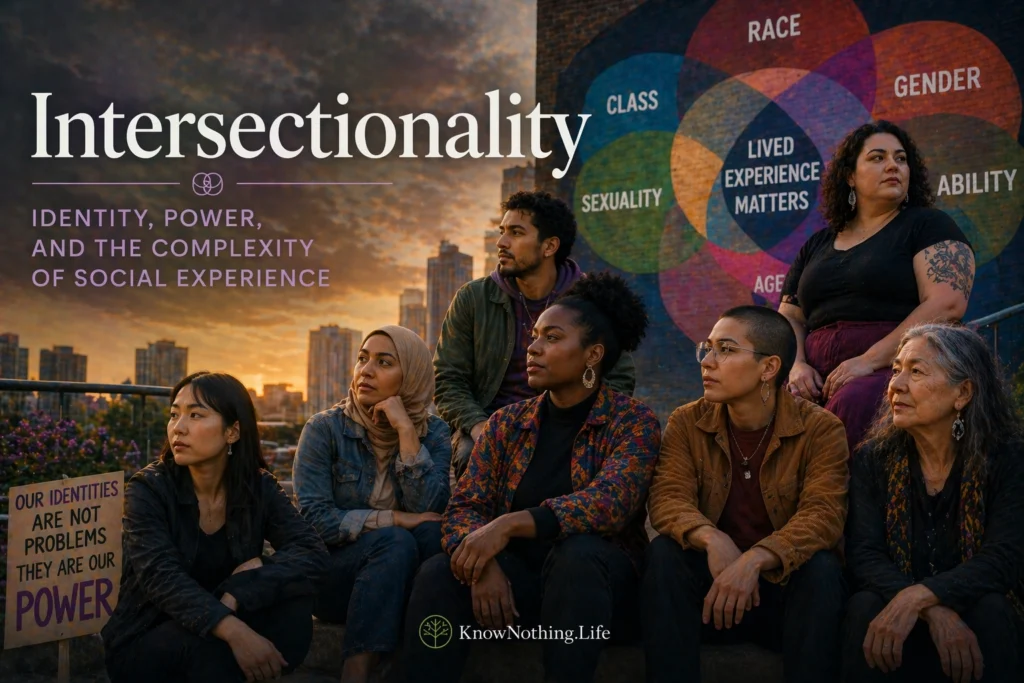
Intersectionality is a framework for understanding how different aspects of identity—such as race, gender, class, sexuality, and ability—interact to shape individual experiences and social outcomes. Rather than treating these categories as separate and independent, intersectionality emphasizes their interconnected nature, showing how multiple forms of inequality can overlap and reinforce one another. This perspective challenges simplified approaches to social analysis, revealing the complexity of lived experience.
Philosophically, intersectionality raises questions about identity, justice, and the nature of oppression. It asks how social categories are constructed and how they function within systems of power. It also explores how individuals navigate multiple and sometimes conflicting identities, highlighting the importance of context in understanding human experience. By addressing these issues, intersectionality provides a more nuanced and inclusive framework for analyzing social reality.
Origins and Development of Intersectionality
The concept of intersectionality was developed by Kimberlé Crenshaw in the late 20th century, building on earlier feminist and civil rights scholarship. Crenshaw introduced the term to describe how legal and social systems often fail to address the unique experiences of individuals who belong to multiple marginalized groups. Her work highlighted the limitations of frameworks that consider only one dimension of identity at a time.
Intersectionality emerged from a broader tradition of thought that sought to challenge dominant narratives about inequality. Black feminist thinkers, such as bell hooks, emphasized the need to consider the combined effects of race, gender, and class in shaping social experience. These contributions laid the groundwork for intersectionality as a critical analytical tool.
Over time, intersectionality has expanded beyond its original context, influencing fields such as sociology, philosophy, political theory, and cultural studies. Its development reflects a growing recognition of the complexity of social identity and the need for approaches that account for this complexity. Today, intersectionality is widely used to analyze issues of inequality and to inform efforts toward social justice.
The Nature of Intersecting Identities
At the heart of intersectionality is the idea that identities are not isolated but intersect in ways that produce unique experiences. For example, the experience of a woman cannot be fully understood without considering factors such as race, class, or sexuality. These intersections create forms of advantage and disadvantage that differ from those experienced by individuals who share only one aspect of identity.
Philosophically, this challenges essentialist views of identity, which assume that categories such as “woman” or “Black” have fixed and universal meanings. Intersectionality emphasizes that these categories are shaped by context and interaction, highlighting their fluid and relational nature. This perspective aligns with broader critiques of identity that question the stability and coherence of social categories.
Understanding intersecting identities requires attention to both individual experience and structural context. Individuals navigate their identities within systems of power that influence opportunities, constraints, and social recognition. Intersectionality thus provides a framework for analyzing how these systems operate and how they affect different groups in distinct ways.
Power, Oppression, and Structural Inequality
Intersectionality is deeply concerned with the dynamics of power and oppression. It examines how social structures—such as laws, institutions, and cultural norms—create and maintain inequalities. These structures often operate in ways that privilege certain groups while disadvantaging others, reinforcing patterns of inequality across multiple dimensions.
Philosophers and theorists draw on the work of Michel Foucault to analyze how power functions within society. Foucault’s concept of power as diffuse and pervasive helps explain how inequalities are embedded in everyday practices and institutions. Intersectionality builds on this insight by showing how different forms of power intersect, creating complex patterns of domination and resistance.
The analysis of structural inequality highlights the importance of considering context in ethical and political discussions. Policies and practices that appear neutral may have unequal effects on different groups, depending on how identities intersect. Intersectionality thus provides a critical lens for evaluating social systems and identifying areas for change.
Epistemology and Standpoint Theory
Intersectionality has significant implications for epistemology, the study of knowledge. It challenges the idea that knowledge can be entirely objective or detached from social context, emphasizing the role of perspective in shaping understanding. This aligns with feminist epistemology and standpoint theory, which argue that marginalized groups can offer valuable insights into social reality.
Standpoint theorists suggest that individuals who experience oppression may have a unique vantage point from which to analyze systems of power. Their experiences can reveal aspects of social structure that are invisible to those in more privileged positions. This perspective redefines objectivity as a more inclusive and reflective process, incorporating diverse viewpoints.
Intersectionality extends this idea by emphasizing that no single standpoint is sufficient. Because identities intersect, individuals may occupy multiple positions within systems of power, each providing different insights. This complexity underscores the importance of dialogue and collaboration in the pursuit of knowledge, as well as the need to consider multiple perspectives.
Intersectionality and Ethics
Intersectionality also plays a crucial role in ethical theory, particularly in discussions of justice and responsibility. Traditional ethical frameworks often assume a universal subject, overlooking the ways in which social context influences moral experience. Intersectionality challenges this assumption, highlighting the need for ethical approaches that account for diversity and complexity.
In practical terms, this means considering how policies and actions affect different groups in different ways. Ethical decision-making must account for the intersecting identities of those involved, recognizing that outcomes may not be equally distributed. This perspective emphasizes fairness and inclusivity, encouraging more nuanced and context-sensitive approaches to ethics.
Intersectionality also raises questions about moral responsibility. If individuals are shaped by social structures, to what extent can they be held accountable for their actions? This question highlights the tension between individual agency and structural influence, suggesting that ethical analysis must consider both dimensions.
Representation, Culture, and Social Narratives
Cultural representation is another key area of intersectional analysis. Media, literature, and other forms of cultural expression shape how identities are understood and valued. Intersectionality examines how these representations can reinforce stereotypes or challenge dominant narratives, influencing perceptions of different groups.
The work of Judith Butler on performativity is relevant here, as it highlights the role of repeated actions and expressions in constructing identity. Intersectionality builds on this by examining how multiple aspects of identity are represented and how these representations interact. This analysis reveals the complexity of cultural narratives and their impact on social experience.
By critiquing representation, intersectionality seeks to promote more inclusive and accurate portrayals of identity. This involves challenging stereotypes and creating space for diverse voices and perspectives. Cultural change is thus an important component of addressing inequality, complementing structural and institutional efforts.
Intersectionality in Contemporary Context
In contemporary society, intersectionality has become a central framework for analyzing social issues and promoting justice. It is used to examine a wide range of topics, from healthcare and education to politics and employment. Its emphasis on complexity and context makes it particularly relevant in addressing the challenges of a diverse and interconnected world.
The interdisciplinary nature of intersectionality allows it to draw on insights from multiple fields, including philosophy, sociology, and law. This integration reflects the complexity of the issues it addresses, requiring a comprehensive approach that considers both theoretical and practical dimensions. Intersectionality thus serves as a bridge between academic analysis and real-world application.
At the same time, the application of intersectionality presents challenges. Balancing the need for detailed analysis with the practical demands of policy and action can be difficult. Nevertheless, its influence continues to grow, shaping discussions of equality and justice in meaningful ways.
Conclusion
Intersectionality provides a powerful framework for understanding the complexity of social identity and the dynamics of power and inequality. By emphasizing the interconnected nature of different forms of oppression, it challenges simplified approaches and encourages more nuanced analysis. Its contributions extend across philosophy, social theory, and practical ethics, offering valuable insights into the structure of human experience.
The study of intersectionality highlights the importance of context, perspective, and diversity in understanding social issues. It reveals that identities are not fixed or isolated but are shaped by interactions within systems of power. This perspective opens new possibilities for addressing inequality and promoting justice.
Ultimately, intersectionality invites a deeper engagement with the realities of human life. It encourages reflection on how identities are formed and how they influence experience, offering a framework for creating more inclusive and equitable societies. By recognizing the complexity of identity, it provides a foundation for more thoughtful and effective approaches to social change.