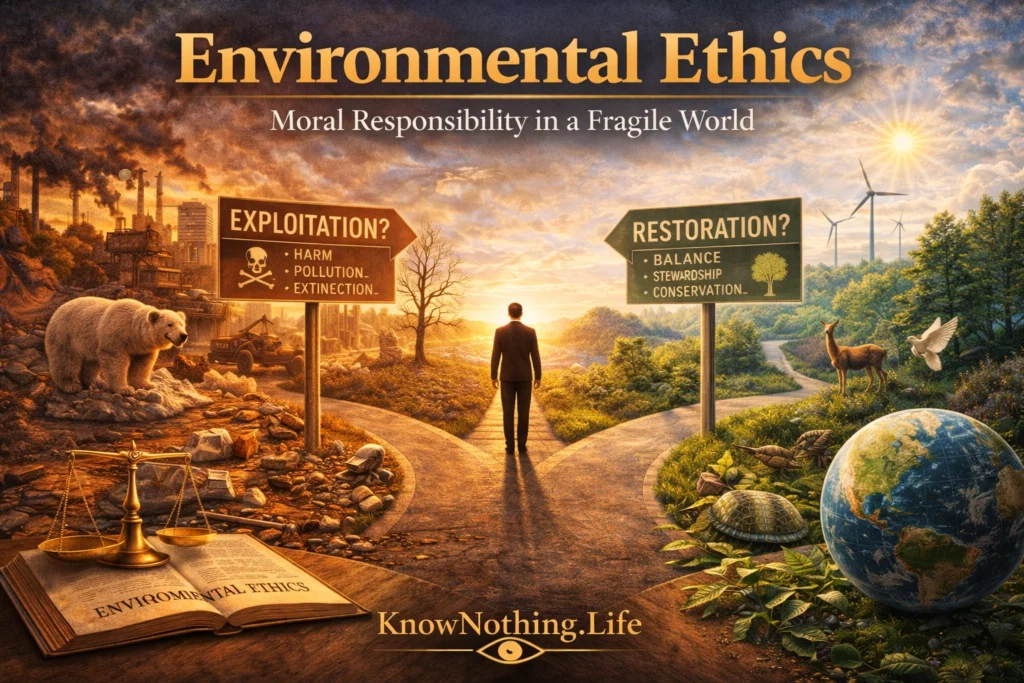
Environmental ethics is the branch of applied ethics that examines the moral relationship between human beings and the natural world. It asks a fundamental question: Do humans have obligations beyond themselves—to animals, ecosystems, and future generations? As environmental crises such as climate change, biodiversity loss, and resource depletion intensify, this question has become one of the most urgent in contemporary philosophy. Environmental ethics seeks not only to understand these issues but to guide action in response to them.
Traditionally, ethical systems were largely anthropocentric, focusing on human interests and treating nature as a resource to be used. Environmental ethics challenges this perspective by expanding the moral community to include non-human life and even entire ecosystems. It asks whether forests, rivers, and species possess intrinsic value—value independent of their usefulness to humans—and what obligations follow from recognizing such value.
The field is inherently interdisciplinary, drawing on philosophy, ecology, economics, and political theory. It reflects a shift in moral thinking from short-term human benefit to long-term ecological sustainability. In doing so, environmental ethics redefines what it means to act responsibly in a world where human actions have global and lasting consequences.
Historical Development and Philosophical Foundations
Although environmental ethics emerged as a formal discipline in the 20th century, its roots can be traced to earlier philosophical and cultural traditions that emphasized harmony with nature. Indigenous worldviews, for example, often recognize the interconnectedness of all living things and the importance of stewardship. These perspectives challenge the dominance of human-centered ethics and offer alternative frameworks for understanding moral responsibility.
In modern philosophy, Henry David Thoreau played a significant role in shaping environmental thought. In Walden, Thoreau reflected on the value of simplicity and the importance of living in close connection with nature. “In wildness is the preservation of the world,” he wrote, suggesting that the natural environment possesses a value that transcends human utility. His work inspired later thinkers to reconsider the ethical significance of the natural world.
A major turning point in environmental ethics came with Aldo Leopold and his influential essay “The Land Ethic,” included in A Sand County Almanac. Leopold proposed that humans are members of a broader ecological community and that ethical consideration should extend to the land itself. “A thing is right,” he wrote, “when it tends to preserve the integrity, stability, and beauty of the biotic community.” This idea marked a shift from individual-centered ethics to an ecological perspective, laying the foundation for modern environmental philosophy.
Anthropocentrism vs Non-Anthropocentrism
A central debate in environmental ethics concerns the scope of moral consideration: should ethical concern be limited to humans, or should it include non-human entities? Anthropocentrism holds that only human beings have intrinsic moral value, and that the environment matters primarily insofar as it affects human well-being. This view has historically dominated Western thought, supporting the use of natural resources for human purposes.
Non-anthropocentric perspectives challenge this limitation, arguing that animals, plants, and ecosystems possess intrinsic value. Peter Singer, in Animal Liberation, extended moral consideration to non-human animals based on their capacity to suffer. He argued that species membership alone is not a morally relevant criterion, coining the term “speciesism” to describe the unjustified preference for human interests over those of other beings.
Other philosophers have gone further, advocating for biocentrism or ecocentrism. Biocentrism assigns intrinsic value to all living organisms, while ecocentrism emphasizes the value of entire ecosystems. These perspectives challenge traditional ethical frameworks by expanding the moral community and redefining the basis of moral worth. They raise important questions about how to balance competing interests and how to act responsibly in a complex ecological system.
Deep Ecology and Ecological Thinking
One of the most influential movements in environmental ethics is deep ecology, developed by Arne Naess. Deep ecology calls for a fundamental shift in human consciousness, moving away from an anthropocentric worldview toward a recognition of the intrinsic value of all forms of life. Naess argued that environmental problems cannot be solved merely through technological or policy changes; they require a transformation in how humans perceive their place in the world.
Deep ecology emphasizes the interconnectedness of all living beings and the importance of ecological balance. It challenges the idea that humans are separate from or superior to nature, instead viewing humanity as one part of a larger ecological whole. This perspective encourages practices such as conservation, sustainability, and respect for biodiversity, grounded in a deep appreciation of the natural world.
Critics of deep ecology argue that it may be too abstract or impractical, particularly when it comes to making policy decisions. However, its emphasis on holistic thinking and long-term perspective has had a significant influence on environmental philosophy and activism. It highlights the need for ethical frameworks that address not only immediate concerns but also the broader context of ecological relationships.
Environmental Justice and Global Responsibility
Environmental ethics also encompasses issues of justice, particularly the unequal distribution of environmental benefits and burdens. Environmental justice examines how factors such as race, class, and geography influence access to clean air, water, and natural resources. It highlights the ways in which marginalized communities are often disproportionately affected by pollution, climate change, and environmental degradation.
Philosophers and activists have argued that addressing environmental issues requires not only ecological awareness but also social equity. The concept of intergenerational justice further expands this perspective by considering the rights and interests of future generations. Decisions made today—such as those related to fossil fuel use or deforestation—have long-term consequences that will affect people who have no say in current policies.
Hans Jonas addressed these concerns in The Imperative of Responsibility, arguing that modern technology imposes new ethical obligations. “Act so that the effects of your action are compatible with the permanence of genuine human life,” he wrote, emphasizing the need for foresight and responsibility. This principle underscores the importance of considering both present and future impacts in ethical decision-making.
Climate Change and Contemporary Ethical Challenges
Climate change represents one of the most pressing challenges in environmental ethics, raising questions about responsibility, cooperation, and sacrifice. It involves complex interactions between scientific knowledge, economic interests, and political decision-making, making ethical analysis both difficult and essential. Who is responsible for reducing emissions? How should the costs of mitigation be distributed? What obligations do wealthy nations have to poorer ones?
These questions highlight the global nature of environmental ethics. Unlike many traditional ethical issues, climate change cannot be addressed by individuals or nations acting alone. It requires coordinated action and a shared commitment to sustainability. This raises challenges related to collective responsibility and the enforcement of ethical norms on a global scale.
Environmental ethics also intersects with technological innovation, such as renewable energy and geoengineering. While these developments offer potential solutions, they also introduce new risks and ethical dilemmas. Balancing innovation with caution requires careful consideration of both immediate benefits and long-term consequences, reflecting the broader themes of responsibility and stewardship.
Conclusion
Environmental ethics represents a critical expansion of moral philosophy, addressing the relationship between humans and the natural world in an era of unprecedented environmental change. By challenging anthropocentric assumptions and emphasizing the intrinsic value of nature, it offers a framework for understanding and responding to ecological crises.
The contributions of thinkers such as Henry David Thoreau, Aldo Leopold, Arne Naess, and Hans Jonas have shaped the field, providing diverse perspectives on how to approach environmental responsibility. Their work highlights the importance of integrating ethical reflection with scientific understanding and social awareness.
Ultimately, environmental ethics calls for a rethinking of human values and priorities. It challenges individuals and societies to act not only in their own interest but in the interest of the broader ecological community. In doing so, it offers a path toward a more sustainable and ethically grounded relationship with the world we inhabit.