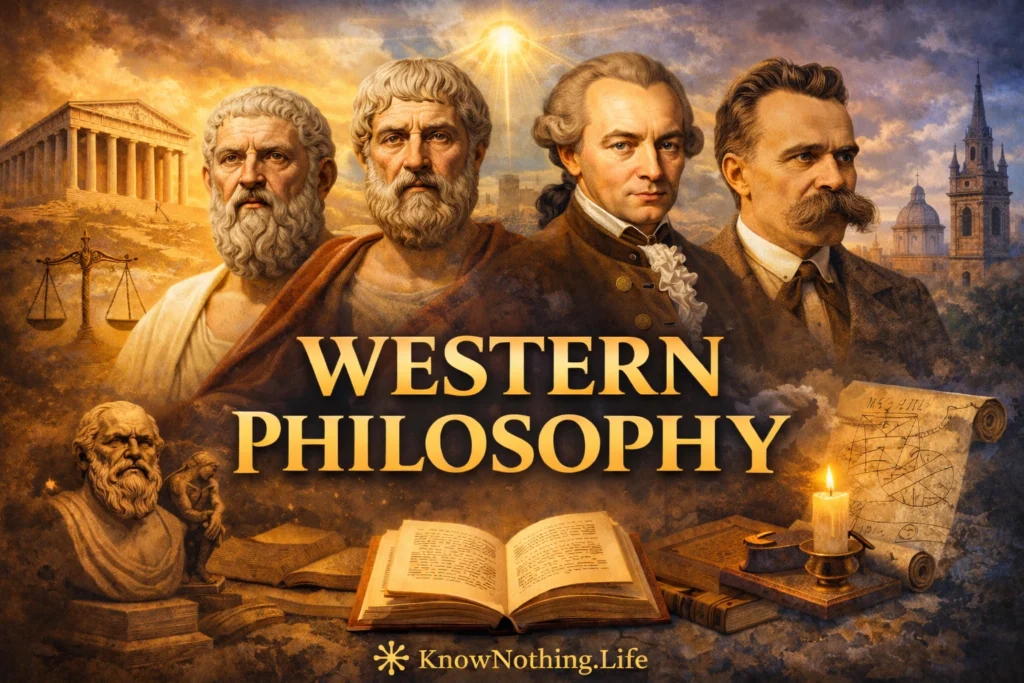
Western philosophy represents a continuous intellectual tradition that seeks to understand reality, knowledge, ethics, and human existence through reasoned inquiry. Originating in ancient Greece and evolving through centuries of debate, Western philosophy has shaped science, politics, religion, and culture. It is characterized by its emphasis on logic, argumentation, and systematic exploration of fundamental questions, including what exists, how we know, and how we ought to live.
This tradition is not a single unified system but a dynamic and evolving conversation. Each generation of philosophers responds to the ideas of those who came before, refining, challenging, and expanding them. The development of Western philosophy reflects broader historical changes, including the rise of scientific thinking, the influence of religious traditions, and the emergence of modern political systems. By tracing its major phases, we can better understand how philosophical inquiry has shaped—and continues to shape—the modern world.
Ancient Greek Foundations
Western philosophy begins in ancient Greece, where thinkers sought to explain the world through reason rather than myth. Early philosophers, known as the pre-Socratics, explored questions about the nature of reality, proposing theories about the fundamental substance of the universe. However, it is with Socrates that philosophy takes a decisive turn toward ethical inquiry and critical reflection. Socrates, as depicted in the dialogues of Plato, emphasizes the importance of questioning assumptions and examining one’s beliefs. He famously declares, “The unexamined life is not worth living,” underscoring the role of self-reflection in the pursuit of wisdom.
Plato builds on this foundation in works such as The Republic, where he explores justice, knowledge, and the ideal state. His theory of Forms posits that true reality consists of abstract, unchanging entities that exist beyond the physical world. This metaphysical framework influences subsequent philosophical thought, particularly in its emphasis on reason as a means of accessing truth.
Aristotle, Plato’s student, offers a more empirical approach in works like Nicomachean Ethics and Metaphysics. Aristotle emphasizes observation and classification, laying the groundwork for scientific inquiry. His ethical theory, centered on virtue and the cultivation of character, reflects a practical approach to philosophy, focusing on how individuals can achieve a flourishing life.
Medieval Philosophy and the Role of Religion
The medieval period sees the integration of philosophical inquiry with religious thought, particularly within Christian, Islamic, and Jewish traditions. Philosophy becomes a tool for understanding and articulating theological concepts, leading to a synthesis of faith and reason. Augustine of Hippo, in works such as Confessions, explores the relationship between divine truth and human understanding, emphasizing the role of introspection and faith.
Thomas Aquinas further develops this synthesis in Summa Theologica. Drawing on Aristotle, Aquinas argues that reason and revelation are compatible, and that philosophical inquiry can support religious belief. His work represents a high point in medieval philosophy, integrating classical ideas with theological frameworks.
In the Islamic world, philosophers such as Avicenna and Averroes engage deeply with Greek philosophy, preserving and expanding its insights. Their contributions highlight the cross-cultural exchange of ideas that characterizes this period, demonstrating that Western philosophy has always been influenced by broader intellectual traditions.
The Rise of Modern Philosophy
The transition to modern philosophy marks a shift toward new methods of inquiry and a renewed emphasis on human reason. René Descartes, in Meditations on First Philosophy, seeks a foundation for knowledge based on certainty. His method of doubt leads to the famous conclusion, “I think, therefore I am,” establishing the thinking self as the starting point for philosophical inquiry.
The modern period is characterized by the development of rationalism and empiricism. Rationalists, such as Baruch Spinoza, emphasize reason as the primary source of knowledge, while empiricists like John Locke and David Hume argue that knowledge arises from experience. Locke’s concept of the mind as a “tabula rasa” suggests that individuals are shaped by their environment, while Hume’s skepticism challenges assumptions about causation and certainty.
Immanuel Kant attempts to reconcile these perspectives in Critique of Pure Reason. Kant argues that knowledge results from the interaction between sensory experience and the structures of the mind, offering a synthesis that reshapes epistemology. His work marks a turning point in Western philosophy, influencing subsequent debates about knowledge, ethics, and metaphysics.
Nineteenth-Century Transformations
The nineteenth century sees significant developments in Western philosophy, with thinkers addressing the social, political, and existential challenges of their time. Georg Wilhelm Friedrich Hegel develops a dialectical approach to history and reality, emphasizing the dynamic and evolving nature of ideas. His work influences a wide range of later thinkers, including Karl Marx, who applies dialectical analysis to economic and social structures.
Marx’s critique of capitalism, articulated in Capital, focuses on issues of class, labor, and inequality. He argues that economic systems shape social relations and that philosophical inquiry must address material conditions. His famous assertion that “philosophers have only interpreted the world… the point, however, is to change it” reflects a shift toward practical and transformative approaches to philosophy.
At the same time, existential themes begin to emerge in the work of Friedrich Nietzsche, who challenges traditional moral and religious values. Nietzsche’s declaration that “God is dead” signals a crisis of meaning and authority, prompting new questions about individual freedom and responsibility. These developments highlight the diversity and complexity of nineteenth-century philosophy.
Twentieth-Century Traditions: Analytic and Continental Thought
In the twentieth century, Western philosophy becomes increasingly specialized, giving rise to distinct traditions. Analytic philosophy, associated with figures like Bertrand Russell and Ludwig Wittgenstein, emphasizes clarity, logic, and the analysis of language. Wittgenstein’s Philosophical Investigations explores how meaning arises from language use, challenging traditional assumptions about representation.
Continental philosophy, by contrast, focuses on broader questions of existence, culture, and interpretation. Martin Heidegger, in Being and Time, examines the nature of being and the human condition, while Jean-Paul Sartre develops existentialism, emphasizing freedom and responsibility. Sartre writes, “Man is condemned to be free,” highlighting the burden of choice in a world without predetermined meaning.
These traditions reflect different approaches to philosophical inquiry, with analytic philosophy prioritizing precision and continental philosophy emphasizing interpretation and critique. Together, they illustrate the richness and diversity of modern philosophical thought.
The Continuing Evolution of Western Philosophy
Western philosophy continues to evolve, addressing new challenges and incorporating diverse perspectives. Contemporary debates explore issues such as technology, environmental ethics, and global justice, reflecting the changing conditions of modern life. Philosophers draw on earlier traditions while also engaging with new ideas, demonstrating the adaptability of philosophical inquiry.
The influence of Western philosophy extends beyond academia, shaping public discourse, policy, and cultural understanding. Its emphasis on critical thinking and reasoned argument provides tools for navigating complex issues and making informed decisions. At the same time, it remains open to revision and critique, reflecting its commitment to ongoing inquiry.
Ultimately, Western philosophy is not a fixed body of knowledge but a living tradition, characterized by dialogue and exploration. Its enduring significance lies in its ability to ask fundamental questions and to challenge assumptions, inviting individuals to engage with the world in thoughtful and reflective ways.