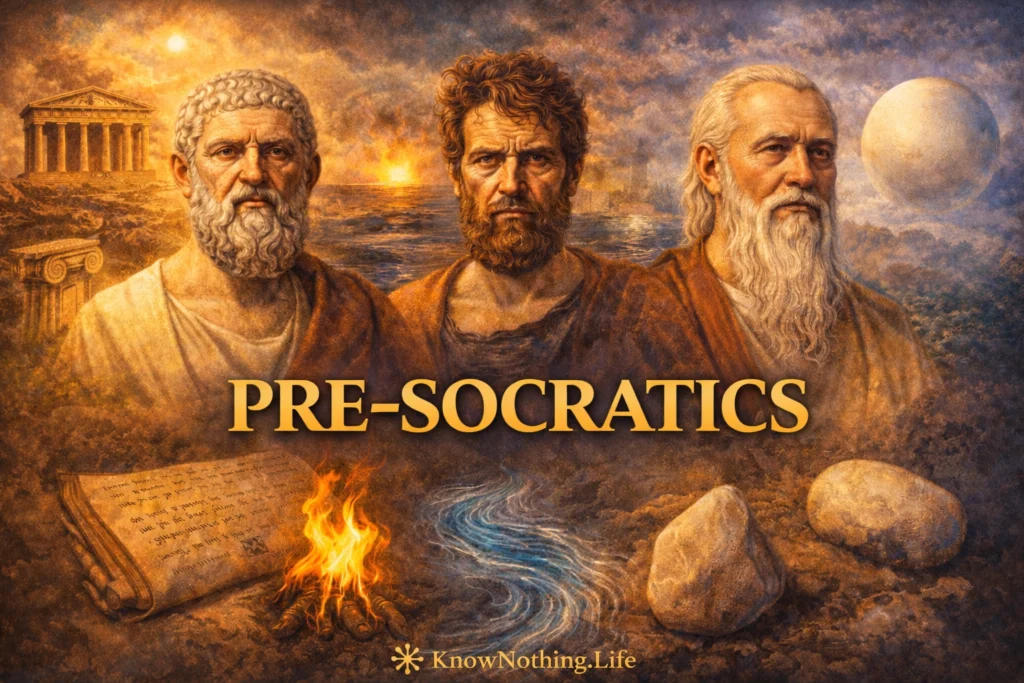
The Pre-Socratic philosophers mark the beginning of Western philosophy, representing the first sustained attempt to explain the world through reason rather than myth. Active primarily between the 6th and 5th centuries BCE, these thinkers sought to identify the underlying principles of nature, asking what the world is made of, how change occurs, and whether reality is stable or in flux. Their work laid the intellectual foundation for later philosophical inquiry, shifting attention from divine narratives to rational explanation.
What distinguishes the Pre-Socratics is not only the content of their ideas but their method. They introduced a new way of thinking—one that relied on observation, argument, and speculation rather than tradition alone. While their writings survive only in fragments and later reports, their influence is profound. They established many of the central questions of philosophy, particularly in metaphysics and cosmology, and their debates continue to resonate in modern scientific and philosophical discussions.
The Milesian School and the Search for the Arche
The earliest Pre-Socratic thinkers are associated with the Milesian school, located in the Greek city of Miletus. Thales is often considered the first philosopher in this tradition. He proposes that water is the fundamental substance, or arche, underlying all things. While this claim may seem simplistic, its significance lies in its attempt to explain the diversity of the natural world through a single unifying principle.
Thales’ successors, Anaximander and Anaximenes, develop this idea further. Anaximander introduces the concept of the apeiron, an indefinite and boundless origin from which all things emerge and to which they return. This represents a move toward abstraction, suggesting that the fundamental principle of reality cannot be identified with any specific element. Anaximenes, by contrast, returns to a more concrete proposal, identifying air as the primary substance and explaining change through processes of condensation and rarefaction.
These early thinkers are united by their search for unity behind diversity. They seek to explain how the multiplicity of the world arises from a single source, establishing a pattern of inquiry that would shape the development of both philosophy and science. Their work represents a crucial step in the transition from mythological to rational explanations of the cosmos.
Heraclitus and the Doctrine of Flux
A significant departure from the Milesian emphasis on stability is found in the philosophy of Heraclitus. Heraclitus argues that change is the fundamental feature of reality, encapsulated in his famous statement, “You cannot step into the same river twice.” For him, the world is in a constant state of flux, with all things undergoing continuous transformation.
Heraclitus introduces the concept of the logos, a rational principle that governs the process of change. While everything is in flux, this change is not chaotic but follows an underlying order. The logos represents the unity within diversity, providing a framework for understanding the dynamic nature of reality. Heraclitus’ philosophy emphasizes the tension between opposites, suggesting that conflict and balance are essential to the structure of the world.
This perspective challenges the search for a stable underlying substance, shifting the focus to processes and relationships. Heraclitus’ emphasis on change and contradiction has had a lasting influence, particularly in later philosophical traditions that explore the nature of becoming and transformation.
Parmenides and the Denial of Change
In stark contrast to Heraclitus, Parmenides argues that change is an illusion and that reality is unchanging and unified. In his poem On Nature, Parmenides distinguishes between the “way of truth” and the “way of opinion,” asserting that only reason, not sensory experience, can reveal the true nature of reality. According to Parmenides, what is must be, and what is not cannot be; therefore, change, which implies the coming into being of what is not, is impossible.
Parmenides’ argument represents a radical challenge to earlier thinkers, calling into question the reliability of the senses and the possibility of change. His emphasis on logical consistency and rational argument marks a significant development in philosophical method, influencing later thinkers such as Plato.
The tension between Heraclitus and Parmenides—between change and permanence—becomes one of the central problems of philosophy. Subsequent thinkers attempt to reconcile these opposing views, seeking a framework that can account for both the stability and the dynamism of the world.
Pluralists and the Reconciliation of Change and Stability
In response to the conflict between Heraclitus and Parmenides, a group of philosophers known as the pluralists attempt to reconcile the existence of change with the idea of unchanging elements. Empedocles proposes that all matter is composed of four elements—earth, air, fire, and water—combined and separated by the forces of love and strife. This model allows for change as the rearrangement of stable components, preserving Parmenides’ insight while accommodating Heraclitus’ emphasis on transformation.
Anaxagoras introduces a different solution, suggesting that the universe is composed of infinitely divisible particles, or “seeds,” organized by a cosmic mind, or nous. This concept of a directing intelligence adds a new dimension to Pre-Socratic thought, integrating rational order with physical processes.
These pluralist theories represent an important step in the development of scientific thinking, offering explanations that combine stability and change. They demonstrate the ability of philosophy to evolve through debate, incorporating and refining earlier ideas in the search for a coherent understanding of reality.
Atomism and the Nature of Reality
Another influential development in Pre-Socratic philosophy is the theory of atomism, associated with Leucippus and Democritus. According to this view, all matter is composed of indivisible particles, or atoms, moving through empty space. Change occurs through the rearrangement of these atoms, providing a mechanistic explanation of the natural world.
Democritus’ atomism represents a significant departure from earlier theories, emphasizing materialism and the absence of purpose or design in the universe. He famously states, “By convention sweet, by convention bitter… but in reality atoms and void,” highlighting the distinction between subjective experience and objective reality. This perspective anticipates later scientific developments, offering a model of the universe based on physical laws rather than metaphysical principles.
Atomism provides a powerful framework for understanding change and diversity, suggesting that complex phenomena can be explained through simple underlying structures. Its influence extends beyond philosophy, contributing to the development of modern science and shaping our understanding of the physical world.
The Legacy of the Pre-Socratics
The Pre-Socratic philosophers establish many of the central themes of Western philosophy, including the search for underlying principles, the nature of change, and the relationship between reason and experience. Their work represents a shift from mythological explanations to rational inquiry, laying the groundwork for subsequent philosophical traditions.
Their influence is evident in the work of later thinkers such as Plato and Aristotle, who build on and respond to Pre-Socratic ideas. Plato’s theory of Forms can be seen as an attempt to reconcile the insights of Heraclitus and Parmenides, while Aristotle’s empirical approach reflects the legacy of early natural philosophy.
Ultimately, the Pre-Socratics are significant not only for their specific theories but for their role in shaping the practice of philosophy itself. They demonstrate the power of reasoned inquiry and the importance of questioning assumptions, establishing a tradition of thought that continues to evolve and inspire.