The philosophy of Anaximander represents a decisive evolution in early Greek thought, moving beyond the search for a single observable substance to a more abstract and profound conception of reality. A student of Thales of Miletus, Anaximander did not simply continue his teacher’s work—he transformed it. Where Thales identified water as the fundamental principle, Anaximander proposed something far more radical: the apeiron, the infinite or boundless, as the origin of all things.
Born in the ancient Ionian city of Miletus in the early 6th century BCE, Anaximander lived in a culture rich with intellectual exchange and emerging scientific curiosity. His work marks one of the earliest attempts to describe the cosmos in abstract, non-mythological terms. By introducing the concept of the infinite as the source of reality, he expanded the scope of philosophical inquiry, laying the groundwork for metaphysics, cosmology, and scientific reasoning.
Life and Historical Context
Although detailed historical records are scarce, Anaximander is known to have been a prominent figure in Miletus, a center of early philosophical activity. As a member of the Milesian school, he was part of a tradition that sought to explain the natural world through reason and observation rather than myth. His association with Thales places him within the first generation of Western philosophers.
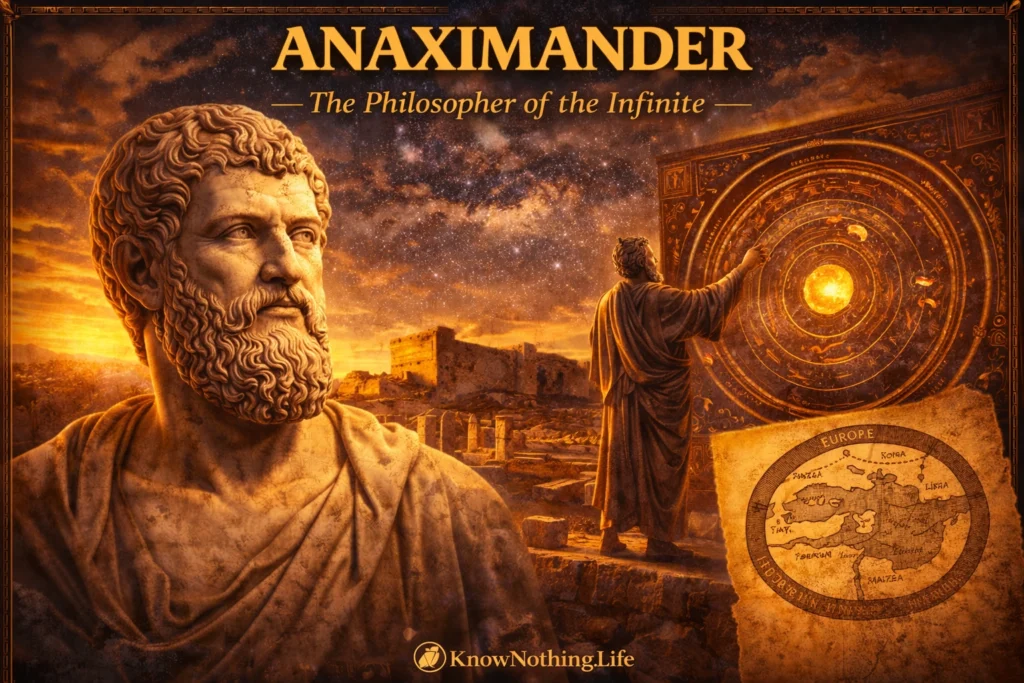
Anaximander is often credited with a range of intellectual achievements beyond philosophy. He is said to have constructed one of the earliest maps of the known world, as well as devices such as a gnomon—a simple instrument used to measure time and the position of the sun. These contributions reflect his interest in understanding both the structure of the Earth and its place within the cosmos.
The intellectual climate of his time was characterized by a shift from mythos to logos, from storytelling to rational explanation. Anaximander’s work exemplifies this transition, as he sought to describe the origins and structure of the universe using principles that could be understood through thought rather than tradition.
The Apeiron: The Infinite as First Principle
Anaximander’s most significant contribution is his concept of the apeiron, often translated as “the boundless” or “the infinite.” Unlike Thales’ water, the apeiron is not a specific substance that can be observed or measured. Instead, it is an abstract, indefinite principle that gives rise to all things.
The apeiron is eternal, ungenerated, and indestructible. It contains within itself the potential for all forms and opposites—hot and cold, wet and dry, light and dark. From this infinite source, the cosmos emerges through processes of separation and differentiation. This idea represents a major step forward in philosophical thinking, as it moves beyond concrete explanations to a more conceptual understanding of reality.
By introducing the apeiron, Anaximander addresses a problem inherent in earlier theories: if one element is the origin of all things, how can it give rise to its opposites? The infinite, being undefined and boundless, avoids this limitation. It serves as a neutral source from which all things can emerge without contradiction.
Cosmology and the Structure of the Universe
Anaximander’s cosmology reflects his innovative approach to understanding the universe. He proposed that the Earth is not supported by anything, but remains in place due to its equal distance from all other things. This idea challenges earlier notions of the Earth resting on a physical foundation, suggesting instead a balance of forces.
He also developed a model of the cosmos in which celestial bodies are arranged in concentric rings. The sun, moon, and stars are not independent entities, but are part of a structured system governed by natural laws. This perspective represents an early attempt to describe the universe as an ordered and intelligible whole.
Anaximander’s ideas about the origins of life are equally remarkable. He suggested that life began in the sea and that humans evolved from other forms of life, a concept that anticipates later theories of evolution. While his explanations were speculative, they demonstrate a willingness to explore the origins of existence through natural processes rather than myth.
Justice, Balance, and Cosmic Order
One of the most intriguing aspects of Anaximander’s philosophy is his concept of cosmic justice. He describes the interactions of opposites—such as hot and cold or wet and dry—as governed by a principle of balance. When one element dominates, it must eventually give way to its opposite, restoring equilibrium.
This idea is captured in a fragment often attributed to him:
- “Things perish into those things out of which they have their being, according to necessity; for they pay penalty and retribution to each other for their injustice according to the order of time.”
This statement suggests that the universe operates according to a form of moral or legal order, where imbalance is corrected through natural processes. While not moral in a human sense, this concept reflects a deep belief in the structured and regulated nature of reality.
Anaximander’s notion of cosmic justice introduces a dynamic element to his philosophy, emphasizing change and balance within a larger framework of order. It bridges the gap between metaphysics and ethics, suggesting that the principles governing the universe have a kind of inherent fairness.
Quotes and Key Ideas
Although Anaximander’s writings survive only in fragments, his ideas have been preserved through later philosophers, particularly Aristotle and Theophrastus. Key statements attributed to him include:
- “The boundless is the source of all things.”
- “Things arise from the apeiron and return to it.”
- “The Earth remains in place because of its equilibrium.”
- “All things are in a state of balance and justice.”
These ideas reflect his emphasis on the infinite, the cyclical nature of existence, and the structured order of the cosmos. They demonstrate a shift toward abstraction and conceptual thinking that would influence later philosophy.
Anaximander’s key contributions—the apeiron, his cosmological model, and the concept of cosmic justice—represent a significant advancement in the development of philosophical thought. They expand the scope of inquiry and introduce new ways of understanding reality.
Influence on Philosophy and Science
Anaximander’s influence on subsequent philosophy is substantial. His introduction of the apeiron as an abstract principle paved the way for later metaphysical concepts, including the idea of substance and the nature of existence. Philosophers such as Parmenides and Heraclitus engaged with questions that Anaximander helped to formulate.
His work also contributed to the development of scientific thought. By proposing natural explanations for the structure of the universe and the origins of life, he established a framework for inquiry that would later be refined by thinkers such as Aristotle. His emphasis on observation and reasoning anticipates the methods of modern science.
In addition, Anaximander’s contributions to geography and astronomy demonstrate the interconnectedness of his ideas. He did not separate disciplines, but approached knowledge as a unified pursuit, seeking to understand the world in its entirety.
Legacy and Historical Significance
Anaximander’s legacy lies in his willingness to move beyond the limits of observation and embrace abstraction. By proposing the infinite as the origin of all things, he introduced a concept that continues to resonate in philosophy and science. His work represents a crucial step in the development of metaphysics, expanding the scope of inquiry to include questions about the nature of existence itself.
Although his ideas were later challenged and refined, they remain foundational to the history of thought. Anaximander’s approach reflects a commitment to understanding the world through reason, a principle that continues to guide intellectual inquiry.
His contributions also highlight the importance of questioning assumptions. By rejecting the idea that a single observable element could explain the universe, he opened the door to more complex and nuanced explanations. This spirit of inquiry remains central to philosophy and science.
Conclusion
Anaximander stands as one of the most innovative thinkers of the early Greek tradition, transforming the search for knowledge through his introduction of the apeiron and his exploration of cosmic order. His work represents a shift from concrete explanations to abstract principles, expanding the boundaries of philosophical inquiry.
Through his cosmology, his concept of the infinite, and his emphasis on balance and justice, Anaximander offers a vision of the universe that is both dynamic and structured. His ideas challenge us to think beyond the limits of perception and to consider the deeper principles that govern reality.
In the history of philosophy, Anaximander occupies a pivotal position, bridging the gap between early natural philosophy and later metaphysical thought. His legacy endures as a testament to the power of abstraction and the enduring quest to understand the origins of the cosmos.