The cosmological argument is one of the most enduring and influential philosophical arguments for the existence of God. It begins with a simple yet profound observation: things exist, and many of them depend on other things for their existence. From this starting point, the argument seeks to explain why there is something rather than nothing, often concluding that there must be a first cause or necessary being that grounds all existence.
Unlike the ontological argument, which relies on pure reason, the cosmological argument is rooted in experience. It draws on observations about causation, change, and dependency in the world, using these to infer a deeper metaphysical foundation. Over centuries, philosophers have developed multiple versions of the argument, each emphasizing different aspects of existence and causality, but all aiming to establish the necessity of a first principle or ultimate explanation.
Classical Foundations
The roots of the cosmological argument can be traced back to ancient philosophy, particularly the work of Aristotle. Aristotle proposed the concept of an “unmoved mover,” a being that initiates motion without itself being moved. Observing that everything in motion is set in motion by something else, he argued that this chain cannot regress infinitely and must terminate in a first cause.
This idea was later developed by medieval philosophers, most notably Thomas Aquinas. In his Five Ways, Aquinas presented several arguments for God’s existence, three of which are forms of the cosmological argument. He argued from motion, causation, and contingency, each time concluding that there must be a first mover, a first cause, or a necessary being that explains the existence of all other things.
Aquinas’ formulations emphasize the impossibility of infinite regress in certain kinds of causal chains. He distinguished between temporal sequences and hierarchical dependencies, arguing that even if the universe had no beginning in time, it would still require a sustaining cause. This distinction has remained central to later developments of the argument.
The Argument from Cause
One of the most familiar versions of the cosmological argument is the argument from cause. It begins with the premise that every effect has a cause and that nothing can cause itself. From this, it follows that the chain of causes must either extend infinitely or terminate in a first cause.
Philosophers who support this argument contend that an infinite regress of causes is problematic, as it fails to provide a sufficient explanation for the existence of the chain itself. If each cause depends on a prior cause, then the entire sequence lacks an ultimate foundation. Therefore, they argue, there must be a first cause that exists independently and initiates the chain.
Critics of this argument often challenge the assumption that an infinite regress is impossible. Some suggest that the universe itself may be self-contained or that causation may not require a first beginning. Others question whether the concept of causation applies beyond the observable world, particularly in relation to the origin of the universe.
The Argument from Contingency
Another important form of the cosmological argument is the argument from contingency. This version focuses on the distinction between contingent and necessary beings. Contingent beings are those that exist but could have failed to exist; their existence depends on external factors. Necessary beings, by contrast, exist by necessity and do not depend on anything else.
Gottfried Wilhelm Leibniz developed a sophisticated version of this argument, asking why there is something rather than nothing. He argued that the existence of contingent beings requires an explanation, and that this explanation cannot itself be contingent. Therefore, there must be a necessary being that provides the ultimate reason for the existence of everything else.
This argument introduces the principle of sufficient reason, which holds that everything must have an explanation. By applying this principle to the universe as a whole, Leibniz concluded that a necessary being is required to account for its existence. This approach shifts the focus from causation to explanation, emphasizing the need for an ultimate grounding of reality.
The Kalam Cosmological Argument
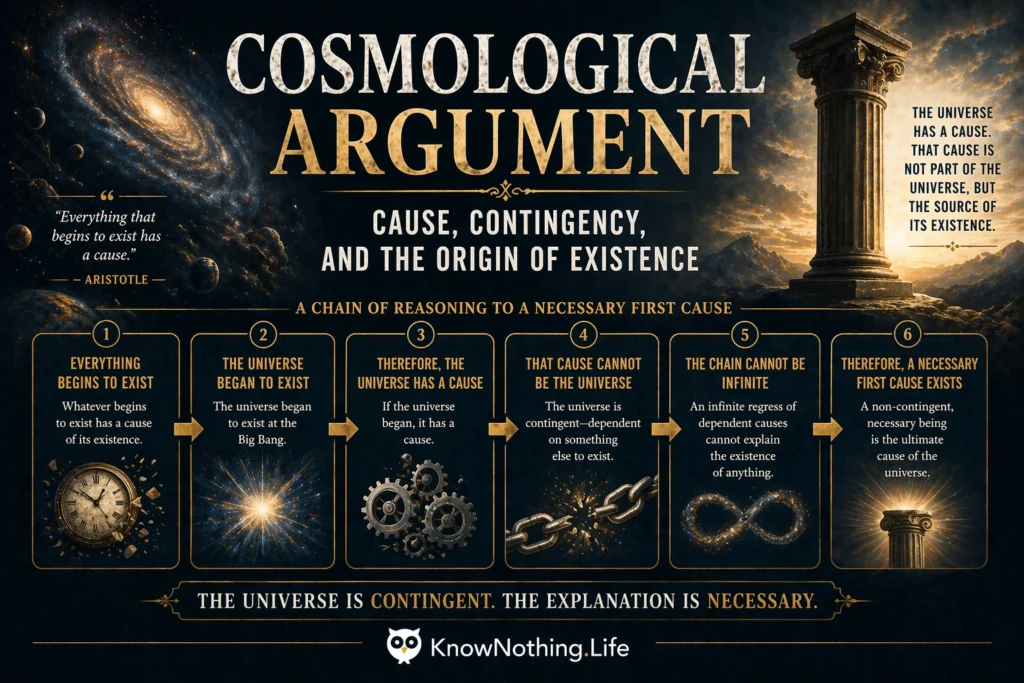
A more recent formulation of the cosmological argument is the Kalam cosmological argument, which has roots in medieval Islamic philosophy and has been revived in contemporary discussions. This argument focuses on the beginning of the universe and is often presented in a simple syllogistic form: whatever begins to exist has a cause; the universe began to exist; therefore, the universe has a cause.
Proponents of the Kalam argument draw on both philosophical reasoning and scientific evidence, such as the Big Bang theory, to support the premise that the universe had a beginning. They argue that an infinite temporal regress is impossible and that the universe must have a finite starting point.
The conclusion of the Kalam argument is that the cause of the universe must be something beyond space and time, often identified as God. Critics, however, challenge both premises, questioning whether causation applies to the origin of the universe and whether the concept of a beginning is coherent in this context.
Infinite Regress and Its Challenges
A central issue in all forms of the cosmological argument is the question of infinite regress. Can there be an infinite chain of causes or explanations, or must there be a stopping point? This question has been debated extensively, with philosophers offering arguments on both sides.
Those who reject infinite regress often argue that it fails to provide a satisfactory explanation. An infinite chain, they contend, is like an endless series of borrowed books, each depending on another, without any original source. Without a first cause or necessary being, the entire system lacks a foundation.
On the other hand, some philosophers argue that an infinite regress is not inherently problematic. They suggest that the demand for a first cause may be based on intuitions that do not apply at a cosmic level. This debate highlights the complexity of the cosmological argument and the assumptions underlying it.
Modern Perspectives and Scientific Context
In contemporary philosophy, the cosmological argument is often discussed in relation to scientific theories about the origin and structure of the universe. Advances in cosmology have provided new insights into the beginning of the universe, but they have also raised new questions about causation and explanation.
Some philosophers argue that scientific explanations can replace the need for a first cause, offering naturalistic accounts of the universe’s origin. Others maintain that even scientific theories presuppose certain metaphysical principles, such as the existence of laws and initial conditions, which themselves require explanation.
The interaction between philosophy and science has enriched the discussion of the cosmological argument, showing that it is not merely a relic of pre-modern thought but a living topic that engages with contemporary knowledge.
Critiques and Counterarguments
The cosmological argument has faced numerous critiques, ranging from challenges to its premises to questions about its conclusions. Some critics argue that the argument commits a fallacy by applying principles of causation beyond their appropriate domain. Others question whether the conclusion—often identified as God—follows from the premises.
Another line of criticism concerns the nature of the first cause or necessary being. Even if such a being exists, it is not clear that it possesses the attributes traditionally associated with God, such as omniscience or moral perfection. This raises questions about the scope and implications of the argument.
Despite these criticisms, the cosmological argument remains a central part of philosophical discussions about existence and the nature of reality. Its various forms continue to be refined and debated, reflecting its enduring significance.
Conclusion
The cosmological argument offers a powerful and enduring approach to the question of why anything exists at all. From the ancient insights of Aristotle to the systematic formulations of Thomas Aquinas and the philosophical rigor of Gottfried Wilhelm Leibniz, it has evolved into a rich and multifaceted tradition.
While no version of the argument has achieved universal acceptance, its exploration of causation, contingency, and explanation continues to inspire philosophical inquiry. By grappling with the deepest questions about existence, the cosmological argument remains a vital part of the ongoing search for understanding.