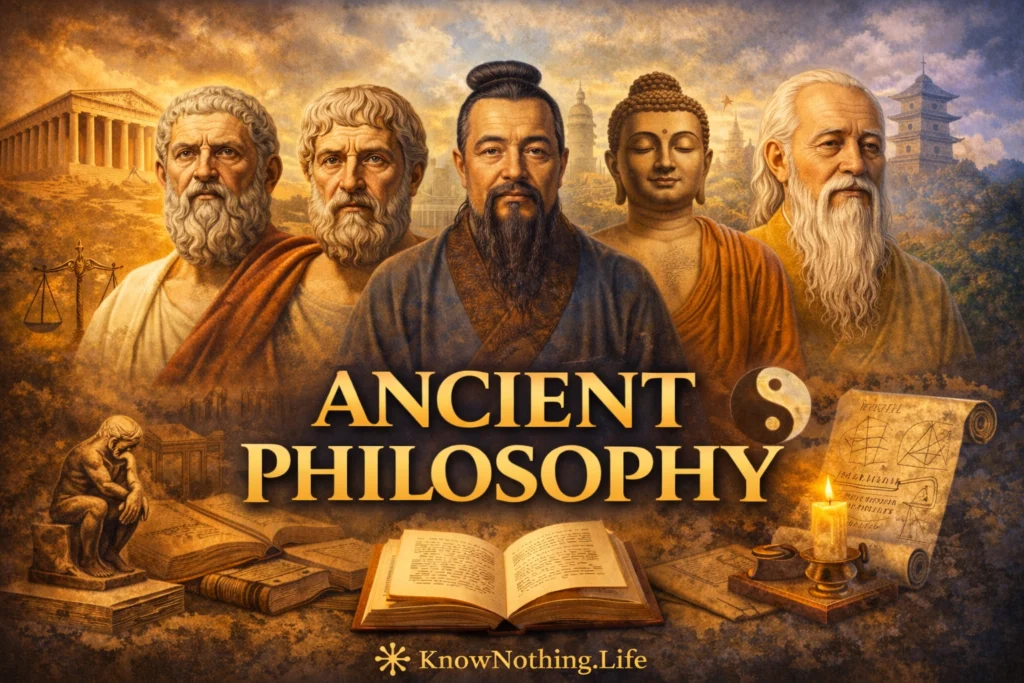
Ancient philosophy represents the earliest systematic attempts to understand the nature of reality, knowledge, ethics, and human existence through reasoned inquiry. Emerging independently across cultures—including ancient Greece, India, and China—these traditions laid the intellectual groundwork for much of later philosophical thought. What distinguishes ancient philosophy is not merely its historical position but its enduring relevance: many of the questions first posed in antiquity remain central to contemporary debates.
At its core, ancient philosophy marks a transition from mythological explanations of the world to rational and reflective analysis. Rather than relying solely on tradition or divine authority, early philosophers sought principles that could be examined, debated, and justified. This shift introduces a new mode of thinking—one that values argument, evidence, and critical reflection. By examining ancient philosophical traditions, we gain insight into the origins of intellectual inquiry and the foundational ideas that continue to shape human understanding.
Pre-Socratic Thought and the Search for First Principles
The earliest phase of ancient Greek philosophy is associated with the pre-Socratic thinkers, who focused on explaining the natural world. Philosophers such as Thales, Anaximander, and Heraclitus sought to identify the fundamental substance or principle underlying all things. Thales, for example, proposed that water is the primary element of the universe, while Anaximander introduced the concept of the “apeiron,” an indefinite or boundless origin of all existence.
Heraclitus offers a more dynamic view, emphasizing change and flux as essential features of reality. He famously states, “You cannot step into the same river twice,” highlighting the constant transformation of the world. This perspective contrasts with that of Parmenides, who argues that change is illusory and that reality is unchanging and unified. The tension between these views—between change and permanence—becomes a central theme in later philosophy.
The pre-Socratic thinkers are significant not only for their specific theories but also for their method. They seek natural explanations for phenomena, moving away from mythological accounts and toward rational inquiry. This approach establishes the foundation for philosophical and scientific investigation, emphasizing the importance of questioning and explanation.
Socrates and the Turn to Ethics
A major shift in ancient philosophy occurs with Socrates, who redirects attention from the natural world to human life and ethical questions. Rather than speculating about the cosmos, Socrates focuses on how individuals ought to live, examining concepts such as justice, virtue, and knowledge. His method, known as the Socratic method, involves questioning assumptions and engaging in dialogue to uncover deeper truths.
Socrates’ approach is characterized by intellectual humility and a commitment to inquiry. He famously claims, “I know that I know nothing,” suggesting that wisdom begins with the recognition of one’s ignorance. This stance challenges conventional beliefs and encourages critical reflection, making philosophy a practical and transformative activity.
Although Socrates did not write his ideas, his influence is preserved through the works of his students, particularly Plato. Through Plato’s dialogues, Socrates emerges as a central figure in the development of ethical philosophy, emphasizing the importance of reason, dialogue, and self-examination in the pursuit of a good life.
Plato and the World of Forms
Plato expands on Socratic thought by developing a comprehensive philosophical system that addresses metaphysics, epistemology, and ethics. In works such as The Republic, he introduces the theory of Forms, which posits that the physical world is a reflection of a higher, unchanging reality. According to Plato, true knowledge is not derived from sensory experience but from understanding these abstract Forms.
The theory of Forms provides a foundation for Plato’s ethical and political philosophy. In The Republic, he explores the nature of justice and the structure of an ideal state, arguing that a just society is one in which each individual fulfills their appropriate role. He also introduces the concept of the philosopher-king, suggesting that those with knowledge of the Forms are best suited to govern.
Plato’s work reflects a deep concern with the relationship between knowledge and power. He argues that true understanding leads to just action, and that ignorance is a source of moral and political disorder. This connection between knowledge and ethics becomes a central theme in Western philosophy, influencing subsequent thinkers and traditions.
Aristotle and Empirical Inquiry
Aristotle, a student of Plato, offers a different approach that emphasizes empirical observation and practical reasoning. In works such as Nicomachean Ethics and Metaphysics, Aristotle develops a systematic framework for understanding reality, knowledge, and ethics. He rejects Plato’s theory of Forms, arguing that form and matter are inseparable and that knowledge arises from studying the natural world.
Aristotle’s ethical theory centers on the concept of virtue, defined as a mean between extremes. He argues that achieving a good life involves cultivating virtues through practice and habit, guided by reason. As he writes, “We are what we repeatedly do. Excellence, then, is not an act, but a habit.” This practical approach emphasizes the importance of character and the role of experience in moral development.
In addition to ethics, Aristotle makes significant contributions to logic, biology, and political theory. His emphasis on classification and analysis lays the groundwork for scientific inquiry, while his political philosophy examines different forms of government and their relation to the common good. Aristotle’s work represents a culmination of ancient Greek philosophy, integrating diverse areas of inquiry into a coherent system.
Hellenistic Philosophy and the Search for Tranquility
Following the classical period, Hellenistic philosophy focuses on practical concerns related to human happiness and well-being. Schools such as Stoicism, Epicureanism, and Skepticism offer different approaches to achieving tranquility in a changing and uncertain world. Epictetus and Marcus Aurelius emphasize the importance of inner control and acceptance of what cannot be changed. Epictetus teaches that “It’s not what happens to you, but how you react to it that matters.”
Epicureanism, founded by Epicurus, advocates for a life of moderate pleasure and the avoidance of pain. Contrary to common misconceptions, Epicurus does not promote excess but rather a simple and balanced life. He argues that true happiness comes from freedom from fear and disturbance, particularly the fear of death and the gods.
Skepticism, associated with Pyrrho, questions the possibility of certain knowledge, suggesting that suspending judgment can lead to peace of mind. These Hellenistic traditions reflect a shift toward practical philosophy, focusing on how individuals can navigate the challenges of life and achieve a sense of stability and contentment.
Ancient Philosophy Beyond Greece
While Greek philosophy is often central to discussions of ancient thought, other traditions also make significant contributions. In ancient India, texts such as the Upanishads explore metaphysical and spiritual questions, examining the nature of the self and ultimate reality. Siddhartha Gautama develops a philosophical and ethical system centered on the alleviation of suffering, emphasizing mindfulness, ethical conduct, and insight.
In ancient China, Confucius focuses on ethics, social harmony, and the cultivation of virtue, while Laozi explores the concept of the Dao and the importance of living in accordance with natural rhythms. These traditions highlight the diversity of ancient philosophy, demonstrating that fundamental questions about existence and ethics arise across cultures.
The inclusion of these traditions broadens our understanding of ancient philosophy, showing that it is not limited to a single geographical or cultural context. Instead, it represents a global phenomenon, reflecting the universal human desire to understand and navigate the world.
The Enduring Legacy of Ancient Philosophy
Ancient philosophy continues to influence modern thought, providing foundational concepts and methods that remain relevant today. Its emphasis on reason, inquiry, and ethical reflection shapes contemporary discussions in fields ranging from science to politics. The questions posed by ancient philosophers—about reality, knowledge, and the good life—remain central to philosophical inquiry.
The enduring legacy of ancient philosophy lies in its ability to inspire critical thinking and reflection. It encourages individuals to question assumptions, engage in dialogue, and seek understanding. By exploring its ideas, we not only gain historical insight but also develop the tools needed to address the challenges of the present. Ultimately, ancient philosophy is not merely a relic of the past but a living tradition, one that continues to inform and enrich our understanding of the world.