Among the foundational figures of ancient philosophy, Laozi occupies a uniquely elusive and profound position. Traditionally regarded as the author of the Tao Te Ching and the founder of Daoism, Laozi’s influence extends far beyond the boundaries of Chinese thought. His philosophy challenges conventional ideas about action, knowledge, and control, offering instead a vision of life rooted in balance, simplicity, and alignment with the natural order.
What distinguishes Laozi is not only the depth of his insights but the paradoxical nature of his teachings. Rather than prescribing rigid rules, he presents a way of thinking that resists definition. His work invites readers to reconsider the relationship between effort and ease, power and humility, knowledge and wisdom. Through this approach, Laozi established a philosophical tradition that continues to resonate in discussions of ethics, leadership, and personal development.
Historical Context and the Question of His Existence
The historical figure of Laozi is shrouded in mystery, and scholars continue to debate whether he was a single individual, a composite of multiple thinkers, or a symbolic representation of a philosophical tradition. According to traditional accounts, Laozi lived during the 6th century BCE, roughly contemporaneous with Confucius, in the late period of the Zhou dynasty.
These accounts describe Laozi as a keeper of archives or a court historian, someone deeply familiar with ancient texts and traditions. Disillusioned by the moral and political decline of his time, he is said to have left society, traveling westward in search of solitude. Before departing, he was persuaded by a border guard to record his teachings, resulting in the composition of the Tao Te Ching.
Whether or not these details are historically accurate, they reflect an important aspect of Laozi’s legacy: his philosophy emerges as a response to social disorder and intellectual rigidity. In contrast to systems that emphasize structure and hierarchy, Laozi offers a vision of harmony grounded in the natural flow of existence.
The Tao Te Ching and Its Philosophical Vision
The Tao Te Ching is one of the most influential philosophical texts in history, consisting of short, poetic passages that explore the nature of the Dao (or Tao), often translated as “the Way.” Unlike systematic treatises, the text resists linear interpretation, presenting ideas through paradox, metaphor, and suggestion.
At the heart of the text is the concept of the Dao, an underlying principle that governs the universe. The Dao is not a deity or a force that can be fully understood; it is the source and pattern of all things. Laozi begins the text with a striking assertion: “The Dao that can be spoken is not the eternal Dao.” This statement sets the tone for the entire work, emphasizing the limitations of language and the importance of direct experience.
Closely related to the Dao is the concept of wu wei, often translated as “non-action” or “effortless action.” This does not imply passivity, but rather acting in accordance with the natural flow of events. By avoiding unnecessary force and resistance, individuals can achieve greater effectiveness and harmony. This principle has profound implications for both personal conduct and leadership.
Core Teachings and Philosophical Themes
Laozi’s philosophy revolves around a set of interrelated themes that challenge conventional assumptions. One of the most prominent is the idea of simplicity. He advocates for a life free from excessive desire and artificial complexity, suggesting that contentment arises from appreciating what is already present.
Another key theme is the value of humility. Laozi frequently contrasts strength with softness, arguing that what appears weak is often more enduring. Water, for example, is a recurring metaphor in his work: it is soft and yielding, yet capable of overcoming even the hardest obstacles. This imagery illustrates his belief that adaptability and gentleness are more powerful than rigidity.
Balance is also central to his thought. Laozi emphasizes the interplay of opposites, a concept later associated with yin and yang. He suggests that qualities such as light and dark, strength and weakness, and action and stillness are not in conflict but are mutually defining. Understanding this dynamic allows individuals to navigate life with greater awareness and harmony.
Key Teachings and Quotes
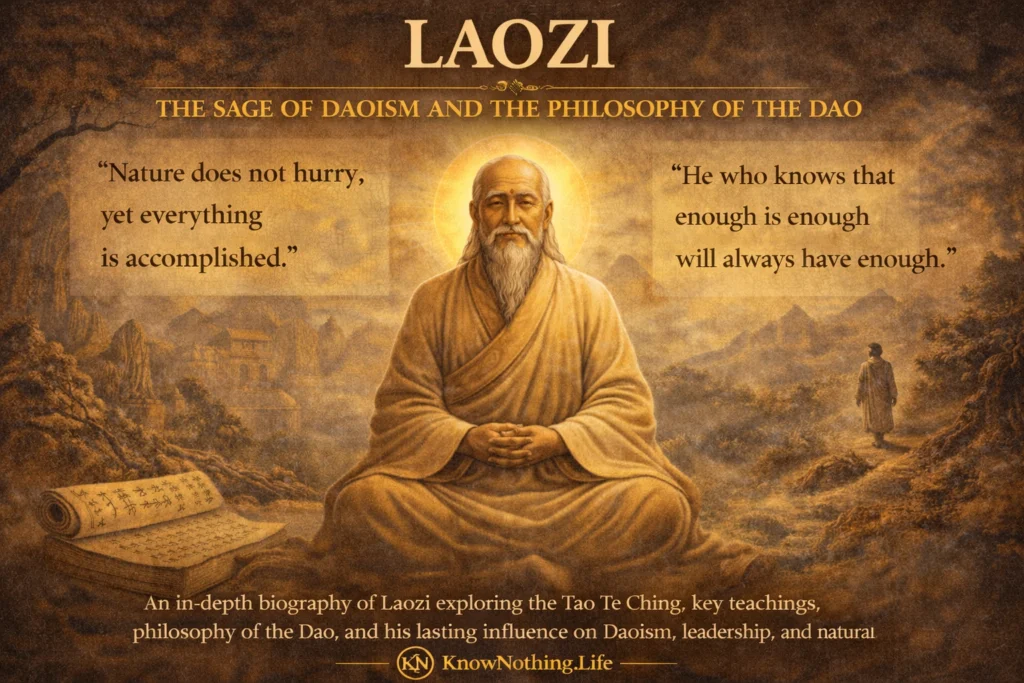
The teachings of Laozi are often expressed through concise, paradoxical statements that invite reflection. One of his most well-known sayings is: “Nature does not hurry, yet everything is accomplished.” This insight captures the essence of wu wei, highlighting the effectiveness of patience and alignment with natural processes.
Another significant teaching is: “He who knows that enough is enough will always have enough.” This statement reflects Laozi’s emphasis on contentment and the dangers of excessive desire. By recognizing the sufficiency of what one has, individuals can avoid the endless pursuit of more and achieve a sense of peace.
He also offers guidance on leadership: “A leader is best when people barely know he exists.” This perspective challenges traditional notions of authority, suggesting that the most effective leaders are those who act subtly and empower others. Rather than imposing control, they create conditions in which harmony can emerge naturally.
Laozi’s Approach to Governance and Society
Laozi’s philosophy extends beyond individual conduct to encompass broader social and political concerns. He was deeply skeptical of excessive governance and rigid systems, believing that overregulation often leads to disorder rather than stability. In his view, attempts to control society through force or complexity disrupt the natural balance.
He advocated for a minimalist approach to governance, where rulers act with restraint and avoid unnecessary intervention. By allowing people to live in accordance with their nature, society can achieve a more organic form of order. This idea contrasts sharply with more structured political philosophies, offering an alternative vision of leadership.
At the same time, Laozi did not reject the need for guidance altogether. Instead, he emphasized the importance of wisdom and self-awareness in those who hold power. Leaders, in his view, should embody the principles of the Dao, demonstrating humility, patience, and an understanding of the interconnectedness of all things.
Influence and Legacy
The influence of Laozi extends across centuries and cultures, shaping not only Chinese philosophy but also global thought. Daoism, as inspired by his teachings, developed into both a philosophical tradition and a religious practice, influencing art, literature, medicine, and spirituality.
In China, his ideas coexisted with and complemented other traditions, including Confucianism and Buddhism. While Confucianism emphasized social order and ethical responsibility, Daoism offered a counterbalance, focusing on natural harmony and individual freedom. Together, these traditions created a rich and dynamic intellectual landscape.
In modern times, Laozi’s philosophy has gained renewed relevance. His emphasis on simplicity, balance, and sustainability resonates with contemporary concerns about environmental degradation and the pace of modern life. His insights into leadership and personal development continue to influence fields ranging from business to psychology.
Conclusion
Laozi’s philosophy presents a vision of life that is both deeply subtle and profoundly practical. Through his exploration of the Dao, he offers a framework for understanding the world that transcends rigid categories and embraces complexity. His teachings encourage a shift from control to cooperation, from force to flow, and from excess to simplicity.
Rather than prescribing a fixed path, Laozi invites individuals to observe, reflect, and align themselves with the natural rhythms of existence. In doing so, he provides a guide for navigating life with clarity and ease. His work reminds us that true wisdom often lies not in striving harder, but in understanding when to let go.
In a world that often values speed, control, and accumulation, Laozi’s message offers a powerful alternative. By embracing balance, humility, and harmony, individuals can find a deeper sense of fulfillment—one that arises not from external achievement, but from living in accordance with the Way.