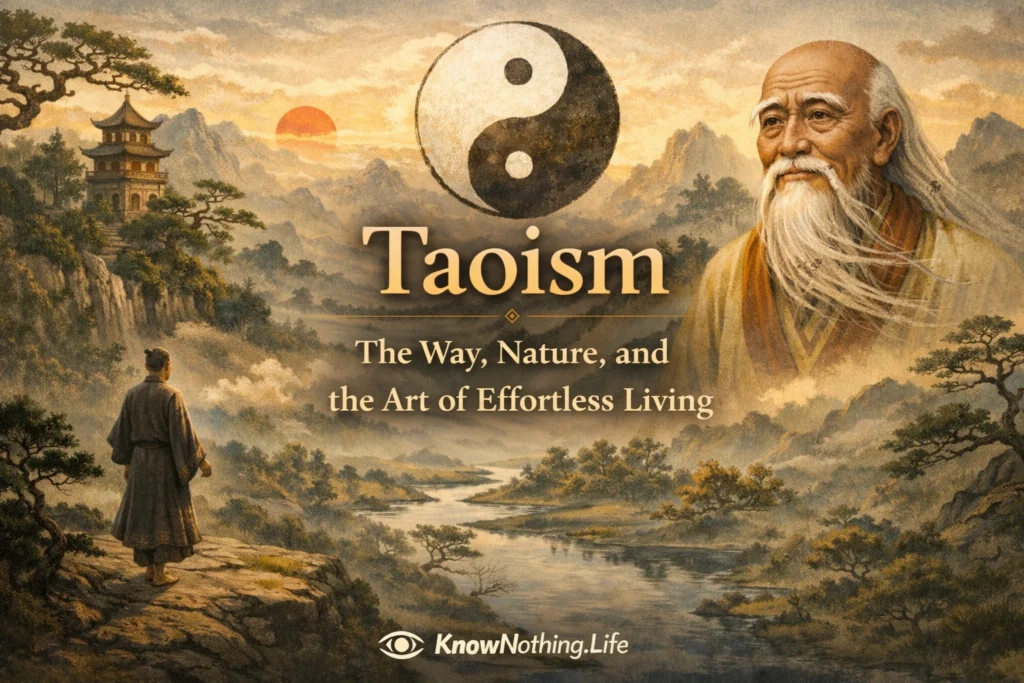
Taoism, also known as Daoism, is one of the foundational philosophical traditions of ancient China, centered on the concept of the Dao (the Way)—an ineffable, underlying principle that gives rise to and unifies all things. Emerging during the same turbulent era that shaped Confucianism, Taoism offered a radically different response to disorder: instead of emphasizing structured ethics and social roles, it encouraged alignment with the natural flow of existence. The tradition is most closely associated with the legendary sage Laozi, whose teachings are preserved in the Tao Te Ching, and later expanded by thinkers such as Zhuangzi in the text bearing his name, the Zhuangzi.
At its core, Taoism resists rigid definition. The Dao itself cannot be fully articulated, as Laozi famously begins: “The Dao that can be spoken is not the eternal Dao.” This paradox reflects a central insight of Taoist thought—that reality is dynamic, fluid, and beyond the limits of conceptual language. Rather than constructing elaborate systems or doctrines, Taoism invites individuals to experience the world directly, to observe its rhythms, and to live in harmony with its unfolding patterns. It is a philosophy of attunement rather than control, of participation rather than domination.
The Nature of the Dao and the Principle of Wu Wei
The Dao is not a god, a substance, or a fixed law, but a generative process that underlies all existence. It is the source from which all things emerge and to which they return, an ever-present but elusive force that cannot be grasped through logic alone. Laozi describes it as “empty yet inexhaustible,” suggesting that its power lies precisely in its openness and indeterminacy. This conception of reality challenges the human tendency to impose rigid categories and encourages a more receptive mode of understanding.
Closely tied to the Dao is the principle of wu wei, often translated as “non-action” or “effortless action.” Contrary to what the term might suggest, wu wei does not mean passivity or inaction, but rather acting in accordance with the natural flow of things. It is the art of doing without forcing, of allowing events to unfold while responding with sensitivity and awareness. As Laozi writes, “The sage does nothing, yet nothing is left undone,” capturing the paradoxical efficiency of actions that arise from harmony rather than resistance.
This principle has profound implications for both personal conduct and governance. In contrast to systems that rely on strict control or coercion, Taoism advocates for minimal intervention and trust in the inherent order of the world. When individuals and leaders act in alignment with the Dao, their actions become spontaneous and effective, free from the strain of excessive effort. This vision of effortless efficacy stands as one of Taoism’s most distinctive contributions to philosophical thought.
Zhuangzi and the Freedom of the Mind
While Laozi provides the foundational vision of Taoism, the philosopher Zhuangzi develops its themes with imaginative depth and literary brilliance. The Zhuangzi text is filled with parables, anecdotes, and paradoxical stories that challenge conventional distinctions and reveal the relativity of human perspectives. Through humor and irony, Zhuangzi invites readers to question their assumptions and embrace a more fluid understanding of reality.
One of the most famous passages is the “butterfly dream,” in which Zhuangzi recounts dreaming that he was a butterfly, only to awaken and wonder whether he is a man who dreamed of being a butterfly or a butterfly dreaming of being a man. This story illustrates the instability of identity and the limitations of rigid categories, suggesting that reality is not as fixed as we often assume. It also points to a deeper freedom that arises when one is no longer bound by narrow definitions of self.
Zhuangzi’s philosophy emphasizes spontaneity, creativity, and the liberation of the mind from social conventions. He celebrates individuals who transcend rigid norms and live in accordance with their own nature, unburdened by the expectations of society. “Where can I find a man who has forgotten words,” he asks, “so I can have a word with him?” This paradox underscores his belief that true understanding lies beyond language and conceptual thought, in a direct and intuitive engagement with the world.
Taoism, Nature, and the Cosmos
Taoism is deeply rooted in an appreciation of the natural world, viewing nature not as something to be conquered but as a model for human life. The rhythms of the seasons, the flow of water, and the growth of plants all exemplify the principles of the Dao. Water, in particular, serves as a powerful metaphor in Taoist thought: it is soft and yielding, yet capable of overcoming the hardest obstacles. Laozi writes, “Nothing in the world is softer and weaker than water, yet nothing is better at overcoming the hard and strong,” illustrating the paradoxical strength of gentleness.
This reverence for nature extends to a broader cosmological vision in which all things are interconnected and constantly transforming. The interplay of yin and yang—complementary forces that generate and balance each other—reflects the dynamic harmony of the universe. Rather than opposing forces, yin and yang are interdependent, each containing the seed of the other. This perspective encourages a holistic understanding of reality, where change and balance are fundamental aspects of existence.
In this context, human beings are not separate from nature but an integral part of it. Taoism encourages individuals to align their lives with natural processes, cultivating simplicity, humility, and awareness. By observing the patterns of the natural world, one can learn to live more harmoniously, avoiding unnecessary conflict and striving. This ecological sensibility has made Taoism increasingly relevant in contemporary discussions of environmental ethics and sustainable living.
Taoism in Practice and Daily Life
Taoism is not merely a philosophical system but a way of life that can be expressed in everyday actions. Its principles are reflected in practices that emphasize balance, mindfulness, and harmony, including meditation, breathing exercises, and martial arts such as Tai Chi. These practices are not aimed at achieving external goals but at cultivating an inner state of alignment with the Dao.
In daily life, Taoism encourages simplicity and moderation. It values humility over ambition, contentment over excess, and flexibility over rigidity. The Taoist sage does not seek to dominate or control but to adapt and respond with ease. This approach can be applied to relationships, work, and decision-making, offering a counterpoint to the pressures of modern life. By letting go of unnecessary striving, individuals can find a deeper sense of peace and fulfillment.
Taoism also offers a distinctive perspective on leadership and governance. Rather than imposing strict rules or pursuing aggressive policies, the Taoist leader leads by example and creates conditions in which people can flourish naturally. “When the best leader’s work is done,” Laozi observes, “the people say, ‘We did it ourselves.’” This vision of leadership emphasizes subtlety, trust, and the power of non-interference, challenging conventional notions of authority and control.
Taoism in Historical and Modern Contexts
Historically, Taoism developed alongside Confucianism and later interacted with Buddhism, forming a complex and dynamic intellectual landscape in China. While Confucianism dominated official institutions, Taoism often served as a counterbalance, offering a more introspective and individualistic approach to life. Over time, Taoism also evolved into a religious tradition with rituals, temples, and a rich mythology, blending philosophical insights with spiritual practices.
In the modern era, Taoism has gained global recognition as a source of wisdom for navigating the complexities of contemporary life. Its emphasis on balance, adaptability, and harmony resonates in fields ranging from psychology and leadership to ecology and health. Thinkers and writers across cultures have drawn inspiration from Taoist ideas, finding in them a timeless guide to living with greater awareness and ease.
The enduring appeal of Taoism lies in its simplicity and depth. It does not demand adherence to rigid doctrines or elaborate systems but invites individuals to explore their own relationship with the world. By encouraging a return to what is natural and unforced, Taoism offers a path toward clarity and freedom in an increasingly complex and fast-paced world.
Final Reflections on Taoism
Taoism presents a vision of life that is both subtle and profound, grounded in the recognition that the deepest truths cannot be fully captured in words. It challenges the impulse to control and dominate, offering instead a philosophy of harmony, balance, and effortless action. Through its teachings on the Dao and wu wei, it provides a framework for living that is at once practical and transformative.
The wisdom of Taoism lies in its ability to reveal the extraordinary within the ordinary—to show that by aligning with the natural flow of life, one can achieve a state of ease and fulfillment that cannot be forced. As the Tao Te Ching reminds us, “Nature does not hurry, yet everything is accomplished.” In this quiet insight, Taoism offers a timeless invitation: to slow down, to observe, and to rediscover the deeper rhythms that sustain both the world and the self.