Among the great thinkers of ancient China, Zhuangzi stands as one of the most imaginative and radical voices in philosophical history. A central figure in the development of Daoism, Zhuangzi expanded upon the ideas attributed to Laozi while introducing a uniquely playful, skeptical, and deeply liberating approach to understanding reality. His philosophy challenges fixed distinctions, rigid beliefs, and the human tendency to impose order on a world that is inherently fluid and ever-changing.
What sets Zhuangzi apart is not only the content of his ideas but the way he presents them. Through parables, allegories, and paradoxical stories, he invites readers to question their assumptions and loosen their attachment to certainty. Rather than offering a strict system of thought, Zhuangzi opens a space for freedom—freedom from conceptual constraints, social expectations, and even the boundaries of the self. His work remains one of the most profound explorations of perspective, identity, and the nature of existence.
Historical Background and Life
Zhuangzi is believed to have lived during the 4th century BCE, in the period known as the Warring States Period. This was a time of intense political conflict and intellectual activity, as various schools of thought emerged in response to the instability of the era. Philosophers sought to address questions of governance, ethics, and human nature, often proposing structured systems aimed at restoring order.
In contrast to many of his contemporaries, Zhuangzi appears to have lived a relatively private and modest life. He is said to have worked as a minor official in the state of Song, but he declined opportunities for higher political office. According to traditional accounts, he chose a life of simplicity and independence rather than one of power and prestige. This decision reflects a core aspect of his philosophy: a rejection of artificial distinctions and societal ambitions in favor of personal freedom and authenticity.
While historical details about his life are limited, his writings provide a vivid sense of his character. He emerges as a thinker who valued spontaneity, humor, and detachment. Rather than seeking to reform society through institutional means, he focused on transforming the way individuals perceive and engage with the world.
The Zhuangzi Text and Literary Style
The primary source of Zhuangzi’s philosophy is the Zhuangzi, a collection of stories, dialogues, and reflections attributed to him and later followers. Unlike more systematic philosophical works, this text is rich in narrative and imagery, blending philosophical insight with literary creativity. It is widely regarded as one of the greatest works of Chinese literature.
The text is divided into three sections: the Inner Chapters, Outer Chapters, and Miscellaneous Chapters. The Inner Chapters are generally considered the most authentic, directly reflecting Zhuangzi’s voice and ideas. These sections contain some of his most famous parables, including the story of the butterfly dream, which explores the fluidity of identity and perception.
Zhuangzi’s use of storytelling allows him to convey complex ideas in an accessible and engaging way. Rather than arguing through formal logic, he presents scenarios that challenge the reader’s assumptions. This method encourages a shift in perspective, inviting readers to experience insight rather than simply understand it intellectually.
Core Philosophy: Relativity and the Nature of Reality
At the heart of Zhuangzi’s philosophy is the idea that distinctions between things are not absolute but relative. Concepts such as right and wrong, good and bad, or success and failure are shaped by perspective and context. By recognizing this relativity, individuals can free themselves from rigid judgments and embrace a more fluid understanding of the world.
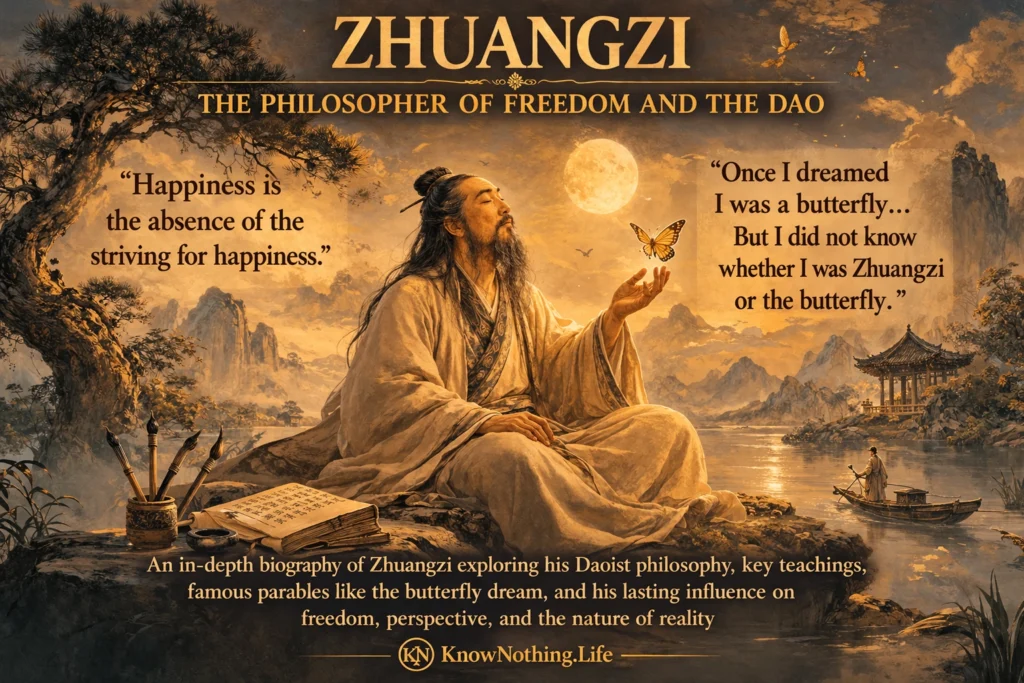
One of his most famous parables illustrates this idea: “Once I, Zhuangzi, dreamed I was a butterfly… Suddenly I awoke, and I was myself again. But I did not know whether I was Zhuangzi who had dreamed he was a butterfly, or a butterfly dreaming that I was Zhuangzi.” This story challenges the assumption of a stable, fixed identity, suggesting that the boundaries between self and other, reality and illusion, are not as clear as they seem.
Zhuangzi also emphasized the importance of aligning with the Dao, the underlying process that governs all things. However, unlike more structured interpretations, his understanding of the Dao is deeply dynamic and open-ended. He encourages individuals to move with the flow of life, adapting to change rather than resisting it. This approach fosters a sense of ease and spontaneity, allowing one to navigate complexity without becoming entangled in it.
Freedom, Detachment, and the Ideal Life
A central theme in Zhuangzi’s thought is the pursuit of freedom—not political freedom, but existential freedom. This involves releasing attachments to fixed ideas, social roles, and personal desires. By letting go of these constraints, individuals can experience a state of openness and flexibility that aligns with the natural flow of the Dao.
Zhuangzi often contrasts those who are bound by societal expectations with those who live freely. He describes individuals who cling to status, reputation, or rigid moral codes as being limited in their understanding. In contrast, the truly wise person moves beyond such constraints, embracing uncertainty and change as essential aspects of life.
This perspective is reflected in his approach to life and death. Zhuangzi viewed death not as something to be feared, but as a natural transformation within the ongoing process of existence. By accepting this, individuals can live without anxiety about the future, focusing instead on the present moment and the unfolding of experience.
Key Teachings and Quotes
Zhuangzi’s teachings are often expressed through memorable and thought-provoking statements. One of his most well-known insights is: “Happiness is the absence of the striving for happiness.” This paradox highlights his belief that the pursuit of specific outcomes can create tension and dissatisfaction, whereas letting go leads to a more genuine sense of well-being.
Another important teaching is: “Flow with whatever may happen, and let your mind be free.” This reflects his emphasis on adaptability and mental freedom. By resisting the urge to control every aspect of life, individuals can respond more effectively to changing circumstances.
He also observed: “The perfect man has no self; the spiritual man has no achievement; the true sage has no name.” This statement encapsulates his critique of ego and social identity. By transcending the need for recognition and accomplishment, individuals can access a deeper and more authentic way of being.
Influence and Legacy
The influence of Zhuangzi extends across philosophy, literature, and art. Within Daoism, his ideas complement and expand upon those attributed to Laozi, offering a more expansive and imaginative exploration of the Dao. His emphasis on spontaneity and freedom has shaped the development of Daoist thought and practice.
In Chinese culture, Zhuangzi’s work has inspired poets, painters, and scholars, contributing to a tradition that values creativity and introspection. His stories continue to be studied and interpreted, reflecting their enduring relevance and depth. Beyond China, his ideas have gained recognition in global philosophical discourse, resonating with themes found in existentialism, skepticism, and phenomenology.
Modern readers often find in Zhuangzi a perspective that challenges contemporary assumptions about identity, success, and control. His emphasis on flexibility and openness offers a counterbalance to rigid systems and fixed beliefs, encouraging a more nuanced and adaptive approach to life.
Conclusion
Zhuangzi’s philosophy represents a radical invitation to rethink the way we perceive ourselves and the world. Through his exploration of relativity, freedom, and the Dao, he offers a vision of life that is both liberating and deeply insightful. His teachings challenge us to move beyond rigid distinctions and embrace the fluid, interconnected nature of existence.
Rather than providing definitive answers, Zhuangzi encourages a process of questioning and discovery. His work reminds us that understanding is not a fixed destination, but an ongoing journey shaped by perspective and experience. In this sense, his philosophy is not something to be mastered, but something to be lived.
In a world often defined by certainty and control, Zhuangzi’s message remains profoundly relevant. By letting go of rigid expectations and embracing the flow of life, individuals can find a deeper sense of freedom and harmony. Through this lens, his legacy continues to inspire those who seek not just knowledge, but wisdom.