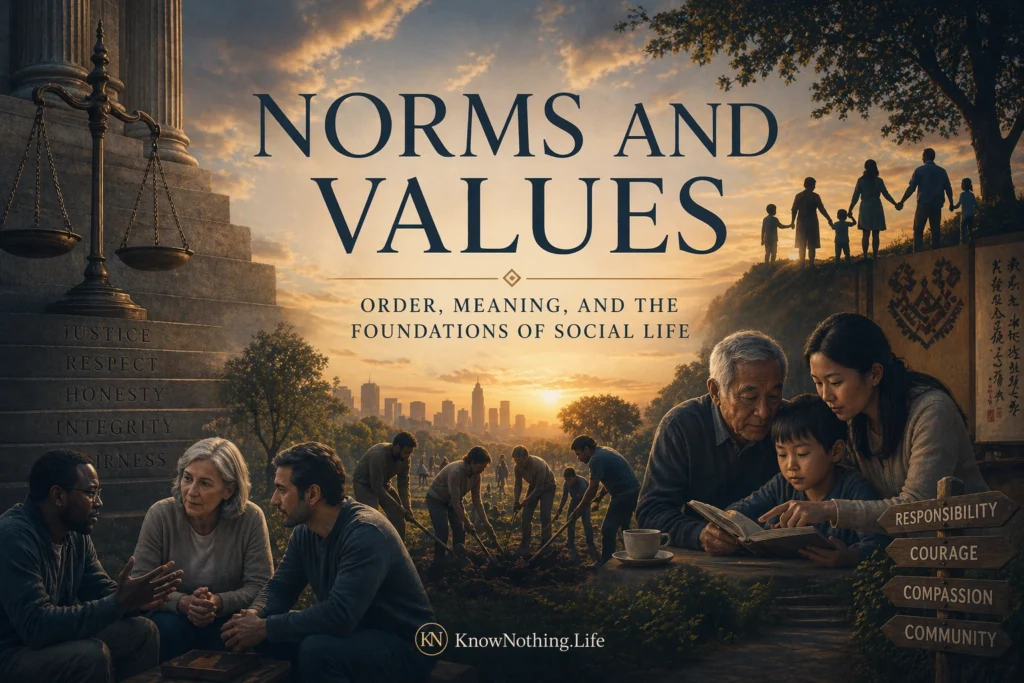
Norms and values are the invisible architecture of human societies. They guide behavior, shape expectations, and provide the standards by which actions are judged. Values express what is considered important or desirable—such as justice, freedom, or loyalty—while norms translate these values into concrete rules and practices. Together, they form the moral and cultural framework that allows individuals to coordinate their lives within a shared social world.
Philosophically, norms and values raise foundational questions about the nature of morality and social order. Are values objective truths or human creations? How do norms gain authority, and why do individuals feel compelled to follow them? These questions connect ethics, sociology, and political philosophy, revealing the deep interplay between individual agency and collective structure. Understanding norms and values is essential for understanding how societies function, evolve, and sometimes break down.
Historical Foundations of Normative Thought
Philosophical inquiry into norms and values has deep historical roots. In ancient Greece, Aristotle explored the role of virtue in ethical life, emphasizing that good character is developed through habituation within a community. For Aristotle, norms are not arbitrary rules but expressions of shared values that guide individuals toward flourishing. This perspective highlights the connection between moral development and social context.
In contrast, early modern philosophy sought more universal foundations for norms and values. Immanuel Kant argued that moral norms arise from rational principles that apply to all individuals. His concept of the categorical imperative provides a framework for evaluating actions based on their consistency and universality, emphasizing the autonomy of the moral agent.
Meanwhile, David Hume offered a different account, suggesting that values are grounded in human sentiments rather than pure reason. According to Hume, moral judgments arise from feelings of approval and disapproval, reflecting the social and emotional dimensions of human life. These contrasting perspectives illustrate the enduring debate over the origins and nature of norms and values.
The Nature of Values
Values are fundamental beliefs about what is important, worthwhile, or desirable. They provide the criteria by which individuals and societies evaluate actions, institutions, and outcomes. Values can be personal, reflecting individual preferences, or shared, forming the basis of cultural and social systems.
Philosophers have long debated whether values are objective or subjective. Objectivist theories hold that values exist independently of human perception, grounded in facts about the world or human nature. Subjectivist theories, by contrast, argue that values are created by individuals or communities, shaped by cultural and historical contexts. Each perspective has implications for how values are understood and justified.
The diversity of values across cultures highlights the complexity of this issue. While some values, such as fairness or well-being, appear widely shared, others vary significantly. This raises questions about whether there are universal values or whether all values are context-dependent. The study of values thus involves balancing recognition of diversity with the search for common ground.
Norms as Social Rules
Norms are the practical expressions of values, guiding behavior through expectations and rules. They can be formal, such as laws and regulations, or informal, such as customs and social conventions. Norms provide a framework for coordination, enabling individuals to predict and respond to one another’s actions.
The authority of norms often depends on social acceptance. Individuals follow norms not only because of external enforcement but also because of internalized expectations. This process of internalization reflects the role of socialization, through which individuals learn the norms of their community from an early age. Over time, these norms become part of one’s identity, shaping behavior even in the absence of external pressure.
Philosophically, norms raise questions about obligation and freedom. Why should individuals follow norms, and what justifies their authority? Some theories emphasize the role of consent or agreement, while others focus on the benefits of social order. Understanding norms involves examining both their practical functions and their moral foundations.
Power, Ideology, and Norm Formation
Norms and values are not created in a vacuum; they are shaped by power relations and social structures. Philosophers analyze how dominant groups influence the formation of norms, often embedding their interests within cultural practices. This perspective reveals that norms can serve both to maintain order and to reinforce inequality.
Karl Marx argued that dominant values often reflect the interests of those who control economic resources, shaping ideology in ways that justify existing power structures. Similarly, Michel Foucault examined how norms are produced through systems of knowledge and discourse, influencing what is considered normal or acceptable.
This analysis highlights the importance of critical reflection in evaluating norms. Not all norms are equally justified, and some may perpetuate injustice or exclusion. By examining the power dynamics underlying norm formation, philosophers seek to distinguish between norms that promote well-being and those that require transformation.
Norms, Values, and Social Change
While norms and values provide stability, they are not static. Societies evolve, and with them, the standards that guide behavior. Social change often involves challenging existing norms and proposing new values, reflecting shifts in understanding and priorities.
Philosophers explore how such changes occur and what drives them. Movements for social justice, for example, often involve reexamining norms related to equality, rights, and inclusion. These changes are not merely theoretical but have practical implications for laws, institutions, and everyday practices.
The process of change raises questions about resistance and adaptation. Individuals may resist new norms that conflict with established beliefs, while others advocate for transformation. Understanding this dynamic requires attention to both the stability provided by norms and the potential for innovation and reform.
Norms and Values in Ethical Theory
Norms and values are central to ethical theory, providing the foundation for evaluating actions and guiding moral decision-making. Different ethical frameworks offer varying accounts of how norms and values should be understood and applied.
Utilitarian theories emphasize outcomes, evaluating norms based on their consequences for overall well-being. Deontological theories, associated with Immanuel Kant, focus on duties and principles, emphasizing the importance of consistency and respect for individuals. Virtue ethics, rooted in Aristotle, emphasizes character and the cultivation of virtues.
These approaches highlight different aspects of norms and values, reflecting the complexity of moral life. By examining their strengths and limitations, philosophers seek to develop more comprehensive accounts of ethical reasoning that can address a wide range of situations.
Norms and Values in Contemporary Society
In the modern world, norms and values are shaped by rapid social and technological change. Globalization has brought diverse cultures into closer contact, raising questions about how different value systems can coexist and interact. At the same time, digital communication has transformed how norms are created and enforced, enabling new forms of influence and interaction.
Contemporary debates often focus on issues such as individual freedom, collective responsibility, and the role of institutions in shaping norms. These discussions reflect the ongoing tension between tradition and innovation, as societies navigate the challenges of change.
Philosophical analysis provides tools for understanding these developments, emphasizing the need for critical engagement with norms and values. By examining their origins, functions, and implications, individuals can better navigate the complexities of modern life and contribute to the development of more just and inclusive systems.
Conclusion
Norms and values are fundamental to the organization of human life, shaping behavior, guiding decisions, and providing a framework for social interaction. They reflect both shared ideals and the influence of social structures, highlighting the interplay between individual agency and collective dynamics.
Philosophical inquiry reveals that norms and values are not fixed but evolving, subject to critique and transformation. Understanding their nature and origins is essential for evaluating their legitimacy and effectiveness. This involves balancing respect for tradition with openness to change, ensuring that norms and values promote well-being and justice.
Ultimately, the study of norms and values invites reflection on what it means to live well together. It encourages individuals and societies to examine their priorities, question assumptions, and strive for systems that reflect both shared humanity and respect for diversity.