Few thinkers have shaped the modern world as profoundly and controversially as Karl Marx. His analysis of capitalism, class struggle, and historical change not only transformed political philosophy but also influenced revolutions, governments, and global economic systems. Marx did not merely interpret the world—he sought to change it, grounding his philosophy in material conditions and real human struggles rather than abstract ideals.
At the heart of Marx’s thought lies a powerful claim: the structure of society is determined by its economic foundations. This perspective, known as historical materialism, reframes history as a dynamic process driven by conflicts between social classes. Marx’s work continues to provoke debate, admiration, and criticism, reflecting both its intellectual depth and its far-reaching consequences.
Early Life and Intellectual Formation
Karl Marx was born in 1818 in Trier, a city in the Prussian Rhineland, into a middle-class family with intellectual and professional aspirations. His father, a lawyer, encouraged rigorous education, exposing Marx to Enlightenment thought and liberal ideals. As a student at the University of Bonn and later the University of Berlin, Marx became immersed in philosophy, particularly the work of Georg Wilhelm Friedrich Hegel.
Hegel’s influence on Marx was profound, though ultimately contested. While Hegel viewed history as the unfolding of ideas and Spirit, Marx would later reinterpret this dialectical framework in material terms. He became associated with the Young Hegelians, a group of radical thinkers who sought to critique religion and political authority. Through these engagements, Marx began to develop his own philosophical identity, one that would depart sharply from idealism.
A turning point in Marx’s intellectual development came through his collaboration with Friedrich Engels, who became both a lifelong friend and intellectual partner. Engels’s firsthand knowledge of industrial conditions in England provided Marx with concrete insights into the realities of capitalism, reinforcing his commitment to analyzing society through the lens of economic relations.
Historical Context and the Rise of Industrial Capitalism
Marx’s philosophy cannot be understood apart from the social and economic transformations of the 19th century. The Industrial Revolution reshaped societies across Europe, creating unprecedented wealth alongside widespread poverty and exploitation. Factories replaced traditional forms of labor, and a new class structure emerged, dividing society into capitalists and workers.
These changes provided the empirical foundation for Marx’s critique of capitalism. He observed that industrial production concentrated power and wealth in the hands of a few, while the majority of workers experienced alienation and hardship. This imbalance, he argued, was not accidental but inherent to the capitalist system, which prioritizes profit over human well-being.
The political upheavals of the time, including the revolutions of 1848, further reinforced Marx’s belief that history is driven by conflict. He saw these events as evidence of underlying tensions within society, tensions that would eventually lead to more profound transformations. For Marx, the conditions of his time were not unique, but part of a broader historical pattern.
Major Works and Intellectual Contributions
Marx’s ideas are most fully developed in a series of works that remain central to political and economic thought. Among these, The Communist Manifesto, co-authored with Engels, stands as one of the most influential political documents in history. In it, Marx famously declares, “The history of all hitherto existing society is the history of class struggles,” a statement that encapsulates his view of historical development.
Another cornerstone of his thought is Das Kapital, a detailed analysis of the capitalist system. In this work, Marx examines how value is created, how labor is exploited, and how capital accumulates. His concept of surplus value—the difference between what workers produce and what they are paid—reveals the mechanisms through which profit is generated.
Earlier writings, such as the Economic and Philosophic Manuscripts of 1844, introduce key concepts like alienation, while The German Ideology outlines the foundations of historical materialism. Across these works, Marx develops a comprehensive critique of capitalism, combining philosophical insight with economic analysis.
Historical Materialism and the Structure of Society
One of Marx’s most significant contributions is his theory of historical materialism, which redefines the way we understand social development. According to this framework, the economic base of society—its modes of production and relations of labor—determines its political, legal, and cultural institutions. Rather than ideas shaping reality, Marx argued that material conditions shape ideas.
This perspective challenges traditional philosophies that prioritize consciousness or morality as the driving forces of history. For Marx, human beings are fundamentally shaped by their economic environment, and social change occurs when contradictions within this environment become unsustainable. These contradictions often take the form of class warfare, as different groups compete over resources and power.
Historical materialism also emphasizes the dynamic nature of society. Just as feudalism gave way to capitalism, Marx believed that capitalism would eventually be replaced by a new system. This process is not guided by abstract ideals, but by the material realities of production and the conflicts they generate.
Class Struggle and Alienation
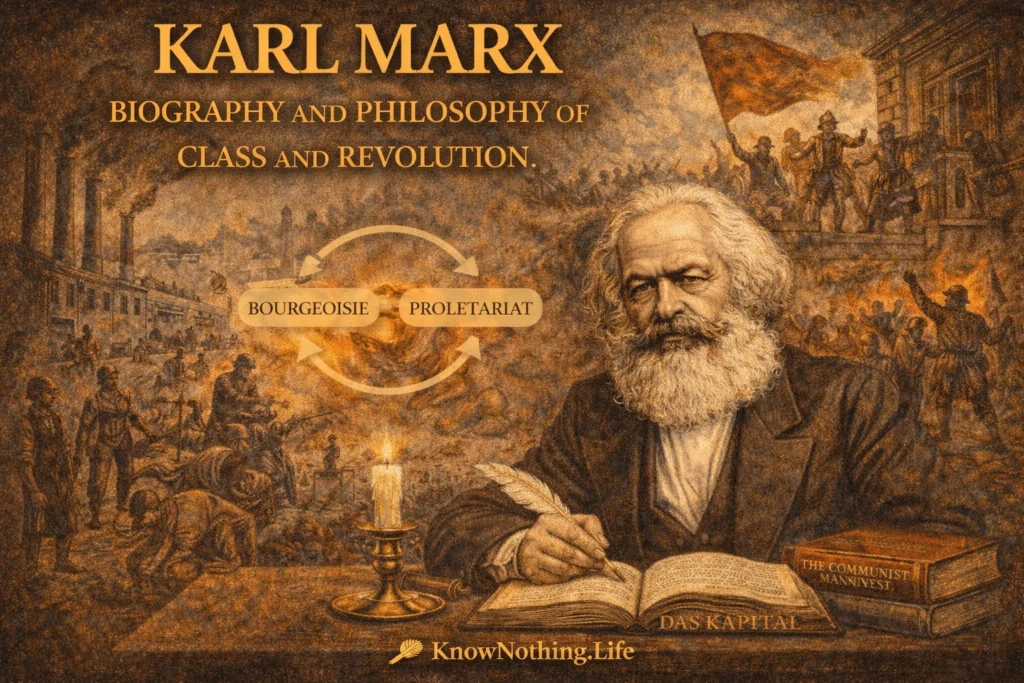
Central to Marx’s analysis is the concept of class struggle, the conflict between groups with opposing economic interests. In capitalist society, this struggle takes place between the bourgeoisie, who own the means of production, and the proletariat, who sell their labor. Marx argued that this relationship is inherently exploitative, as workers do not receive the full value of their labor.
Alienation is another key concept in Marx’s thought, describing the estrangement of workers from their labor, their products, and ultimately themselves. In a capitalist system, work becomes a means of survival rather than a source of fulfillment. Workers have little control over what they produce or how they produce it, leading to a sense of disconnection and powerlessness.
Marx believed that these conditions would eventually lead to revolutionary change. As workers become more aware of their shared situation, they would unite to challenge the existing system. This process of class consciousness is essential to Marx’s vision of social transformation.
Revolution, Communism, and the Future of Society
Marx’s philosophy is not merely descriptive but prescriptive, offering a vision of how society might evolve beyond capitalism. He argued that the contradictions of capitalism would lead to its collapse, paving the way for a new system based on collective ownership and cooperation. This system, often referred to as communism, would eliminate class divisions and create a more equitable distribution of resources.
In The Communist Manifesto, Marx calls for workers of the world to unite, emphasizing the global nature of class struggle. He envisioned a society in which production is organized for the benefit of all, rather than for profit. In such a system, individuals would be free to develop their abilities without the constraints imposed by economic necessity.
Despite the transformative potential of his ideas, Marx did not provide a detailed blueprint for a future society. Instead, he focused on analyzing existing conditions and identifying the forces that could drive change. This open-ended approach has allowed his ideas to be interpreted and applied in various ways, sometimes with dramatically different outcomes.
Legacy and Influence
The influence of Karl Marx extends across politics, economics, sociology, and beyond. His ideas inspired revolutionary movements in countries such as Russia and China, shaping the course of global history in the 20th century. At the same time, his work has been subject to intense criticism, particularly in light of how his theories were implemented in practice.
Beyond political movements, Marx’s analysis of capitalism continues to inform contemporary debates about inequality, labor, and globalization. His insights into the dynamics of economic systems remain relevant in an era marked by rapid technological change and persistent social disparities.
Marx’s intellectual legacy is also evident in the work of later thinkers who built upon or responded to his ideas. From critical theory to modern sociology, his influence can be traced across a wide range of disciplines. Whether viewed as a visionary or a controversial figure, Marx’s impact on modern thought is undeniable.
Final Thoughts
Karl Marx stands as one of the most consequential thinkers in the history of philosophy. His attempt to understand and transform the world through a materialist lens reshaped the way we think about society, economics, and human relationships. By focusing on the realities of labor and production, he brought philosophy into direct engagement with everyday life.
His famous assertion that “Philosophers have only interpreted the world, in various ways; the point, however, is to change it” captures the enduring spirit of his work. Marx’s ideas continue to challenge us to examine the structures that shape our lives and to consider the possibilities for a more just and equitable society.