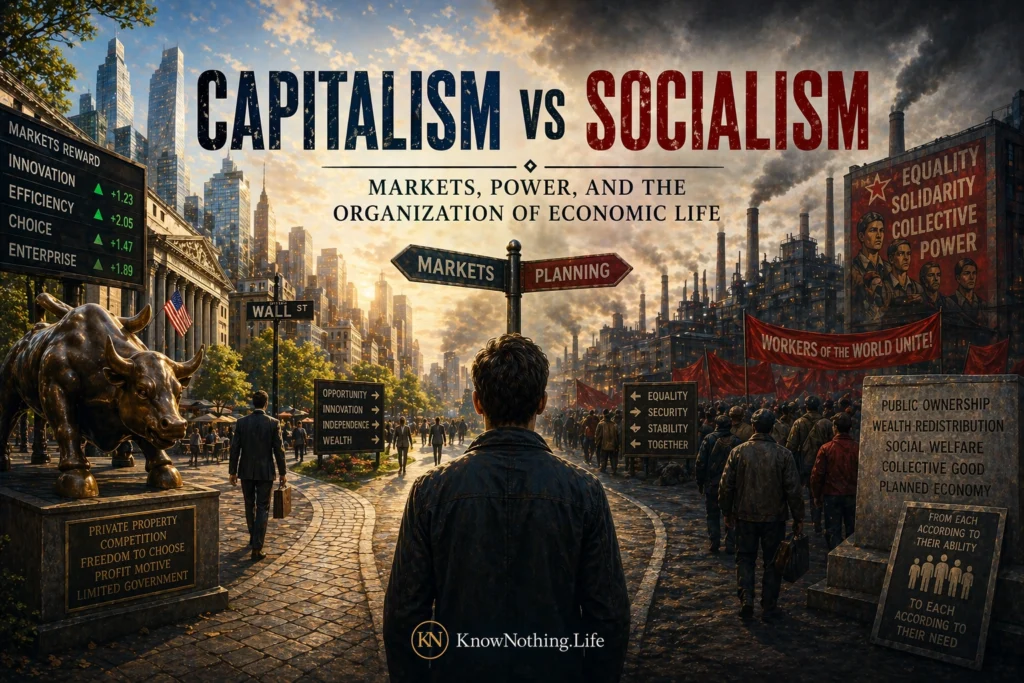
The debate between capitalism and socialism is one of the most enduring and consequential discussions in political and economic thought. At its core, it concerns how societies should organize the production, distribution, and ownership of resources. These systems are not merely technical arrangements; they reflect deeper philosophical commitments about freedom, equality, human nature, and the role of institutions. The tension between them has shaped revolutions, policies, and global alignments for centuries, influencing how nations define prosperity and justice.
Capitalism and socialism are often presented as opposites, but in practice, they exist along a spectrum. Most modern societies incorporate elements of both systems, blending market mechanisms with social protections. Understanding their differences requires moving beyond slogans and examining the principles that guide each model, as well as the historical contexts in which they emerged. From the industrial transformations of the 18th and 19th centuries to contemporary debates over inequality and welfare, the comparison between these systems remains central to discussions about the future of economic life.
Foundations of Capitalism
Capitalism is an economic system defined by private ownership of the means of production, market-based exchange, and the pursuit of profit. In capitalist systems, individuals and firms make decisions about production and investment based on market signals, particularly prices, which are shaped by supply and demand. This decentralized structure is often seen as a strength, allowing for innovation, efficiency, and adaptability in response to changing conditions.
The intellectual roots of capitalism are closely associated with thinkers like Adam Smith, who argued that individuals pursuing their own interests could unintentionally contribute to the collective good through what he described as the “invisible hand.” Smith did not advocate unrestrained greed but emphasized the importance of moral sentiments and institutional frameworks that guide market behavior. Over time, capitalism evolved into various forms, including laissez-faire models with minimal government intervention and regulated versions that incorporate oversight and public goods provision.
Foundations of Socialism
Socialism, by contrast, centers on the idea that the means of production should be owned or controlled collectively, either by the state or by the community as a whole. Its primary goal is to reduce inequality and ensure that resources are distributed in a way that reflects social needs rather than private profit. In socialist systems, economic planning often plays a significant role, with decisions about production and allocation guided by collective priorities rather than market competition.
The development of socialist thought is closely linked to critics of early industrial capitalism, most notably Karl Marx. Marx argued that capitalism inherently produces inequality by concentrating wealth and power in the hands of those who own capital, while workers receive only a portion of the value they create. For Marx, socialism represented a transitional stage toward a classless society in which exploitation would be eliminated. While many modern socialist models differ from Marx’s vision, the emphasis on equality and collective responsibility remains central.
Freedom and Individual Choice
One of the most significant points of divergence between capitalism and socialism lies in their treatment of individual freedom. Capitalist systems are often associated with economic liberty—the ability to choose one’s occupation, start a business, and engage in voluntary exchange. Supporters argue that this freedom fosters creativity and personal responsibility, allowing individuals to pursue their own goals within a competitive environment.
Critics, however, question whether such freedom is meaningful when access to resources is uneven. In a system where wealth is concentrated, the range of real choices available to individuals may be limited. Socialist perspectives emphasize the importance of substantive freedom—the idea that true liberty requires not just formal rights, but also access to basic needs such as healthcare, education, and housing. From this viewpoint, reducing inequality is not a constraint on freedom but a condition for making it genuinely attainable.
Equality and Distribution
Equality is a central concern in the comparison between these systems. Capitalism tends to accept a degree of inequality as a byproduct of competition and innovation. Differences in income and wealth are often justified as incentives that drive productivity and reward effort or risk-taking. Proponents argue that even if inequality exists, overall prosperity can increase, benefiting society as a whole.
Socialism places greater emphasis on reducing disparities and ensuring a more equitable distribution of resources. This does not necessarily mean complete equality, but it involves mechanisms to prevent extreme concentrations of wealth and to provide a safety net for all members of society. The challenge lies in balancing fairness with efficiency—ensuring that redistribution does not undermine the incentives that contribute to economic growth. The tension between these goals is a recurring theme in debates about taxation, welfare, and public policy.
Efficiency and Innovation
Another key dimension of the debate concerns economic efficiency and innovation. Capitalist systems are often praised for their ability to generate technological progress and respond quickly to consumer demand. Competition encourages firms to improve products, reduce costs, and explore new ideas, leading to dynamic and evolving markets. The rapid development of industries such as technology and biotechnology is frequently cited as evidence of capitalism’s innovative capacity.
However, critics argue that markets can also produce inefficiencies, particularly when profit motives conflict with social needs. Issues such as environmental degradation, financial instability, and underinvestment in public goods highlight the limitations of relying solely on market forces. Socialist approaches, with their emphasis on planning and coordination, aim to address these gaps by prioritizing long-term societal goals. Yet centralized planning has historically faced challenges related to information, incentives, and adaptability, raising questions about its effectiveness in complex economies.
The Role of Government
The role of government is a defining feature of both systems. In capitalist frameworks, the state typically acts as a regulator, ensuring fair competition, protecting property rights, and providing public goods. The extent of government involvement varies widely, from minimal intervention in laissez-faire models to more active roles in welfare states that combine market economies with social programs.
In socialist systems, the government often takes on a more direct role in economic management, whether through ownership of key industries or comprehensive planning mechanisms. This expanded role is intended to align economic activity with collective goals, but it also raises concerns about bureaucracy, accountability, and individual autonomy. The balance between state authority and market freedom remains a central question in contemporary policy debates.
Hybrid Systems and Modern Economies
In practice, few societies adhere strictly to pure forms of capitalism or socialism. Most modern economies are mixed systems that incorporate elements of both. Countries often rely on markets to allocate resources while using government interventions to address inequality, provide public services, and stabilize the economy. This blending reflects a pragmatic recognition that each system has strengths and limitations.
Examples of hybrid approaches can be seen in various welfare states, where robust social safety nets coexist with competitive markets. These systems aim to combine the efficiency of capitalism with the equity goals of socialism, though achieving this balance is an ongoing challenge. Differences in cultural values, historical experiences, and political institutions shape how each society navigates this combination.
Ethical and Philosophical Dimensions
Beyond economic performance, the debate between capitalism and socialism raises deeper ethical questions about what societies should prioritize. Is the primary goal to maximize overall wealth, or to ensure fairness and dignity for all individuals? Should economic systems reflect competition or cooperation as their guiding principle? These questions do not have simple answers, as they involve competing values and visions of the good life.
Philosophers and political theorists continue to explore these issues, examining how different systems align with broader concepts of justice, rights, and human flourishing. The debate is not merely about choosing one system over another, but about understanding the trade-offs involved and the values that underpin those choices. In this sense, the discussion of capitalism versus socialism is ultimately a reflection of deeper philosophical commitments about how human societies ought to be organized.
Conclusion
The comparison between capitalism and socialism is a complex and evolving dialogue that extends beyond economics into ethics, politics, and philosophy. Each system offers distinct advantages and faces significant challenges, reflecting different priorities regarding freedom, equality, and the role of institutions. While capitalism emphasizes market dynamics and individual initiative, socialism focuses on collective responsibility and equitable distribution.
In reality, most societies operate within a spectrum that blends elements of both approaches, seeking to harness the benefits of each while mitigating their shortcomings. The ongoing debate highlights the importance of critical reflection and adaptability in shaping economic systems that respond to changing conditions and diverse human needs. Ultimately, the question is not simply which system is better, but how societies can design frameworks that promote both prosperity and justice in a sustainable and inclusive way.