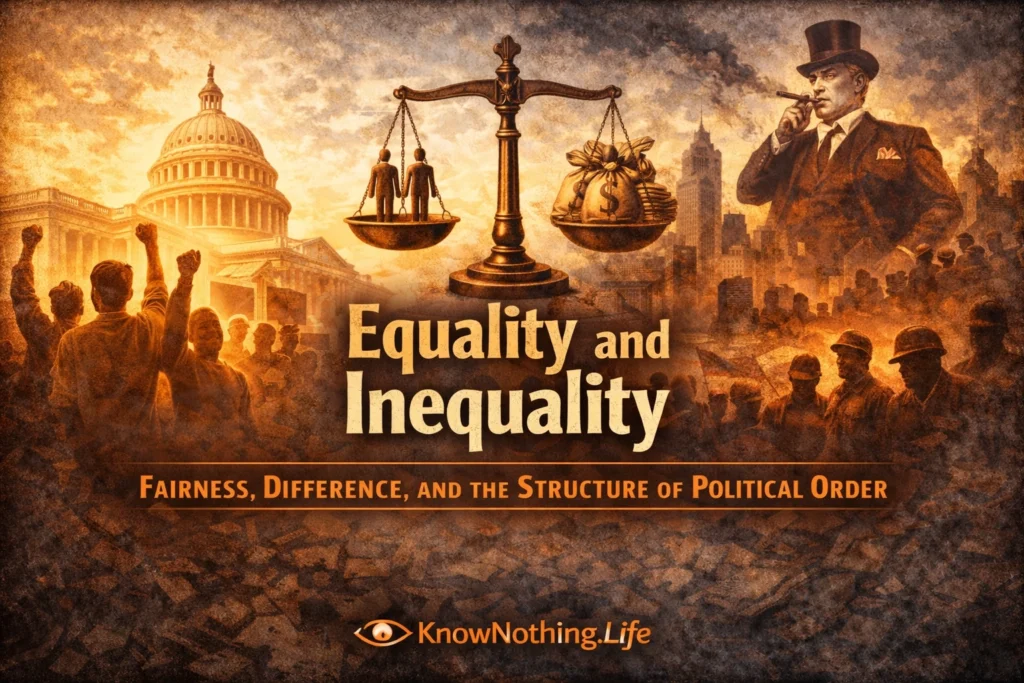
Equality and inequality are among the most persistent and contested concepts in political and moral philosophy. At their core lies a fundamental question: in what sense should human beings be treated as equals, and when are differences justified? Equality suggests that individuals possess the same moral worth and are entitled to fair treatment, while inequality reflects the realities of differing outcomes in wealth, status, opportunity, and power. The tension between these ideas shapes debates about justice, rights, and the organization of society.
Inequality is not inherently unjust; differences in talent, effort, and preference can lead to varied outcomes that many consider acceptable. However, when inequalities arise from arbitrary or unjust factors—such as discrimination, inherited privilege, or structural disadvantage—they become morally problematic. The challenge is to determine which inequalities are permissible and which demand correction. This requires a framework for evaluating fairness, one that balances individual freedom with collective responsibility.
Philosophical Foundations of Equality
The modern conception of equality is deeply influenced by Enlightenment thought, particularly the work of Jean-Jacques Rousseau. In Discourse on the Origin of Inequality, Rousseau distinguishes between natural inequality, which arises from physical differences, and moral or political inequality, which is created by social institutions. He argues that much of the inequality found in society is not natural but constructed, often serving the interests of those in power. His critique highlights the role of social structures in shaping unequal outcomes.
Rousseau’s analysis challenges the assumption that inequality is inevitable or justified. He famously observes that “the first man who, having enclosed a piece of land, thought of saying ‘This is mine,’ and found people simple enough to believe him, was the true founder of civil society.” This statement underscores the idea that property and social hierarchies are not natural givens but products of human decisions. By exposing the origins of inequality, Rousseau opens the possibility of rethinking and reforming social arrangements.
The principle of equality is also central to the work of John Locke, who argues in Two Treatises of Government that all individuals are equal in the state of nature. This equality forms the basis for natural rights and legitimate government. However, Locke also justifies certain forms of inequality, particularly those arising from property ownership and labor. This dual perspective reflects an ongoing tension between the ideal of equality and the acceptance of differences in outcomes.
Equality of Opportunity vs Equality of Outcome
One of the central debates in discussions of equality concerns the distinction between equality of opportunity and equality of outcome. Equality of opportunity focuses on ensuring that individuals have a fair chance to succeed, regardless of their background. This approach emphasizes removing barriers such as discrimination and providing access to education and resources. It aligns with the idea that individuals should be judged based on their abilities and efforts rather than arbitrary factors.
Equality of outcome, by contrast, seeks to reduce disparities in results, aiming for a more even distribution of wealth, status, or resources. Proponents argue that unequal outcomes often reflect deeper structural inequalities that cannot be addressed solely by providing equal opportunities. Critics, however, contend that enforcing equal outcomes can undermine incentives and individual freedom, leading to inefficiency and stagnation.
John Rawls offers a sophisticated attempt to reconcile these perspectives in A Theory of Justice. Rawls argues that a just society must ensure fair equality of opportunity while allowing inequalities that benefit the least advantaged. His “difference principle” provides a framework for evaluating inequalities, suggesting that they are acceptable only if they improve the position of those at the bottom. As he writes, “All social primary goods… are to be distributed equally unless an unequal distribution of any… is to the advantage of the least favored.”
This approach reflects a middle path between strict equality and unrestricted inequality, emphasizing both fairness and practicality. It has had a profound influence on contemporary debates about social policy and economic justice.
Inequality, Power, and Social Structure
Inequality is not only a matter of distribution but also of power. Differences in wealth and status often translate into differences in influence, shaping political decisions and social norms. Karl Marx provides a critical perspective on this relationship in works such as Capital. Marx argues that economic inequality is rooted in the structure of capitalist societies, where the ownership of the means of production allows a small class to dominate others.
For Marx, inequality is not merely a problem of distribution but a fundamental feature of a system that exploits labor. He famously writes, “The history of all hitherto existing society is the history of class struggles.” This perspective highlights the dynamic and conflictual nature of inequality, emphasizing the role of economic structures in shaping social relations. It also challenges the idea that inequality can be addressed without transforming the underlying system.
Contemporary analyses of inequality build on these insights, examining how factors such as race, gender, and globalization contribute to disparities. These approaches emphasize that inequality is multifaceted, involving not only economic factors but also cultural and institutional dimensions. Addressing inequality, therefore, requires a comprehensive understanding of its causes and effects.
Equality, Liberty, and Justice
The relationship between equality and liberty is one of the most enduring tensions in political philosophy. Expanding equality often requires interventions that limit certain freedoms, such as taxation or regulation. Conversely, maximizing liberty can lead to significant inequalities, as individuals with greater resources are better able to exercise their freedom. Balancing these values is a central challenge for any theory of justice.
Robert Nozick offers a libertarian critique of egalitarian approaches in Anarchy, State, and Utopia. He argues that attempts to achieve patterned distributions of wealth violate individual rights, particularly the right to property. For Nozick, justice lies in the processes by which holdings are acquired and transferred, not in the resulting distribution. This perspective emphasizes liberty over equality, challenging the legitimacy of redistributive policies.
Other thinkers seek to integrate equality and liberty more closely. Amartya Sen, in Development as Freedom, argues that true freedom requires addressing inequalities that limit individuals’ capabilities. By focusing on what people are able to do and be, Sen’s approach reframes the debate, suggesting that equality and liberty are not necessarily opposed but can be mutually reinforcing.
Contemporary Inequality and Global Challenges
In the modern world, inequality has become a global concern, shaped by factors such as economic globalization, technological change, and political institutions. Wealth disparities between and within countries have raised questions about fairness and sustainability, prompting debates about taxation, social welfare, and international responsibility. These issues highlight the complexity of inequality in an interconnected world.
Global inequality also raises ethical questions about the obligations of individuals and nations. Should wealthier societies have a duty to assist poorer ones? How should resources be distributed in addressing global challenges such as climate change? These questions extend the concept of equality beyond national boundaries, requiring new frameworks for understanding justice on a global scale.
At the same time, social movements advocating for equality continue to challenge existing structures. Efforts to address racial injustice, gender inequality, and economic disparity reflect a growing recognition that equality is not merely a theoretical ideal but a practical goal that demands action. These movements emphasize that achieving equality requires both institutional reform and cultural change.
The Ongoing Pursuit of Equality
Equality and inequality remain central to political and moral thought because they touch on fundamental questions about fairness, dignity, and the organization of society. While complete equality may be neither possible nor desirable, the pursuit of a more just distribution of resources and opportunities continues to shape public policy and philosophical inquiry.
The challenge lies in identifying principles that can guide this pursuit, balancing competing values and adapting to changing circumstances. Philosophical theories provide valuable insights, but their application requires careful judgment and ongoing reflection. As societies evolve, so too must their approaches to equality, responding to new challenges while remaining grounded in the recognition of shared human worth.
Ultimately, the debate over equality and inequality is not merely about distribution but about the kind of society we wish to create. It is a question of how to reconcile difference with fairness, ensuring that all individuals have the opportunity to live with dignity and respect.