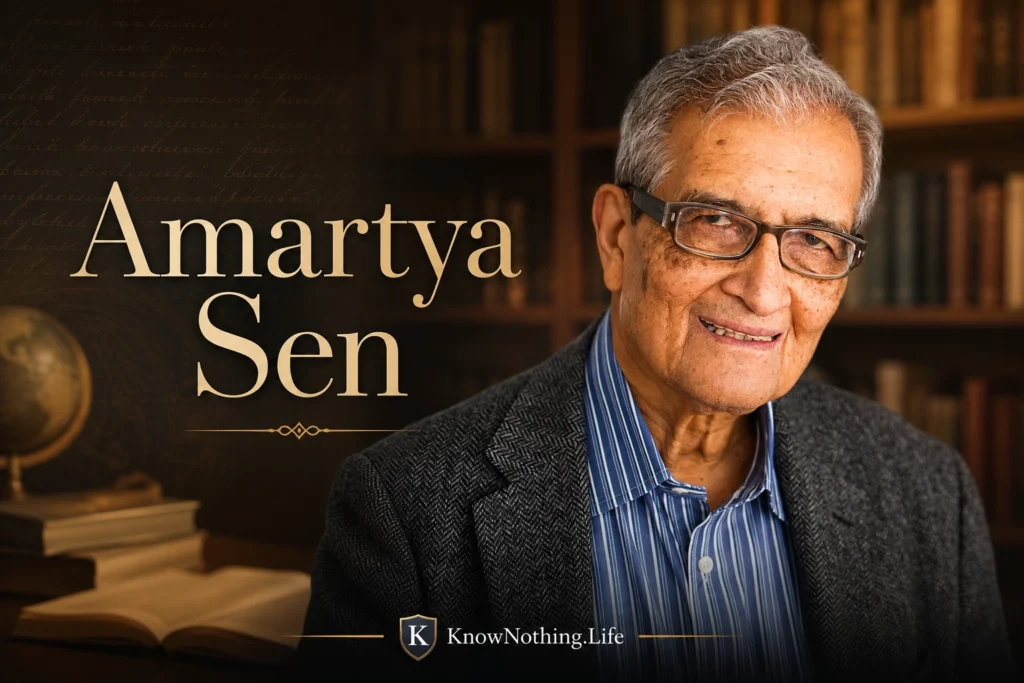
Amartya Kumar Sen was born on November 3, 1933, in Santiniketan, Bengal, in British India. He grew up in an unusually intellectual environment shaped by education, literature, public debate, and the humanist legacy of Rabindranath Tagore, who had founded Visva-Bharati University at Santiniketan. Sen later recalled that he was born on a university campus and seemed to spend his life moving from one campus to another. His father, Ashutosh Sen, was a chemistry professor, and his family background connected him to Bengal’s scholarly and reformist traditions.
Sen’s childhood also exposed him to violence, poverty, and political division. The Bengal famine of 1943 and the communal violence surrounding Partition left a permanent mark on his imagination. One story from his youth became especially important: a wounded Muslim laborer, Kader Mia, came to Sen’s family home after being attacked during communal riots while searching for work in a dangerous area. Sen later used this memory to show that poverty is not merely low income. It is a loss of real freedom, a narrowing of available choices so severe that survival itself becomes hazardous.
Education in Calcutta and Cambridge
Sen studied at Presidency College in Calcutta, where he was trained in economics, mathematics, and public reasoning during a period of intense political change. He then went to Trinity College, Cambridge, where he encountered both technical economic theory and wide philosophical debate. Cambridge gave him access to the traditions of welfare economics, social choice, political philosophy, and moral reasoning. It also placed him in conversation with economists and philosophers who were asking how societies should evaluate well-being, inequality, and collective decisions.
His early academic path was extraordinary. In his early twenties, he became professor of economics at Jadavpur University in Calcutta, a position that signaled both his brilliance and the unusual speed of his intellectual rise. He later held major academic appointments at the Delhi School of Economics, the London School of Economics, Oxford, Cambridge, and Harvard. Across these institutions, Sen refused to let economics become a narrow science of markets alone. He treated it as a moral and analytical discipline concerned with human lives.
Social Choice and Collective Welfare
Sen first became internationally known for his work in social choice theory, the field that asks how individual preferences, judgments, and interests can be combined into collective decisions. Kenneth Arrow had shown, through his famous impossibility theorem, that no voting rule could perfectly satisfy several seemingly reasonable democratic conditions. Sen entered this field not merely to extend technical results, but to ask what they revealed about liberty, justice, information, and human diversity.
His 1970 book Collective Choice and Social Welfare became a landmark. It showed that welfare economics could not be built only on utility totals or preference rankings stripped of ethical content. Sen argued that judgments about poverty, inequality, rights, and well-being require richer information than simple choice data. His famous “liberal paradox,” also called Sen’s paradox, showed that individual liberty and collective preference satisfaction can come into conflict. This work made Sen one of the central figures in the revival of ethical economics.
Poverty, Famines, and Entitlement
Sen’s 1981 book Poverty and Famines: An Essay on Entitlement and Deprivation changed how scholars, policymakers, and humanitarian organizations understood famine. The older assumption was that famine usually results from an overall shortage of food. Sen showed that famine can occur even when food is available, if people lose the ability to command food through wages, employment, trade, legal rights, or public support. He wrote, “Starvation is the characteristic of some people not having enough food to eat,” not simply the characteristic of there being too little food.
This entitlement approach was revolutionary because it shifted attention from aggregate supply to social access. A laborer can starve in a marketplace full of food if wages collapse, prices rise, jobs disappear, or political institutions fail to respond. Sen’s analysis of the Bengal famine argued that millions died not because Bengal had no food, but because vulnerable groups lost purchasing power and entitlement to food. His broader claim, later stated in Development as Freedom, was that no famine has occurred in a functioning democracy with a free press. Democracy matters not only as an ideal, but as a practical protection against catastrophic neglect.
Capability and Human Freedom
Sen’s most influential idea is the capability approach. Instead of measuring development only by income, utility, or economic growth, Sen asks what people are actually able to be and do. A person’s well-being depends on real capabilities: the ability to be nourished, educated, healthy, mobile, respected, politically active, socially included, and free to pursue a life one has reason to value. Money matters, but it is not the final measure. Two people with the same income may have very different real freedoms because of disability, gender discrimination, public health, education, family burdens, or social exclusion.
In Development as Freedom, published in 1999, Sen gave his most accessible statement of this vision. “Expansion of freedom,” he argued, is both the primary end and the principal means of development. The point is simple but profound: development is not just growth in national income. It is the removal of “unfreedoms” that prevent people from living with dignity and agency. Hunger, illiteracy, preventable disease, political repression, social exclusion, and gender inequality are not side issues. They are failures of development itself.
Women, Gender, and Public Reason
Sen’s work on gender inequality has been especially influential. His essay “More Than 100 Million Women Are Missing” drew attention to the demographic consequences of gender discrimination in parts of Asia and North Africa, where unequal nutrition, healthcare, and social valuation produced abnormal sex ratios. Sen’s argument was not merely statistical. It showed that discrimination can become visible in the structure of populations, life expectancy, and survival itself.
He also emphasized women’s agency as a central force in development. Education, employment, property rights, healthcare, reproductive freedom, and political participation are not merely benefits delivered to women. They are sources of social transformation. When women gain real capabilities, families, economies, and democracies change. Sen’s approach helped move development thinking away from treating people as passive recipients of aid and toward seeing them as agents capable of shaping their own futures.
The Nobel Prize and Global Recognition
In 1998, Sen received the Nobel Memorial Prize in Economic Sciences for his contributions to welfare economics. The award recognized his work on social choice, poverty, famine, inequality, and the measurement of well-being. In 1999, India awarded him the Bharat Ratna, the country’s highest civilian honor. These honors reflected the unusual breadth of his influence: Sen was not only an economist admired by economists, but a philosopher of justice, a public intellectual, and a global voice on poverty and democracy.
His academic career has been equally distinguished. He has served as Master of Trinity College, Cambridge, and as Thomas W. Lamont University Professor and Professor of Economics and Philosophy at Harvard. His research ranges across welfare economics, ethics, political philosophy, public health, development economics, decision theory, measurement, and gender studies. Few modern thinkers have done more to show that economics and moral philosophy belong in conversation with one another.
Justice, Democracy, and Public Reasoning
Sen’s later book The Idea of Justice, published in 2009, offered an important alternative to ideal theories of justice. Rather than beginning with a perfectly just society, Sen asked how people can identify and reduce clear injustices here and now. He argued that justice must focus not only on institutions and rules, but on “the lives that people can actually live.” This made his approach practical, comparative, and democratic. We do not need full agreement on utopia before we can fight famine, illiteracy, exclusion, or avoidable disease.
Sen’s commitment to democracy is rooted in public reasoning. Democracy is not only voting; it is discussion, criticism, press freedom, opposition, accountability, and the ability of citizens to make suffering visible. His thought connects economics to argument. A society becomes more just not by handing decisions to experts alone, but by expanding the public space in which people can reason about shared problems. For Sen, freedom is both personal and political.
Legacy and Lasting Importance
Amartya Sen’s major works include Collective Choice and Social Welfare, On Economic Inequality, Poverty and Famines, Commodities and Capabilities, Development as Freedom, Rationality and Freedom, The Argumentative Indian, Identity and Violence, and The Idea of Justice. Across these books, he has transformed how scholars think about poverty, welfare, democracy, famine, rights, freedom, identity, and development. His influence can be seen in the Human Development Index, capability theory, global poverty measurement, feminist economics, public health, and debates about justice.
Sen remains essential because he changed the unit of moral and economic attention. He asked us not only how much wealth a society produces, but what its people are able to do with their lives. He showed that hunger can exist amid food, that growth can coexist with deprivation, and that freedom is not a luxury added after development but the substance of development itself. His lasting message is that economics must begin and end with human beings: their capabilities, voices, choices, vulnerabilities, and real opportunities to live lives they have reason to value.