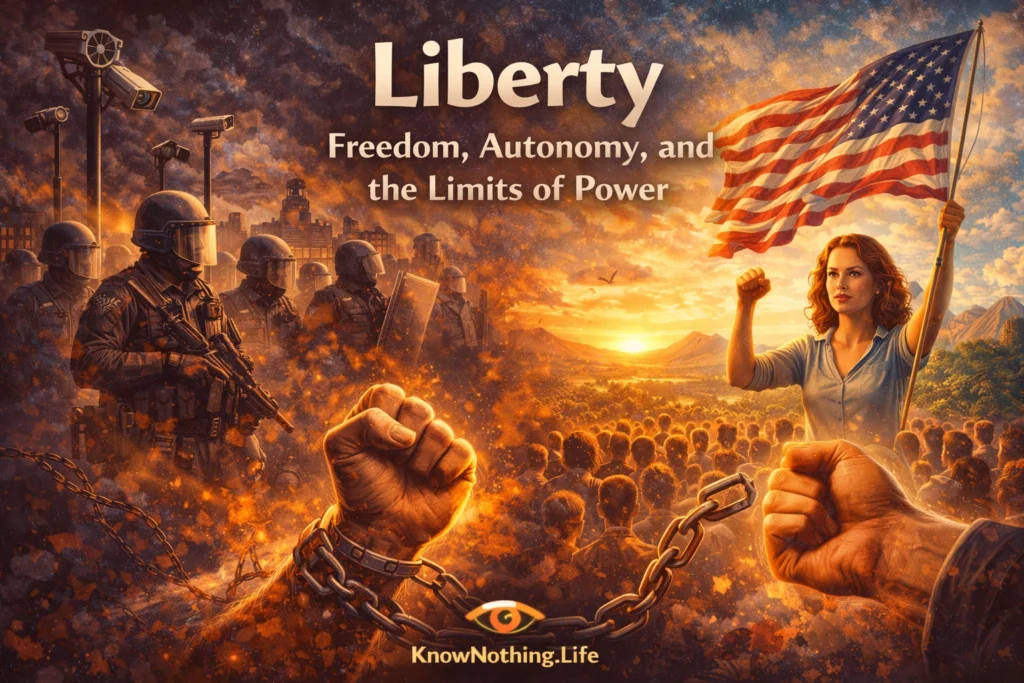
Liberty is one of the central ideals of political and moral philosophy, expressing the condition in which individuals are free to think, act, and pursue their lives without undue interference. It is a concept that resonates across cultures and historical periods, yet its meaning remains deeply contested. At its simplest, liberty refers to the absence of constraints, but philosophical inquiry reveals a far more complex idea—one that involves autonomy, rights, responsibility, and the structure of social institutions. The question is not only whether individuals are free, but what kind of freedom matters and how it should be protected.
The tension within liberty arises from the need to balance individual independence with the realities of living in a society. Absolute freedom is neither possible nor desirable, as the actions of one person inevitably affect others. Laws, norms, and institutions impose limits, but these limits can either protect liberty or undermine it. Understanding liberty, therefore, requires examining the nature of these constraints: when are they justified, and when do they become oppressive? This inquiry has led to the development of competing theories that define freedom in different ways, each offering a distinct vision of what it means to live freely.
Negative Liberty and the Absence of Interference
One of the most influential conceptions of liberty is negative liberty, which defines freedom as the absence of external interference. This idea is most clearly articulated by Isaiah Berlin in his essay Two Concepts of Liberty. Berlin distinguishes negative liberty from other forms of freedom, arguing that it concerns the area within which an individual can act without being obstructed by others. The larger this area, the greater the individual’s freedom.
This conception builds on earlier liberal thought, particularly the work of John Locke. In Two Treatises of Government, Locke argues that individuals possess natural rights to life, liberty, and property, and that the primary role of government is to protect these rights. Liberty, in this framework, is not the absence of all restraint but the absence of arbitrary power. As Locke writes, “Where there is no law, there is no freedom,” emphasizing that legitimate laws can actually secure liberty by preventing domination.
Negative liberty has been highly influential in shaping modern political systems, particularly those that emphasize individual rights and limited government. However, critics argue that this view is too narrow, as it overlooks the ways in which social and economic conditions can restrict freedom even in the absence of direct interference. A person may be formally free but lack the resources or opportunities needed to exercise that freedom meaningfully.
Positive Liberty and Self-Mastery
In contrast to negative liberty, positive liberty focuses on the ability of individuals to control their own lives and realize their potential. Rather than asking what constraints exist, it asks whether individuals have the capacity to act as autonomous agents. This idea has roots in the philosophy of Jean-Jacques Rousseau, particularly in The Social Contract. Rousseau famously declares, “Man is born free, and everywhere he is in chains,” suggesting that true freedom requires more than the absence of interference—it requires participation in shaping the conditions of one’s life.
Positive liberty is closely tied to the concept of self-rule or autonomy. It emphasizes the importance of rational deliberation, moral development, and collective decision-making. In this view, individuals are free not simply when they are left alone, but when they are able to govern themselves according to reason and shared values. This perspective often supports more active roles for institutions, such as education and democratic governance, in enabling freedom.
However, positive liberty has also been criticized for its potential to justify coercion. If freedom is defined as self-realization, authorities may claim to know what is best for individuals and impose restrictions in the name of their true interests. Berlin warns that this can lead to authoritarianism, as the line between enabling freedom and enforcing conformity becomes blurred. The debate between negative and positive liberty remains one of the most significant tensions in political philosophy.
Liberty, Harm, and the Limits of Authority
A central question in the philosophy of liberty is how far individual freedom should extend. John Stuart Mill provides a seminal answer in On Liberty. Mill argues that the only legitimate reason for limiting an individual’s freedom is to prevent harm to others. This “harm principle” establishes a clear boundary: individuals should be free to act as they wish, provided their actions do not infringe on the rights or well-being of others.
Mill’s defense of liberty is grounded in both moral and practical considerations. He believes that allowing individuals to pursue their own paths leads to greater overall happiness and social progress. Freedom of thought and expression, in particular, is essential for the discovery of truth. As he writes, “Over himself, over his own body and mind, the individual is sovereign.” This statement captures the core of liberal individualism, emphasizing personal autonomy and the importance of protecting it from undue interference.
At the same time, Mill acknowledges that defining harm is not always straightforward. Social norms, cultural values, and differing perspectives can complicate judgments about what constitutes harm. Nevertheless, his framework provides a powerful tool for evaluating the legitimacy of laws and policies, reinforcing the idea that liberty must be protected against both governmental overreach and social coercion.
Liberty, Equality, and Social Justice
The relationship between liberty and equality is one of the most enduring debates in political thought. Some argue that maximizing liberty inevitably leads to inequality, as individuals with greater resources are better able to exercise their freedom. Others contend that certain forms of equality are necessary to ensure that liberty is meaningful for all. This tension is explored in the work of John Rawls, particularly in A Theory of Justice.
Rawls attempts to reconcile liberty and equality by prioritizing basic freedoms while allowing for inequalities that benefit the least advantaged. His first principle of justice guarantees equal basic liberties for all, while his second principle addresses the distribution of resources. This framework reflects the idea that liberty must be balanced with fairness, ensuring that all individuals have a genuine opportunity to exercise their freedoms.
Critics of Rawls, such as Robert Nozick, argue that redistributive policies infringe on individual liberty by interfering with property rights. In Anarchy, State, and Utopia, Nozick defends a minimal state that protects rights but does not engage in redistribution. This debate highlights the difficulty of defining liberty in a way that accommodates both individual autonomy and social justice, a challenge that continues to shape contemporary political discourse.
Liberty in the Modern World
In the modern era, the concept of liberty faces new challenges arising from technological, economic, and global developments. Issues such as digital surveillance, data privacy, and algorithmic control raise questions about the nature of freedom in an increasingly interconnected world. While technology can expand opportunities and access, it can also create new forms of constraint and manipulation that are less visible but equally significant.
Globalization further complicates the idea of liberty by extending it beyond national boundaries. Economic interdependence, migration, and international governance structures influence the conditions under which individuals exercise their freedom. These developments require rethinking traditional frameworks that focus primarily on the relationship between individuals and the state.
At the same time, social movements advocating for civil rights, gender equality, and economic justice continue to redefine the meaning of liberty. These movements emphasize that freedom is not only about formal rights but also about the ability to live without discrimination and structural disadvantage. Liberty, in this sense, is an evolving ideal that must adapt to changing social realities while remaining grounded in its core commitment to human dignity.
The Enduring Significance of Liberty
Liberty remains a foundational principle of political and moral life because it speaks to the fundamental human desire for autonomy and self-determination. It underpins democratic institutions, informs legal systems, and shapes cultural values. Yet its meaning is not fixed; it is continually reinterpreted in light of new challenges and perspectives.
The enduring significance of liberty lies in its capacity to guide reflection on the relationship between individuals and the structures that govern them. It invites ongoing debate about the limits of power, the role of institutions, and the conditions necessary for human flourishing. As societies evolve, the pursuit of liberty requires balancing competing values, navigating complex trade-offs, and remaining vigilant against threats to freedom.
Ultimately, liberty is both a condition and an aspiration—a state of being free and a commitment to preserving and expanding that freedom. It is a principle that demands careful thought and constant engagement, reflecting the dynamic and ever-changing nature of human life.