John Locke was born on August 29, 1632, in Wrington, Somerset, during one of the most turbulent periods in English history. The nation stood on the brink of civil war, and questions surrounding authority, governance, and individual rights were not abstract philosophical concerns but urgent political realities. Locke’s father, a lawyer and a supporter of the Parliamentary cause during the English Civil War, exposed him early to ideas of resistance against absolute monarchy and the importance of constitutional order. These formative influences would later shape Locke’s political philosophy in profound ways.
Locke was educated at Westminster School before attending Christ Church, Oxford, where he studied classics, medicine, and philosophy. Although the university curriculum remained steeped in scholastic traditions rooted in Aristotle, Locke found these teachings increasingly unsatisfying. He gravitated instead toward the emerging scientific methods of observation and experimentation, influenced by thinkers such as Francis Bacon and René Descartes. This intellectual shift marked the beginning of his lifelong commitment to empiricism—the idea that knowledge arises from experience rather than innate ideas.
Locke’s early career was not confined to academic study. He trained in medicine and became closely associated with Anthony Ashley Cooper, later the Earl of Shaftesbury, one of the most influential political figures of the time. This relationship provided Locke with direct exposure to political life, economic policy, and governance. It also placed him at the center of debates about religious tolerance, constitutional authority, and the limits of power—issues that would become central to his philosophical work.
The Theory of Knowledge and Empiricism
Locke’s most influential philosophical contribution is found in his monumental work, An Essay Concerning Human Understanding (1689). In this text, he set out to investigate the origins, nature, and limits of human knowledge. Rejecting the notion of innate ideas, Locke famously argued that the human mind at birth is a “tabula rasa,” or blank slate. All knowledge, he claimed, is derived from experience, either through sensation (interaction with the external world) or reflection (the mind’s awareness of its own operations).
This radical departure from traditional epistemology reshaped the philosophical landscape. By grounding knowledge in experience, Locke aligned philosophy more closely with the scientific methods being developed during the Scientific Revolution. His approach emphasized careful observation, analysis, and the gradual accumulation of knowledge, rather than reliance on authority or abstract reasoning alone. As he wrote, “No man’s knowledge here can go beyond his experience,” a statement that encapsulates the essence of his empiricist philosophy.
Locke’s theory of knowledge also introduced important distinctions, such as that between primary and secondary qualities. Primary qualities—such as shape, motion, and number—exist objectively in the world, while secondary qualities—such as color, taste, and sound—are products of human perception. This framework provided a nuanced understanding of how the mind interacts with reality, influencing later philosophers and shaping debates in epistemology for centuries.
Political Philosophy and Natural Rights
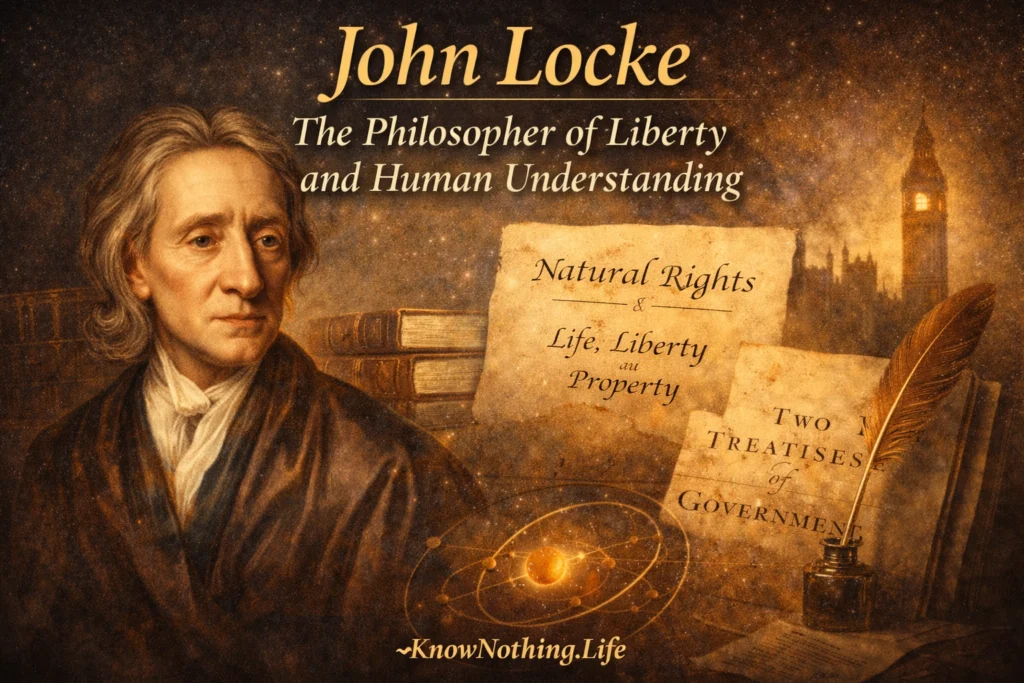
Locke’s political philosophy, articulated most clearly in Two Treatises of Government (1689), stands as one of the foundational texts of modern liberal thought. Writing in the aftermath of the Glorious Revolution, Locke sought to justify the overthrow of absolute monarchy and to establish principles for legitimate governance. At the heart of his theory is the concept of natural rights—rights that belong to individuals by virtue of their humanity, not by the grant of any ruler.
According to Locke, these natural rights include life, liberty, and property. Governments are formed through a social contract in which individuals consent to surrender certain freedoms in exchange for the protection of these rights. However, this consent is conditional. If a government fails to fulfill its duties—if it becomes tyrannical or violates the rights of its citizens—then the people retain the right to resist and replace it. As Locke famously asserted, “Whenever the legislators endeavor to take away and destroy the property of the people… they put themselves into a state of war with the people.”
This theory had far-reaching implications. It provided a philosophical justification for revolution and laid the groundwork for constitutional democracy. Locke’s ideas directly influenced political movements in both Europe and America, shaping documents such as the United States Declaration of Independence. His emphasis on individual rights and limited government remains central to modern political thought, reflecting a vision of society in which authority is derived from the consent of the governed.
Religious Tolerance and the Limits of Authority
In addition to his work on knowledge and politics, Locke made significant contributions to the philosophy of religion, particularly in his advocacy for religious tolerance. In A Letter Concerning Toleration (1689), he argued that the state should not impose religious beliefs on its citizens. Faith, he maintained, cannot be coerced; it must be freely chosen. This position challenged the prevailing assumption that political unity required religious uniformity.
Locke distinguished between the roles of the church and the state, asserting that each operates within its own sphere. The state’s primary function is to protect civil interests—life, liberty, and property—while the church is concerned with the salvation of souls. By separating these domains, Locke sought to reduce religious conflict and promote peaceful coexistence. His argument reflects a broader commitment to individual autonomy and freedom of conscience.
However, Locke’s views on tolerance were not without limits. He excluded certain groups, such as atheists and those he believed could not be trusted to uphold social order, from his vision of toleration. While these exclusions reveal the constraints of his historical context, his broader argument marked a significant step toward the development of modern principles of religious freedom. His insistence that belief cannot be legislated remains a cornerstone of liberal thought.
Major Works and Intellectual Legacy
Locke’s body of work extends beyond his most famous texts, encompassing writings on education, economics, and governance. In Some Thoughts Concerning Education (1693), he emphasized the importance of character formation, practical learning, and the development of reason. Rejecting harsh disciplinary methods, he advocated for an approach that encourages curiosity and self-discipline, reflecting his broader belief in the formative power of experience.
His influence on later thinkers is profound. Philosophers such as David Hume and George Berkeley built upon his empiricist framework, while political theorists drew on his ideas to develop theories of rights and governance. Locke’s integration of philosophy with practical concerns—education, politics, and religion—demonstrates a commitment to applying abstract ideas to real-world problems.
Among his many memorable statements, one stands out for its enduring relevance: “The end of law is not to abolish or restrain, but to preserve and enlarge freedom.” This insight captures the essence of Locke’s philosophy, which seeks to balance order and liberty in a way that respects the dignity and autonomy of the individual.
Final Years and Enduring Influence
In his later years, Locke lived quietly in Essex, continuing to write and reflect on the ideas that had defined his career. Despite declining health, he remained intellectually active, engaging with friends and correspondents on matters of philosophy and politics. His final works further refined his positions, demonstrating a lifelong commitment to inquiry and self-examination.
Locke died on October 28, 1704, leaving behind a legacy that would shape the course of modern thought. His ideas helped to define the Enlightenment, a movement characterized by an emphasis on reason, individual rights, and the pursuit of knowledge. From the development of democratic institutions to the evolution of scientific inquiry, Locke’s influence can be traced across multiple domains.
Today, he is regarded as one of the most important philosophers in history, a thinker whose work continues to inform debates about knowledge, freedom, and the nature of society. His vision of a world grounded in reason, experience, and mutual respect remains as relevant as ever. Through his writings, Locke challenged humanity to think critically, to question authority, and to recognize the fundamental rights that belong to every individual.