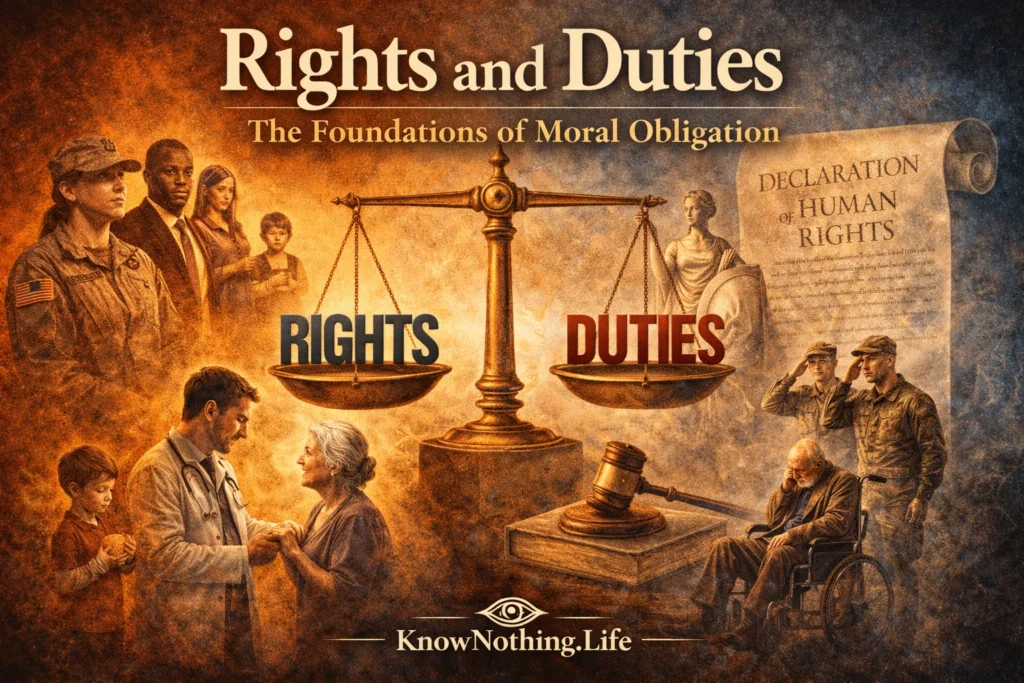
Rights and duties are among the most fundamental concepts in moral and political philosophy, forming the backbone of ethical reasoning about justice, responsibility, and human interaction. A right is typically understood as an entitlement or claim that individuals possess, while a duty is an obligation to act—or refrain from acting—in certain ways. These two concepts are deeply interconnected: the rights of one person often correspond to the duties of others. Together, they provide a framework for understanding how individuals ought to treat one another within a moral community.
The language of rights is central to modern ethical and political discourse. It underpins legal systems, informs debates about justice and equality, and shapes international frameworks such as human rights declarations. At the same time, the concept of duty emphasizes responsibility, reminding individuals that ethical life involves not only what one is entitled to but also what one owes to others. Balancing rights and duties is therefore essential for maintaining social order and promoting fairness.
Philosophical inquiry into rights and duties raises profound questions: Are rights natural or socially constructed? What is the source of moral obligation? How should conflicts between rights be resolved? These questions have been explored by thinkers across centuries, resulting in diverse and sometimes competing theories that continue to influence contemporary debates.
Historical Foundations and Natural Rights Theory
The modern concept of rights is often traced to the tradition of natural rights theory, which holds that individuals possess certain rights simply by virtue of being human. John Locke was one of the most influential proponents of this view. In Two Treatises of Government, Locke argued that individuals have natural rights to life, liberty, and property, which exist independently of political authority. Governments, he maintained, are established to protect these rights, and their legitimacy depends on fulfilling this role.
Locke’s account of rights is closely tied to the idea of duty. If individuals have a right to life, others have a duty not to harm them; if they have a right to property, others have a duty not to steal. This reciprocal relationship highlights the moral structure underlying rights discourse. Locke’s influence can be seen in foundational political documents such as the United States Declaration of Independence, which echoes his emphasis on inalienable rights.
Earlier philosophical traditions also contributed to the development of rights and duties. Thomas Aquinas, drawing on natural law theory, argued that moral obligations are grounded in the rational order of the universe. While he did not use the modern language of rights, his emphasis on duties and moral law laid important groundwork for later developments. These historical perspectives illustrate how the concepts of rights and duties have evolved through philosophical reflection and social change.
Deontological Perspectives on Duty
The concept of duty is central to deontological ethics, which emphasizes the importance of moral rules and obligations. Immanuel Kant provided one of the most influential accounts of duty in Groundwork of the Metaphysics of Morals. Kant argued that moral actions are those performed out of duty, guided by rational principles rather than personal inclinations. “Duty is the necessity of an action from respect for the law,” he wrote, highlighting the role of moral law in guiding behavior.
Kant’s categorical imperative provides a framework for understanding duties. It requires individuals to act only on principles that can be universalized and to treat others as ends in themselves. This approach emphasizes the inherent dignity of persons and the moral obligations that arise from it. Duties, in this view, are not contingent on consequences but are grounded in the structure of rationality itself.
Deontological theories also distinguish between different types of duties. Perfect duties, such as the duty not to lie or harm others, are strict and must always be followed. Imperfect duties, such as the duty to help others, allow for discretion in how they are fulfilled. This distinction reflects the complexity of moral life, where individuals must navigate multiple obligations and make judgments about how to act.
Rights-Based Ethics and Justice
Rights-based approaches to ethics focus on the protection and promotion of individual rights as the primary goal of moral and political systems. These approaches emphasize the importance of safeguarding fundamental freedoms and ensuring that individuals are treated with respect and equality. Rights serve as constraints on actions, limiting what can be done even in pursuit of beneficial outcomes.
John Rawls developed a highly influential theory of justice grounded in rights. In A Theory of Justice, Rawls argued that a just society is one that individuals would choose under conditions of fairness, represented by the “veil of ignorance.” This thought experiment ensures that principles of justice are impartial, protecting the rights of all individuals regardless of their social position. Rawls’s work highlights the role of rights in promoting fairness and equality within social institutions.
Rights-based ethics also plays a central role in international human rights discourse. Documents such as the Universal Declaration of Human Rights articulate a set of fundamental rights that are considered universal and inalienable. These frameworks reflect a global commitment to protecting human dignity, though debates continue about how rights should be interpreted and enforced across different cultural contexts.
Conflicts Between Rights and Duties
While rights and duties provide a framework for ethical reasoning, conflicts between them are often unavoidable. Situations may arise where the rights of different individuals clash, or where fulfilling one duty requires violating another. These conflicts highlight the need for careful judgment and prioritization in ethical decision-making.
Philosophers have proposed various approaches to resolving such conflicts. W. D. Ross introduced the concept of prima facie duties in The Right and the Good, arguing that individuals have multiple obligations that must be balanced against one another. According to Ross, no single duty is absolute; instead, individuals must weigh competing considerations to determine what ought to be done in a given situation.
These conflicts also raise questions about the limits of rights. Are all rights equally important, or do some take precedence over others? How should societies balance individual rights with collective interests? These questions are particularly relevant in areas such as public health, where measures to protect the community may restrict individual freedoms. Addressing these challenges requires both philosophical insight and practical judgment.
Contemporary Debates and Expanding Rights
In contemporary ethics, the concept of rights continues to evolve, expanding beyond traditional human-centered frameworks. Debates have emerged about the rights of non-human animals, future generations, and even the environment. Peter Singer has argued that moral consideration should extend to animals based on their capacity to suffer, challenging the assumption that rights are limited to humans.
Similarly, discussions about environmental ethics have raised the possibility of recognizing rights for ecosystems and natural entities. These developments reflect a broader shift toward inclusive and forward-looking approaches to moral responsibility. They also highlight the dynamic nature of rights discourse, as it adapts to new ethical challenges and perspectives.
At the same time, debates continue about the relationship between rights and duties in a globalized world. Issues such as migration, economic inequality, and climate change raise questions about the distribution of responsibilities across nations and individuals. These challenges underscore the importance of integrating rights with a robust sense of duty, ensuring that ethical frameworks remain responsive to changing conditions.
Conclusion
Rights and duties are foundational concepts that shape moral and political thought, providing a framework for understanding obligation, entitlement, and justice. Through the contributions of thinkers such as John Locke, Immanuel Kant, John Rawls, and W. D. Ross, philosophy has developed a rich and nuanced account of these ideas.
By examining the interplay between rights and duties, we gain insight into how individuals and societies can navigate ethical challenges and promote fairness. These concepts remind us that ethical life involves both claiming what we are owed and fulfilling our obligations to others.
Ultimately, the study of rights and duties highlights the importance of balance and responsibility. It challenges us to consider not only our own interests but also the well-being of others, fostering a more just and cooperative world.