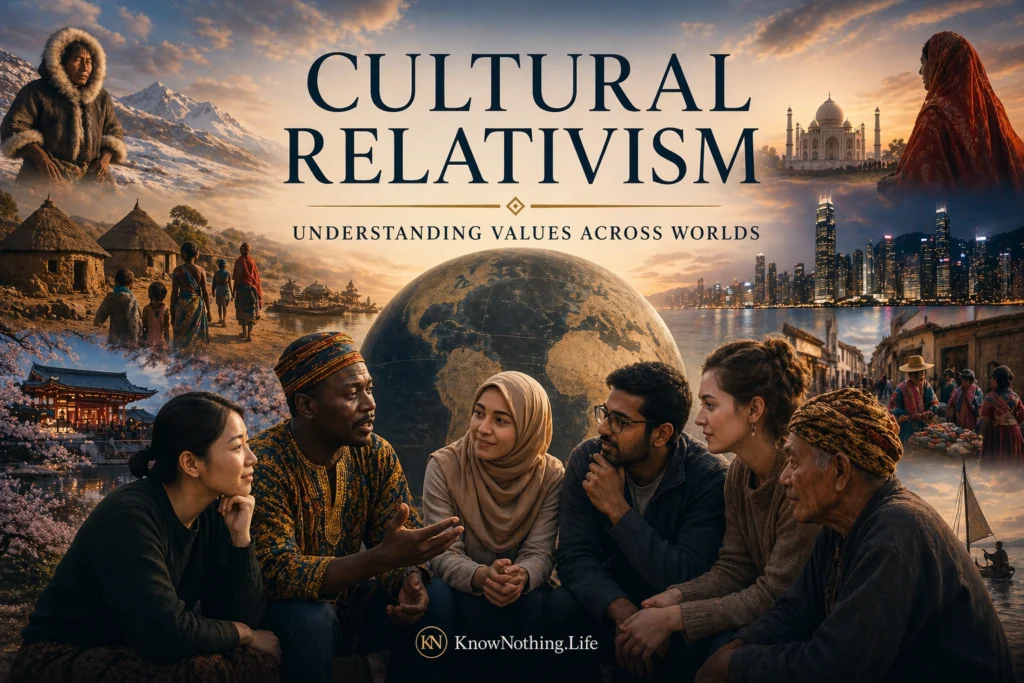
Cultural relativism is the view that beliefs, values, and practices must be understood within the cultural contexts in which they arise. Rather than judging other societies by the standards of one’s own, it calls for interpretation that is sensitive to history, language, and social meaning. At its strongest, cultural relativism challenges the idea of universal moral standards; at its more moderate forms, it urges humility and caution in cross-cultural judgment.
Philosophically, cultural relativism sits at the intersection of ethics, epistemology, and the philosophy of culture. It raises questions about whether moral truths are objective or socially constructed, how understanding is shaped by context, and what it means to evaluate practices that differ from our own. In an interconnected world, where cultures meet and influence one another at unprecedented speed, these questions are not abstract—they are central to politics, law, and everyday life.
Historical Foundations of Relativist Thought
Early reflections on cultural difference appear in ancient accounts of travel and encounter, where observers noted that customs vary widely across societies. Yet it was in modern thought that relativism took on a more systematic form. Johann Gottfried Herder argued that each culture expresses a distinctive “spirit,” shaped by language, history, and environment. For Herder, understanding a people required entering their world of meaning rather than imposing external standards.
In the early twentieth century, anthropology deepened this insight. Franz Boas rejected evolutionary hierarchies that ranked cultures from “primitive” to “civilized,” insisting instead on the equal validity of diverse cultural forms. His students, including Ruth Benedict, showed how moral codes that seem natural in one society can appear unusual in another, emphasizing the variability of norms.
Philosophy absorbed these developments and pressed them further. If moral practices differ so widely, does this undermine the idea of universal values? Cultural relativism emerges as both a methodological stance—how to understand cultures—and a substantive claim about the nature of morality itself.
Descriptive vs. Normative Relativism
A crucial distinction clarifies debates about cultural relativism: the difference between descriptive and normative forms. Descriptive relativism is an empirical claim that moral beliefs and practices vary across cultures. This claim is widely accepted and supported by historical and anthropological evidence.
Normative (or ethical) relativism goes further, arguing that there are no objective moral standards beyond cultural frameworks. According to this view, what is right or wrong is determined by the norms of a given society, and there is no neutral standpoint from which to judge between them. This stronger claim is more controversial, as it appears to limit the possibility of moral criticism.
Between these poles lie moderate positions. Some philosophers accept cultural variation while maintaining that certain minimal standards—such as prohibitions against extreme harm—can be justified across contexts. Others argue that while ultimate foundations may differ, practical convergence on many values is possible. These distinctions help avoid conflating the fact of diversity with the denial of all universality.
Culture, Meaning, and Interpretation
Cultural relativism emphasizes that practices gain their meaning within specific systems of symbols and beliefs. A ritual, law, or custom cannot be fully understood when isolated from the network of meanings that sustain it. This interpretive approach aligns with insights from Ludwig Wittgenstein, who argued that meaning arises from use within forms of life.
Interpretation, however, is not a passive process. It requires entering into unfamiliar perspectives, learning languages and contexts, and recognizing one’s own assumptions. Philosophers and anthropologists have stressed that misunderstanding often arises when practices are translated too quickly into foreign categories. Cultural relativism thus promotes methodological patience and intellectual humility.
At the same time, interpretation is never complete or neutral. Observers bring their own frameworks to what they study, and cross-cultural understanding is shaped by dialogue rather than perfect translation. This suggests that relativism is less about abandoning judgment than about refining it through deeper engagement with context.
Moral Judgment and the Limits of Relativism
A central challenge for cultural relativism concerns moral judgment. If all values are relative to cultures, can any practice be criticized as unjust? Critics argue that strong relativism risks moral paralysis, making it difficult to condemn practices that cause harm or violate widely held intuitions about dignity.
Defenders respond that relativism need not eliminate criticism; it can redirect it. Rather than imposing external standards, critique can emerge from within cultures, drawing on internal values and tensions. Many societies contain competing norms, and change often arises through internal debate and reform. Cultural relativism can thus support a form of immanent critique grounded in local traditions.
Nevertheless, questions remain about practices that appear to conflict with widely shared concerns about suffering or coercion. Philosophers explore whether cross-cultural dialogue can yield shared standards without erasing difference. The tension between respect for diversity and the need for moral evaluation remains one of the field’s most enduring problems.
Universalism, Human Rights, and Dialogue
The rise of international human rights frameworks has intensified debates between relativism and universalism. Universalists argue that certain rights—such as freedom from torture or arbitrary detention—are grounded in human dignity and apply across cultures. Relativists caution that imposing such standards can reflect cultural imperialism if they ignore local contexts.
A productive path has emerged in the form of dialogical approaches. Rather than assuming fixed universals or complete relativism, these approaches emphasize ongoing conversation among cultures. Through dialogue, societies can articulate their values, negotiate differences, and identify areas of overlap. This process treats universality not as a starting point but as a potential outcome of engagement.
Philosophers like Charles Taylor have argued for a “fusion of horizons,” where understanding grows through interaction between perspectives. This model preserves respect for cultural difference while allowing for the possibility of shared norms developed through mutual recognition.
Power, Colonialism, and the Politics of Judgment
Cultural relativism cannot be separated from the history of colonialism and global power. Judgments about “civilization” and “backwardness” were often used to justify domination, making skepticism about universal standards understandable. Relativism, in part, emerges as a corrective to these histories, challenging claims that one culture’s values should govern others.
At the same time, power continues to shape which voices are heard in global debates. Media, economic influence, and political institutions can amplify certain perspectives while marginalizing others. Philosophers draw on analyses by Michel Foucault to show how knowledge and power interact, influencing what counts as truth.
Recognizing these dynamics complicates both relativist and universalist positions. It suggests that ethical debates are not conducted on neutral ground but within asymmetrical systems of influence. Cultural relativism thus serves not only as a theory of values but also as a critical tool for examining how judgments are formed and whose interests they serve.
Cultural Change, Hybridity, and Globalization
In contemporary contexts, cultures are not isolated but interconnected. Migration, trade, and digital communication create hybrid forms of life where traditions mix and evolve. This challenges simple models of cultural relativism that treat societies as bounded and stable.
Philosophers increasingly emphasize the fluidity of culture. Practices and values are continually reinterpreted, and individuals often navigate multiple cultural frameworks simultaneously. This hybridity complicates the idea that norms belong exclusively to discrete groups, suggesting instead that cultures are dynamic and porous.
Globalization also raises practical questions about coordination and cooperation. Issues such as climate change, public health, and economic regulation require shared frameworks, even amid diversity. Cultural relativism must therefore engage with the realities of interdependence, balancing respect for difference with the need for collective action.
Conclusion
Cultural relativism offers a powerful lens for understanding the diversity of human values and practices. By emphasizing context, interpretation, and humility, it challenges assumptions about universality and encourages deeper engagement with cultural difference. It reveals that morality is not a monolithic system but a complex field shaped by history, language, and social life.
At the same time, relativism faces important limits. The need for moral judgment, the realities of global interconnection, and the persistence of injustice all require frameworks that go beyond simple contextualism. The most compelling approaches today seek a balance—acknowledging diversity while pursuing shared standards through dialogue and reflection.
Ultimately, cultural relativism is less a final answer than an ongoing practice. It invites individuals and societies to question their assumptions, listen across differences, and approach moral questions with both conviction and openness. In a plural world, this practice is essential for building understanding and navigating the challenges of coexistence.