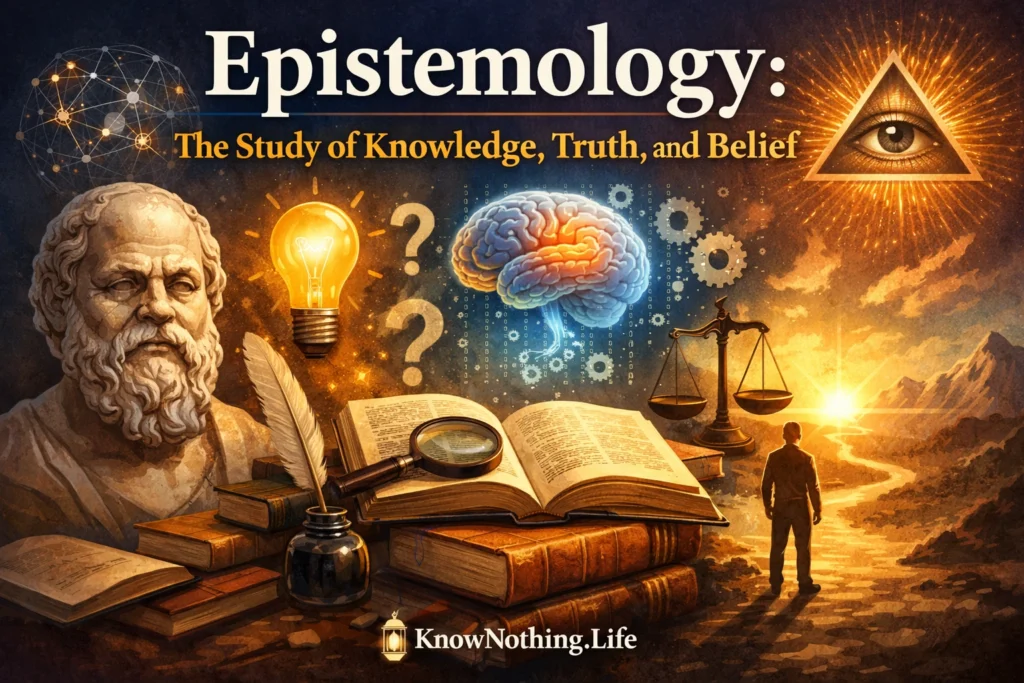
Epistemology, one of the central branches of philosophy, investigates the nature, scope, and limits of human knowledge. It asks foundational questions: What does it mean to know something? How is knowledge acquired? What distinguishes justified belief from mere opinion? These questions are not abstract curiosities but lie at the core of science, reasoning, and everyday decision-making. From the earliest philosophical traditions to contemporary analytic debates, epistemology has shaped how humanity understands truth and certainty.
The term itself derives from the Greek epistēmē (knowledge) and logos (study), signaling its broad ambition to systematically analyze what counts as knowledge. While other philosophical disciplines explore reality (metaphysics) or ethics (moral philosophy), epistemology focuses on the reliability of our cognitive processes and the justification of our beliefs. It bridges skepticism and certainty, offering frameworks that attempt to explain how we can claim to know anything at all.
Throughout its history, epistemology has evolved through debates between rationalists and empiricists, skeptics and foundationalists, realists and constructivists. Figures such as Plato, René Descartes, John Locke, and Immanuel Kant have shaped its trajectory, each offering distinct answers to the enduring question: how do we know what we know?
The Classical Definition of Knowledge
One of the earliest and most influential accounts of knowledge appears in Theaetetus, where Plato explores the idea that knowledge is “justified true belief.” According to this classical definition, three conditions must be met: a belief must be true, the individual must believe it, and there must be sufficient justification supporting that belief. This framework dominated epistemological thought for centuries and remains a foundational reference point.
However, this seemingly intuitive definition was challenged in the 20th century by Edmund Gettier in his short but influential paper Is Justified True Belief Knowledge? (1963). Gettier presented cases in which individuals held beliefs that were true and justified, yet intuitively did not qualify as knowledge due to elements of luck or coincidence. These “Gettier problems” exposed weaknesses in the classical definition and sparked ongoing debates about how to properly define knowledge.
Philosophers have since proposed alternative accounts, including reliabilism, which emphasizes the reliability of belief-forming processes, and virtue epistemology, which focuses on the intellectual character of the knower. Despite these developments, the tension between justification, truth, and belief continues to define epistemology’s central challenge: identifying what transforms belief into genuine knowledge.
Rationalism vs. Empiricism
A major divide in epistemology concerns the sources of knowledge. Rationalists argue that knowledge arises primarily through reason and innate ideas, while empiricists maintain that knowledge is derived from sensory experience. This debate shaped much of early modern philosophy and continues to influence contemporary discussions.
René Descartes, in his work Meditations on First Philosophy, famously employed methodical doubt to arrive at the conclusion “Cogito, ergo sum” (“I think, therefore I am”). For Descartes, certain truths could be known independently of experience, grounded in the clarity and distinctness of reason. Similarly, Gottfried Wilhelm Leibniz argued that the mind contains innate structures that shape knowledge.
In contrast, empiricists like John Locke rejected the notion of innate ideas. In An Essay Concerning Human Understanding, Locke described the mind as a “tabula rasa,” or blank slate, upon which experience writes. David Hume extended this empiricist approach, arguing in An Enquiry Concerning Human Understanding that even fundamental concepts like causation are not logically necessary truths but habits formed through repeated observation.
This debate reached a critical synthesis in the philosophy of Immanuel Kant, who argued in Critique of Pure Reason that knowledge arises from the interaction between sensory input and the mind’s inherent structures. Kant’s famous claim that “thoughts without content are empty, intuitions without concepts are blind” captures his attempt to reconcile rationalism and empiricism into a unified theory of knowledge.
Skepticism and the Limits of Knowledge
Epistemology is deeply concerned with skepticism—the view that knowledge may be impossible or severely limited. Skeptical arguments challenge our assumptions about certainty, perception, and reality, forcing philosophers to justify the very possibility of knowing anything.
Ancient skepticism, associated with figures like Pyrrho, emphasized the suspension of judgment in the face of uncertainty. In the modern era, skepticism took on new forms, particularly in the work of René Descartes, who imagined scenarios such as an evil demon deceiving our senses. His radical doubt questioned whether any belief could be trusted, ultimately leading him to seek indubitable foundations for knowledge.
Later, David Hume introduced a different kind of skepticism, focusing on induction—the process of inferring future events from past experiences. Hume argued that there is no rational justification for assuming that the future will resemble the past, undermining the basis of scientific reasoning. As he famously wrote, “All reasonings concerning matters of fact seem to be founded on the relation of cause and effect.”
Contemporary epistemology continues to grapple with skepticism through various strategies, including contextualism, which suggests that knowledge claims depend on conversational context, and externalism, which shifts the focus from internal justification to external reliability. While skepticism remains unresolved, it serves as a vital force in refining epistemological theories and exposing hidden assumptions.
Justification and Theories of Knowledge
A central concern of epistemology is justification—what it means for a belief to be supported by adequate reasons or evidence. Philosophers have developed competing theories to explain how beliefs can be justified and how they relate to one another within a system of knowledge.
Foundationalism posits that certain basic beliefs are self-evident or indubitable and serve as the foundation for all other knowledge. This view is often associated with René Descartes, who sought secure starting points for knowledge. In contrast, coherentism rejects the idea of foundational beliefs, arguing instead that beliefs are justified by their coherence within a larger system. Knowledge, on this view, resembles a web rather than a hierarchy.
Another influential approach is reliabilism, which defines justification in terms of the reliability of the processes that produce beliefs. If a belief arises from a generally reliable method—such as perception under normal conditions—it may be considered justified even if the individual cannot articulate the reasoning behind it. This externalist perspective shifts the focus from conscious reasoning to the objective functioning of cognitive systems.
Virtue epistemology, inspired in part by Aristotle, emphasizes the intellectual virtues of the knower, such as open-mindedness, intellectual courage, and intellectual humility. Knowledge, in this framework, is not merely a property of beliefs but an achievement of a well-functioning intellectual character.
Contemporary Epistemology and New Directions
Modern epistemology has expanded beyond traditional debates to address new challenges arising from science, technology, and social dynamics. Topics such as social epistemology examine how knowledge is produced and distributed within communities, highlighting the role of testimony, authority, and institutions. In an age of information overload, questions about trust, expertise, and misinformation have become increasingly urgent.
Philosophers like Alvin Goldman have contributed to social epistemology by analyzing how reliable information spreads through networks. Meanwhile, feminist epistemologists such as Miranda Fricker have explored the concept of epistemic injustice—the ways in which individuals can be wronged specifically in their capacity as knowers. In her book Epistemic Injustice, Fricker argues that social power dynamics can distort whose knowledge is recognized and valued.
Another significant development is the intersection of epistemology with cognitive science. Researchers study how human cognition actually works, revealing biases and heuristics that challenge traditional assumptions about rationality. This empirical turn has led to a more nuanced understanding of knowledge as both a philosophical and psychological phenomenon.
Additionally, the rise of artificial intelligence and digital information systems has introduced new epistemological questions. How do we evaluate the reliability of algorithmic outputs? Can machines possess knowledge, or merely process information? These questions push epistemology into new territory, extending its relevance beyond philosophy into technology and society.
Conclusion
Epistemology remains one of the most fundamental and dynamic areas of philosophical inquiry. By examining the nature of knowledge, it shapes our understanding of truth, belief, and justification across all domains of human thought. From Plato’s early reflections to contemporary debates about artificial intelligence and social knowledge, epistemology continues to evolve, responding to new challenges while preserving its core questions.
At its heart, epistemology is not merely an abstract discipline but a practical endeavor. Every claim we accept, every decision we make, and every belief we hold depends on assumptions about what counts as knowledge. As Immanuel Kant observed, “All our knowledge begins with experience, but it does not follow that it arises from experience.” This tension between experience and understanding, skepticism and certainty, defines the enduring relevance of epistemology.
In a world increasingly shaped by information, uncertainty, and competing truths, epistemology provides the tools to navigate complexity with clarity and rigor. It challenges us to question not only what we know, but how we know it—and whether we should trust it at all.