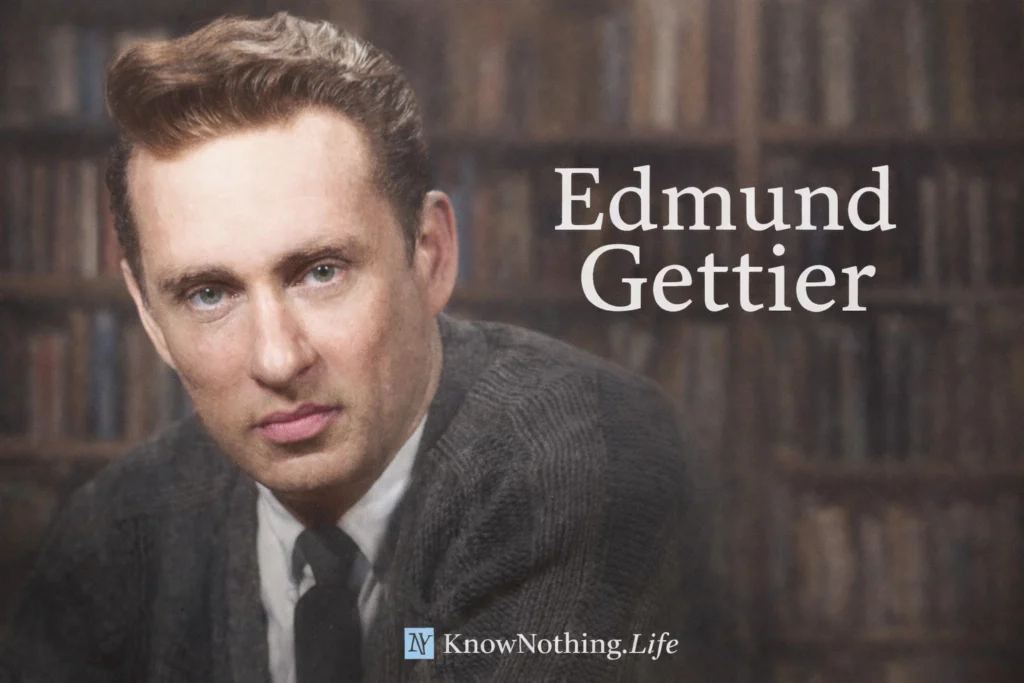
Edmund Lee Gettier III was born in 1927 in Baltimore, Maryland, and became one of the most quietly influential philosophers of the twentieth century. Unlike many major philosophers, he did not build his reputation through a long series of books, public lectures, or a sweeping philosophical system. His fame rests largely on one short article, published in 1963, that forced epistemology to reconsider one of its oldest assumptions: that knowledge is justified true belief. Few thinkers have done so much with so little printed space.
Gettier earned his B.A. from Johns Hopkins University in 1949 and his Ph.D. from Cornell University in 1961. His doctoral work focused on Bertrand Russell’s theories of belief, placing him within the analytic tradition’s concern with logic, language, truth, and mental representation. Before joining the University of Massachusetts Amherst, Gettier taught at Wayne State University from 1957 to 1967. He later became a professor at UMass Amherst, where he was promoted to full professor in 1972 and remained until retiring as professor emeritus in 2001.
A Reserved Philosopher With an Outsized Legacy
Gettier’s career is striking because it resists the usual image of philosophical fame. He was not a public intellectual in the popular sense, and he did not write a shelf of famous books. Colleagues remembered him as serious, precise, private, and intellectually independent. He had interests in logic, metaphysics, and the philosophy of language, but the world came to know him through epistemology. His name became attached not to a school, movement, or manifesto, but to a problem.
That problem became so influential that “Gettier case” is now basic vocabulary in philosophy. Students often meet Gettier early in epistemology because his challenge is simple to state and difficult to solve. He showed that a person can have a belief that is true and justified, yet still seem not to have knowledge. This did not merely create a puzzle about definitions. It exposed the role of luck in human belief. A true belief may be supported by good evidence and still be true for the wrong reason.
The Traditional Analysis of Knowledge
Before Gettier’s article, many philosophers treated knowledge as justified true belief. On this view, a person knows that a proposition is true when three conditions are met: the proposition is true, the person believes it, and the person is justified in believing it. This tripartite analysis had ancient roots and modern defenders. Gettier’s article specifically discussed versions of the view associated with Roderick Chisholm and A. J. Ayer, showing that the basic structure appeared in more than one philosophical vocabulary.
The attraction of the justified true belief account is easy to understand. Belief alone is not knowledge, because someone can believe something false. Truth alone is not enough, because a proposition can be true without anyone knowing it. Justification seems to supply the missing element by separating knowledge from lucky guessing. If someone believes a true proposition for good reasons, it looks as though knowledge has been achieved. Gettier’s genius was to show that this attractive picture was still incomplete.
“Is Justified True Belief Knowledge?”
Gettier’s famous article, “Is Justified True Belief Knowledge?,” appeared in Analysis in 1963 and was only three pages long. Its opening announces the target with remarkable economy: philosophers had tried to state “necessary and sufficient conditions” for knowing a proposition. Gettier then summarized the familiar formula: a subject knows that something is true if it is true, the subject believes it, and the subject is justified in believing it. Then came the challenge. He wrote, “I shall argue that (a) is false,” because the conditions do not sufficiently establish knowledge.
The paper’s power comes from its simplicity. Gettier did not need a long historical survey or an elaborate technical system. He identified two points: first, a person can be justified in believing something false; second, justification can be transferred through valid inference. From those two points, he constructed cases in which someone starts from a justified false belief, validly infers another belief, and ends with a justified true belief that still does not seem to be knowledge. The argument was short, but its consequences were enormous.
The Famous Gettier Cases
In Gettier’s first case, Smith has strong evidence that Jones will get a job and that Jones has ten coins in his pocket. Smith infers that the man who will get the job has ten coins in his pocket. Unknown to Smith, however, Smith himself will get the job, and Smith also happens to have ten coins in his pocket. The proposition is true. Smith believes it. Smith is justified in believing it. Yet the truth of the belief depends on a coincidence Smith does not understand. Intuitively, Smith does not know it.
In the second case, Smith has strong evidence that Jones owns a Ford. From this, he forms disjunctive beliefs such as “Either Jones owns a Ford, or Brown is in Barcelona.” Unknown to Smith, Jones does not own a Ford. But by coincidence, Brown really is in Barcelona. Again, Smith has a justified true belief, but his belief seems true by luck rather than knowledge. The examples are almost plain to the point of awkwardness, but that plainness is part of their force. Gettier did not hide the problem under terminology. He made it visible.
Epistemic Luck and the Search for a Fourth Condition
The Gettier problem changed epistemology because it showed that justification, truth, and belief do not automatically eliminate epistemic luck. A person may arrive at truth through a route that is evidentially respectable but accidentally connected to the facts. This forced philosophers to ask what else knowledge requires. Does knowledge require no false assumptions? A reliable belief-forming process? A causal connection to the fact known? Safety from error? Sensitivity to truth? Intellectual virtue? Defeat-free justification?
The decades after Gettier produced a vast literature attempting to repair or replace the justified true belief account. Some philosophers proposed adding a fourth condition, creating a “JTB plus” theory. Others argued that the entire project of defining knowledge by necessary and sufficient conditions was misguided. Still others used Gettier cases to develop reliabilism, virtue epistemology, causal theories of knowledge, tracking theories, and safety-based accounts. In this sense, Gettier’s article did not close a debate. It opened a new era of epistemology.
Works, Silence, and Philosophical Reputation
Part of Gettier’s legend is the contrast between his enormous influence and his small publication record. According to UMass Amherst’s memorial notice, he published only two papers and one review during his career, all in the 1960s. The 1963 article was the decisive work. He also wrote a review and contributed comments on A. J. Ayer’s “The Concept of a Person.” Unlike many philosophers whose later careers are spent defending, revising, or expanding a famous idea, Gettier largely left the Gettier problem to others.
This silence made his reputation unusual. He became famous not by repeatedly explaining himself, but by having asked a question that refused to disappear. The title “Is Justified True Belief Knowledge?” remains one of the most efficient titles in philosophy because it contains the whole provocation. It asks a question that seems narrow until the reader realizes that the answer affects almost every theory of evidence, rationality, testimony, perception, memory, and scientific belief. What do we really possess when we possess knowledge rather than merely lucky truth?
Legacy and Lasting Importance
Edmund Gettier died on March 23, 2021, at the age of ninety-three. By then, his name had become permanently attached to one of the central problems in modern analytic philosophy. Nearly every serious theory of knowledge now has to explain how it handles Gettier cases. This is an extraordinary legacy for a philosopher whose most famous publication was only three pages long. It shows that philosophical power is not measured by volume, but by precision.
Gettier’s lasting importance lies in the humility his problem imposes on theories of knowledge. It is not enough for a belief to be true. It is not enough for it to be believed. It may not even be enough for it to be justified. Knowledge must somehow be connected to truth in the right way, not merely arrive there by accident. Edmund Gettier made that problem unavoidable. He reminded philosophy that certainty is rare, luck is subtle, and even the most familiar definitions can fail when examined closely.