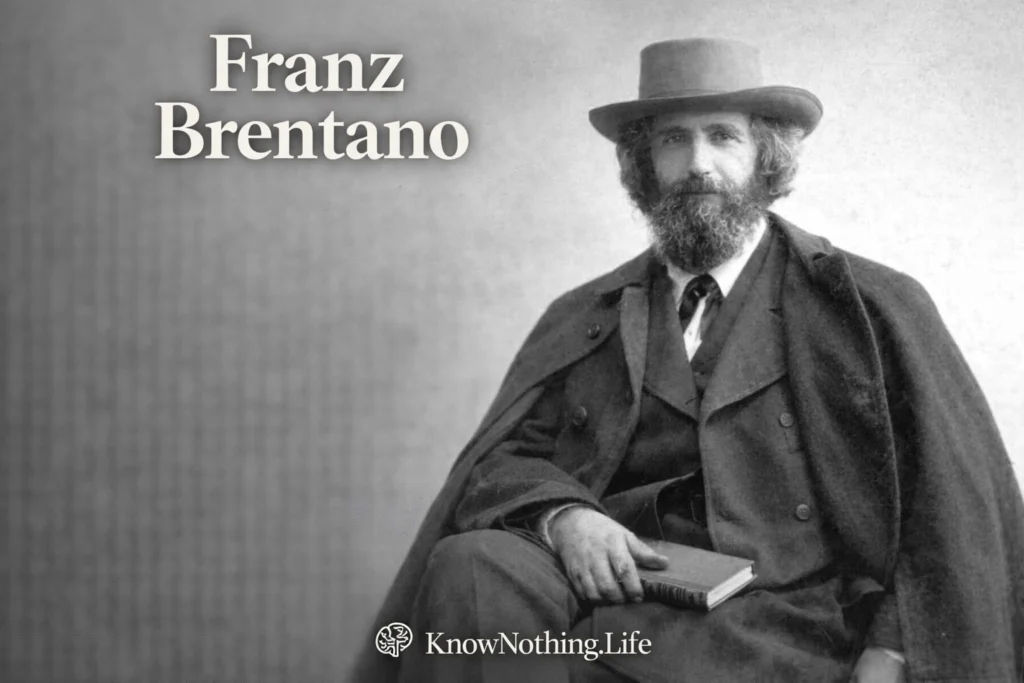
Franz Clemens Brentano was born on January 16, 1838, in Marienberg am Rhein, Germany, into a cultivated Catholic family with deep intellectual roots. His uncle Clemens Brentano and aunt Bettina von Arnim were major figures in German Romantic literature, and the family atmosphere joined religion, scholarship, and European culture. Brentano studied philosophy, theology, mathematics, and classical thought at universities including Munich, Würzburg, Berlin, and Münster. From the beginning, he was drawn to Aristotle, whose realism, logic, and psychology would shape his mature philosophical style.
Brentano was ordained a Catholic priest in 1864, but his relationship with the Church became strained after the First Vatican Council and the doctrine of papal infallibility. He eventually left the priesthood and later married, a decision that affected his academic position in Austria. These personal and institutional conflicts did not make him abandon philosophy; they intensified his commitment to intellectual independence. Brentano wanted philosophy to be rigorous, exact, and free from empty speculation. One of his early theses declared, “The true method of philosophy is that of natural science,” a statement that became a key to his lifelong project.
Aristotle, Science, and the Reform of Philosophy
Brentano’s first major work, On the Several Senses of Being in Aristotle, published in 1862, announced his seriousness as an Aristotelian scholar. He did not approach Aristotle as a museum piece, but as a living resource for modern philosophy. Aristotle gave Brentano a model of careful classification, attention to ordinary experience, and resistance to philosophical abstractions that float away from reality. Brentano’s later work in psychology, metaphysics, ethics, and logic continued this Aristotelian spirit, even when he departed sharply from ancient categories.
His academic career took him to Würzburg and then to the University of Vienna, where he became a powerful teacher. Brentano was not a system builder in the grand German idealist style. He preferred analysis, description, and precision. He believed philosophy should begin with what is given in experience and proceed with the discipline of a science. This did not mean that philosophy should become physics. It meant that philosophy should reject vague speculation and search for evident structures in consciousness, judgment, value, and being.
Psychology From an Empirical Standpoint
Brentano’s most important book, Psychology from an Empirical Standpoint, was published in 1874. It helped define modern philosophy of mind by arguing that psychology should be the “science of mental phenomena.” Brentano’s use of the word “empirical” can be misleading if understood only in the modern laboratory sense. He did not reduce psychology to external measurement. He believed mental life could be studied through careful inner perception: disciplined attention to the acts of consciousness as they are lived from within.
The book’s revolutionary claim was that mental phenomena are distinguished by intentionality. A thought is always of something, a desire is for something, a judgment is about something, and a fear is directed toward something. Brentano famously described mental life through “intentional inexistence,” “reference to a content,” and “direction toward an object.” This was not merely a technical doctrine. It changed the way philosophers understood consciousness. The mind is not a container filled with images; it is an active relation to objects, meanings, values, possibilities, and states of affairs.
Intentionality and the Mark of the Mental
Brentano’s theory of intentionality became his most influential idea. It gave philosophy a vocabulary for the “aboutness” of mental life. If someone thinks about a mountain, hopes for peace, remembers a childhood home, or fears a danger that never arrives, the mental act still has an object in a special sense. The object need not exist in the ordinary physical world for the act to be directed toward it. This made intentionality central to later debates about perception, imagination, language, belief, fiction, and non-existent objects.
The theory also created difficulties. What exactly is the object of a thought when the thing thought about does not exist? Is it inside the mind, outside the mind, or neither? Brentano’s students would develop different answers. Alexius Meinong built a theory of objects that included non-existent objects. Edmund Husserl transformed intentionality into the foundation of phenomenology. Kazimierz Twardowski distinguished between the content and object of presentations. Even when later thinkers criticized Brentano’s formulation, they were working in the world his question created.
Judgment, Value, and Ethics
Brentano did not restrict himself to psychology of mind. He also developed important theories of judgment, truth, value, and ethics. He rejected the traditional view that judgment is mainly the joining of subject and predicate. Instead, he treated judgment as acceptance or rejection. To judge is not merely to combine ideas; it is to affirm or deny. This view influenced later logic, language philosophy, and theories of belief because it placed the act of judging at the center of truth-directed thought.
In The Origin of Our Knowledge of Right and Wrong, published from his 1889 lecture, Brentano argued that ethics should be grounded in the structure of correct emotion. Just as some judgments are self-evidently correct, some loves and hates are fitting or unfitting. The good, in his famous phrase, is what is “worthy to be loved.” This made ethics neither a matter of arbitrary command nor mere subjective preference. Value, for Brentano, is disclosed through properly ordered emotional acts. His theory would later influence moral philosophers and value theorists, including G. E. Moore and Max Scheler.
The Brentano School
Brentano’s influence is difficult to measure because it flowed as much through students as through books. In Vienna and elsewhere, he taught or influenced some of the most important philosophers and psychologists of the next generation: Edmund Husserl, Alexius Meinong, Christian von Ehrenfels, Carl Stumpf, Anton Marty, and Kazimierz Twardowski. Through Twardowski, his influence extended into the Lvov-Warsaw School of logic and analytic philosophy. Through Husserl, it extended into phenomenology. Through Meinong, it shaped object theory. Through Stumpf, it affected psychology and music perception.
This makes Brentano one of the great hidden sources of modern thought. He stands behind traditions that are often treated as separate: phenomenology, analytic philosophy, descriptive psychology, philosophy of mind, object theory, and value theory. His students disagreed with him, sometimes sharply, but they inherited his demand for precision and his conviction that consciousness must be analyzed in its acts. Brentano’s classroom became one of the seedbeds of twentieth-century philosophy.
Later Life and Major Works
Brentano’s later life was marked by travel, private teaching, eye problems, and continued writing. After difficulties surrounding his marriage and university status in Austria, he spent time in Leipzig, Florence, and eventually Zurich. He published less than his influence might suggest, and many of his writings appeared from lectures, manuscripts, and posthumous editions. This partly explains why he is sometimes remembered more for one doctrine than for the full scope of his philosophy.
His major works include On the Several Senses of Being in Aristotle, Psychology from an Empirical Standpoint, The Origin of Our Knowledge of Right and Wrong, Aristotle and His World View, and later writings collected on logic, sensory and noetic consciousness, truth, categories, and descriptive psychology. Across these works, Brentano pursued the same ideal: philosophy as a disciplined science of what is evident in experience. He wanted to understand mental acts, not by dissolving them into physiology, but by describing their essential forms with clarity.
Legacy and Lasting Importance
Franz Brentano died on March 17, 1917, in Zurich. His legacy is both direct and indirect. Directly, he reintroduced intentionality as a central concept in philosophy of mind. Indirectly, he shaped the thinkers who created phenomenology, modern object theory, descriptive psychology, and important strands of analytic philosophy. Few philosophers who are not household names have had such wide historical reach.
Brentano’s lasting importance lies in his restoration of consciousness as an active, directed, analyzable reality. He showed that mental life is not a passive stream of sensations, but a structured field of presentations, judgments, emotions, and values. To think is to think of something. To love is to love something. To judge is to accept or reject. In that simple but profound insight, Brentano gave modern philosophy one of its most durable tools for understanding the mind.