Bertrand Russell was born on May 18, 1872, into one of Britain’s most prominent aristocratic families, yet his intellectual trajectory would lead him far beyond the expectations of his lineage. Raised by his grandparents after the early death of his parents, Russell grew up in an environment shaped by strict moral discipline and liberal political ideals. His grandfather, a former Prime Minister, instilled in him a sense of civic responsibility, while his grandmother’s austere religiosity pushed him toward skepticism. This tension between authority and independence became a defining feature of his philosophical outlook.
As a young man, Russell found solace in mathematics, which he regarded as a refuge from emotional isolation. His education at Trinity College, Cambridge, proved transformative, introducing him to rigorous intellectual traditions and a circle of thinkers who would influence the course of analytic philosophy. At Cambridge, he encountered the works of Gottlob Frege, whose revolutionary approach to logic deeply shaped Russell’s early ambitions. Russell became convinced that mathematics could be reduced to logic, a belief that would drive much of his early work and establish him as one of the founders of modern logic.
The Foundations of Analytic Philosophy
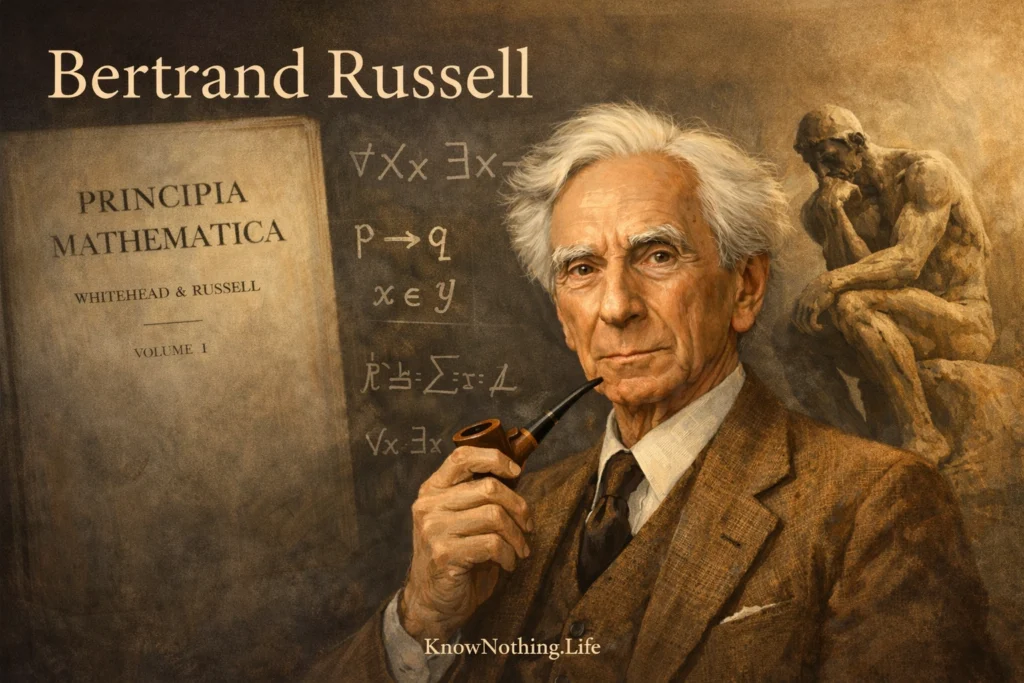
Russell’s early philosophical career was marked by a profound commitment to clarity, precision, and logical analysis. His collaboration with Alfred North Whitehead produced one of the most ambitious works in the history of philosophy: Principia Mathematica. Published in three volumes between 1910 and 1913, this monumental project sought to demonstrate that all mathematical truths could be derived from a set of logical axioms. Though its technical complexity limited its accessibility, its impact on logic, mathematics, and philosophy was immense.
Central to Russell’s philosophical innovation was his theory of descriptions, introduced in his 1905 paper “On Denoting.” This theory addressed problems of language and reference, offering a method for analyzing statements about non-existent or ambiguous entities. It laid the groundwork for the linguistic turn in philosophy and influenced generations of thinkers. Russell’s insistence that philosophical problems often arise from misunderstandings of language became a cornerstone of analytic philosophy, shaping the work of later figures such as Ludwig Wittgenstein, who was initially his student.
Logic, Language, and the Limits of Knowledge
Russell’s work extended beyond formal logic into epistemology and the philosophy of language, where he sought to understand the relationship between knowledge, perception, and reality. In The Problems of Philosophy, he offered an accessible introduction to philosophical inquiry, exploring questions about the nature of truth, appearance, and certainty. He distinguished between “knowledge by acquaintance” and “knowledge by description,” arguing that our direct experiences form the foundation of all knowledge.
Despite his early optimism about the power of logic, Russell later recognized its limitations. The discovery of Russell’s Paradox—a contradiction within naive set theory—revealed that even the most rigorous logical systems could harbor inconsistencies. This realization did not diminish his commitment to rational inquiry but rather deepened his understanding of its complexity. As he famously remarked, “The whole problem with the world is that fools and fanatics are always so certain of themselves, and wiser people so full of doubts.”
Russell’s philosophical style combined analytical rigor with a clarity of expression that made his ideas accessible to a broad audience. He believed that philosophy should not be confined to academic circles but should engage with the concerns of everyday life. This commitment to public philosophy distinguished him from many of his contemporaries and helped establish his reputation as one of the most influential thinkers of the twentieth century.
Political Activism and Social Critique
Russell was not only a philosopher but also a passionate political activist who applied his intellectual principles to the pressing issues of his time. During World War I, he became an outspoken critic of militarism, advocating for pacifism at great personal cost. His opposition to the war led to his dismissal from Trinity College and a prison sentence in 1918. Yet these experiences only strengthened his resolve, reinforcing his belief that moral courage requires standing against popular opinion when necessary.
Throughout his life, Russell engaged with a wide range of political and social issues, from education and marriage to nuclear disarmament and global governance. In works such as Why I Am Not a Christian, he challenged religious orthodoxy and argued for a secular, rational approach to ethics. His critique of organized religion was both philosophical and moral, emphasizing the importance of evidence, compassion, and intellectual freedom. “Do not feel absolutely certain of anything,” he advised, encapsulating his commitment to skepticism and open inquiry.
In the later decades of his life, Russell became a leading voice in the anti-nuclear movement, co-authoring the Russell-Einstein Manifesto and helping to establish the Pugwash Conferences on Science and World Affairs. His activism reflected a consistent ethical vision grounded in reason and humanistic values. He believed that philosophy should not only interpret the world but also contribute to its improvement, a principle that guided his lifelong engagement with public affairs.
Literary Achievements and Public Influence
Russell’s literary output was vast and varied, encompassing technical treatises, popular essays, and autobiographical reflections. His ability to write with clarity and wit made him one of the most widely read philosophers of his time. In 1950, he was awarded the Nobel Prize in Literature, recognizing not only his philosophical contributions but also his role as a champion of humanitarian ideals and freedom of thought.
Among his most influential works is A History of Western Philosophy, a sweeping survey that traces the development of philosophical ideas from ancient Greece to the modern era. While scholars have debated its interpretations, the book remains a landmark in philosophical writing, valued for its accessibility and breadth. Russell’s talent for synthesizing complex ideas into engaging prose allowed him to reach a global audience, shaping public understanding of philosophy for generations.
His autobiography, published in three volumes, offers insight into the personal experiences that shaped his intellectual journey. Through these writings, Russell revealed a life marked by both triumph and struggle, characterized by a relentless pursuit of truth. His reflections on love, knowledge, and human suffering capture the depth of his philosophical vision. In one of his most celebrated passages, he wrote, “The good life is one inspired by love and guided by knowledge,” a succinct expression of his ethical philosophy.
Legacy and Enduring Significance
Bertrand Russell’s influence extends far beyond the boundaries of academic philosophy, shaping fields as diverse as logic, mathematics, political theory, and education. As a pioneer of analytic philosophy, he helped establish a methodological framework that continues to dominate much of contemporary philosophical practice. His emphasis on clarity, logical rigor, and linguistic analysis transformed the discipline, setting new standards for philosophical inquiry.
At the same time, Russell’s commitment to social justice and intellectual freedom ensured that his work remained relevant to the broader human condition. He demonstrated that philosophy could be both intellectually rigorous and socially engaged, bridging the gap between abstract theory and practical concerns. His life serves as a testament to the power of reason, not as an abstract ideal, but as a tool for understanding and improving the world.
Even in the face of criticism and controversy, Russell remained steadfast in his dedication to truth and progress. His willingness to challenge authority, question assumptions, and embrace uncertainty continues to inspire thinkers across disciplines. In an age marked by rapid change and ideological conflict, his call for critical thinking and open dialogue remains as urgent as ever.
Russell died on February 2, 1970, at the age of 97, leaving behind a legacy that endures in both philosophy and public life. His work continues to be studied, debated, and celebrated, reflecting the enduring relevance of his ideas. As he once observed, “Men are born ignorant, not stupid; they are made stupid by education,” a reminder of the importance of fostering curiosity and critical thought. Through his writings and actions, Bertrand Russell exemplified the philosopher as both thinker and citizen, committed to the pursuit of knowledge and the betterment of humanity.